Overview
Spongy Moths (Lymantria dispar) are one of the most destructive invasive forest pests in North America. Formerly known as gypsy moths, these insects were accidentally introduced into the United States during the 1860s and have since spread across millions of acres of forest. The caterpillar stage is responsible for extensive defoliation of hardwood and conifer trees, particularly oak, birch, aspen, willow, apple, and pine species.
During outbreak years, spongy moth caterpillars can strip entire forests of foliage, causing severe tree stress, growth reduction, and widespread mortality. In residential areas, large populations create significant nuisance problems as caterpillars crawl across homes, decks, sidewalks, and outdoor furniture while frass (droppings) rains down from infested trees.
Taxonomy and Classification
- Kingdom: Animalia
- Phylum: Arthropoda
- Class: Insecta
- Order: Lepidoptera
- Family: Erebidae
- Genus: Lymantria
- Species: Lymantria dispar
Spongy moths undergo complete metamorphosis, progressing through egg, larva, pupa, and adult stages. They are famous for their cyclical population explosions, during which millions of acres of forest may be affected over several consecutive years.
Physical Description
The caterpillars are the most recognizable and destructive stage of the insect.
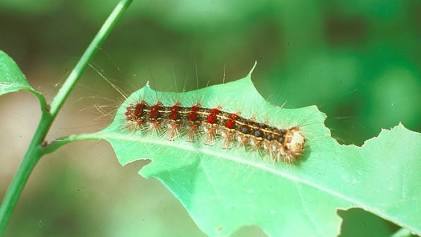
- Caterpillar: Hairy, brownish-gray larvae reaching 2 to 2.5 inches in length.
- Blue and Red Spots: Five pairs of blue spots followed by six pairs of red spots along the back.
- Pupa: Dark brown, enclosed within a loose cocoon attached to bark, structures, or debris.
- Male Moth: Smaller, brown, and capable of flight.
- Female Moth: Larger, white-colored, and flightless in North American populations.
- Egg Mass: Tan, fuzzy, sponge-like masses containing hundreds of eggs.
The characteristic blue and red spots make caterpillars easy to identify and distinguish from other forest defoliators.
Distribution and Habitat
Spongy moths are widespread throughout the northeastern and midwestern United States and continue expanding into new areas. Established populations occur from New England through the Great Lakes region and into portions of the Mid-Atlantic states.
Preferred habitats include:
- Oak forests
- Mixed hardwood forests
- Urban woodlots
- Parks
- Residential landscapes
- Orchards
- Campgrounds
They thrive wherever suitable host trees are abundant.
Life Cycle
Egg Stage
Females lay egg masses during late summer and early fall. Each mass may contain 500 to 1,000 eggs.
Eggs overwinter and remain dormant until spring.
Larval Stage
Caterpillars emerge in spring as leaves begin unfolding. Young larvae may disperse by producing silk threads and being carried by the wind, a behavior known as ballooning.
Larvae feed aggressively for six to eight weeks.
Pupal Stage
Mature caterpillars pupate in protected locations including tree bark crevices, outdoor furniture, and structures.
This stage typically lasts one to two weeks.
Adult Stage
Adults emerge during midsummer. Males actively fly in search of females, while females remain near their emergence site and release pheromones to attract mates.
Adults do not feed and live only long enough to reproduce.
Damage and Economic Importance
Spongy moth caterpillars are among the most economically significant forest pests in North America.
Defoliation
The larvae consume leaves from hundreds of tree species.
Heavy infestations can completely strip a tree’s canopy within weeks.
Tree Stress
Repeated defoliation reduces a tree’s ability to produce energy and maintain normal growth.
Trees become more vulnerable to:
- Drought
- Disease
- Secondary insect attacks
- Environmental stress
Tree Mortality
Oak trees are particularly susceptible to repeated defoliation.
After several years of severe feeding, large numbers of trees may die.
Nuisance Problems
During outbreaks, caterpillars may cover:
- Homes
- Vehicles
- Decks
- Playgrounds
- Outdoor furniture
Their droppings accumulate beneath trees and may sound like rainfall during severe infestations.
Behavior and Conflict
The severity of spongy moth damage results from their enormous appetite and broad host range.
- Wide Host Range: More than 300 tree and shrub species may be attacked.
- Oak Preference: Oak species are among their favorite hosts.
- Mass Outbreaks: Populations can explode rapidly under favorable conditions.
- Dispersal: Young larvae spread by wind while egg masses are frequently transported by vehicles, firewood, and outdoor equipment.
- Forest Impact: Outbreaks can affect millions of acres simultaneously.
Signs of Infestation
Common indicators include:
- Hairy caterpillars with blue and red spots
- Large amounts of leaf damage
- Defoliated tree canopies
- Fuzzy tan egg masses
- Accumulations of frass beneath trees
- Caterpillars crawling on structures
- Dead or declining oak trees
Infestations are usually most noticeable during late spring and early summer.
Management and Control (IPM)
Successful management combines monitoring, mechanical removal, biological controls, and targeted treatments.
Egg Mass Removal
During fall, winter, and early spring:
- Inspect trees and structures.
- Scrape egg masses into soapy water.
- Destroy collected eggs.
This simple practice can eliminate hundreds of future caterpillars.
Tree Banding
Burlap bands wrapped around trunks provide daytime shelter for caterpillars.
Inspect bands daily and remove trapped larvae.
Biological Control
Natural enemies help suppress populations:
- Bacillus thuringiensis (Bt): Effective against young caterpillars.
- LdNPV Virus: A naturally occurring viral disease specific to spongy moths.
- Entomophaga maimaiga: A fungal pathogen that causes major population collapses.
- Predatory Birds: Feed on caterpillars and pupae.
- Parasitic Wasps and Flies: Attack larvae and pupae.
Chemical Control
High-value trees may be protected using:
- Bt applications
- Spinosad treatments
- Registered insecticides applied during early larval development
Applications are most effective when caterpillars are small.
Forest Management
Long-term management may include:
- Promoting species diversity
- Reducing host tree concentrations
- Monitoring populations with pheromone traps
- Regional suppression programs
Research and Future Management
Researchers continue studying:
- Outbreak prediction models
- Biological control organisms
- Pheromone disruption techniques
- Forest resilience strategies
- Improved monitoring systems
Modern management increasingly emphasizes environmentally responsible approaches that preserve beneficial organisms while reducing caterpillar populations.
Conclusion
Spongy Moths are among the most destructive invasive forest pests in North America. Their caterpillars can defoliate millions of acres of forest, weaken valuable trees, and create major nuisance conditions in residential areas. Early detection, egg mass removal, biological controls, and integrated pest management programs remain the most effective tools for reducing their impact. Continued monitoring and research are essential for protecting forests, landscapes, and natural ecosystems from future outbreaks.