“`html
Rice Skipper Caterpillars are important foliage-feeding pests of rice crops throughout tropical and subtropical regions of the world. The larvae of skipper butterflies, particularly Pelopidas mathias and Parnara guttata, are capable of causing significant defoliation in rice fields. Their distinctive habit of folding or rolling rice leaves into protective shelters allows them to feed while avoiding predators and environmental stresses. Severe infestations can reduce photosynthetic capacity, stunt plant growth, and significantly decrease grain yields.
Taxonomy and Classification
Rice Skipper Caterpillars belong to the order Lepidoptera and the family Hesperiidae, commonly known as skipper butterflies. Adult skippers are characterized by their robust bodies and rapid, darting flight patterns.
- Order: Lepidoptera
- Family: Hesperiidae
- Genus: Pelopidas, Parnara
- Common Species: Pelopidas mathias, Parnara guttata
Several skipper species may attack rice, but Pelopidas mathias remains one of the most widespread and economically important species.
Physical Description
Rice Skipper Caterpillars are readily recognized by their distinctive appearance and characteristic leaf-folding behavior.
- Adult Butterfly (Key ID): Small to medium-sized brown butterfly with a wingspan of approximately 25 to 35 mm. Adults exhibit rapid, erratic flight and often possess small pale or white spots on the wings.
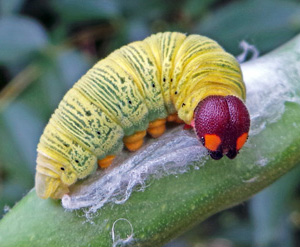
- Larva (Key ID): Smooth, pale green caterpillar measuring up to 35 mm long. The caterpillar possesses a noticeably enlarged, rounded head capsule and a constricted neck region.
- Leaf Shelter: Larvae fold rice leaves lengthwise and secure them with silk, creating a tubular shelter used for feeding and protection.
- Pupa: Brownish pupa enclosed within the rolled leaf.
- Conflict: Agricultural.
Distribution and Habitat
Rice Skipper Caterpillars occur throughout major rice-growing regions worldwide.
They are especially common in:
- South and Southeast Asia
- China and Japan
- India and Pakistan
- Africa
- Australia
- Tropical and subtropical regions of the Americas
Rice paddies, wetlands, irrigated fields, and areas containing wild grasses provide ideal habitat for these pests.
Life Cycle
The Rice Skipper undergoes complete metamorphosis consisting of four stages: egg, larva, pupa, and adult.
Egg Stage
Female butterflies lay eggs singly or in small groups on rice leaves. Eggs hatch within several days depending on environmental conditions.
Larval Stage
Newly hatched caterpillars begin feeding immediately. As they grow, they cut, fold, and secure leaves using silk threads to create protective shelters.
The larval stage consists of several instars and is responsible for all significant crop damage.
Pupal Stage
Pupation usually occurs inside the rolled leaf shelter, where the insect remains protected until adult emergence.
Adult Stage
Adult butterflies emerge, mate, and begin a new reproductive cycle. Multiple generations may occur each year in warm climates.
Behavior and Damage
Rice Skipper Caterpillars are voracious foliage feeders that consume leaf tissue while hidden inside rolled leaves.
- Leaf Rolling: Caterpillars use silk to fold and bind leaves into tubes.
- Defoliation: Feeding removes significant amounts of leaf tissue, reducing photosynthesis.
- Skeletonization: Damaged leaves may appear scraped, shredded, or skeletonized.
- Flag Leaf Injury: Feeding on flag leaves can greatly reduce grain filling and crop yield.
- Yield Loss: Severe infestations may result in substantial reductions in grain production.
Heavy infestations may give rice fields a scorched or ragged appearance.
Signs of Infestation
- Rolled or folded rice leaves
- Silk-bound leaf tubes
- Green caterpillars inside leaf shelters
- Chewed or skeletonized foliage
- Reduced plant vigor
- Increased skipper butterfly activity around fields
Management and Control (IPM)
Integrated Pest Management provides the most sustainable approach for controlling Rice Skipper Caterpillars.
Monitoring
- Scout fields regularly for rolled leaves.
- Inspect plants during tillering and reproductive stages.
- Determine infestation levels before treatment.
Mechanical Control
- Hand-remove and destroy rolled leaves in small plots.
- Remove heavily infested plant material.
Cultural Control
- Maintain balanced fertilization programs.
- Avoid excessive nitrogen applications.
- Manage grassy weeds surrounding rice fields.
- Destroy crop residues after harvest.
Biological Control
Numerous natural enemies suppress Rice Skipper populations, including:
- Parasitic wasps (Trichogramma spp.)
- Predatory spiders
- Birds
- Dragonflies
- Predatory beetles
Conserving these beneficial organisms can significantly reduce pest populations.
Chemical Control
Selective insecticides may be used when populations exceed economic thresholds.
- Treat early larval stages for maximum effectiveness.
- Rotate insecticide classes to prevent resistance.
- Follow all label instructions carefully.
Economic Importance
Rice Skipper Caterpillars can cause substantial economic losses, particularly during outbreak years. Defoliation reduces photosynthesis and interferes with grain production, resulting in lower yields and reduced profitability for growers.
Damage is often most severe during the vegetative and early reproductive stages of crop development.
Research and Future Management
Current research focuses on improving biological control programs, developing resistant rice varieties, refining economic thresholds, and enhancing monitoring technologies for early pest detection.
Related Articles
“`