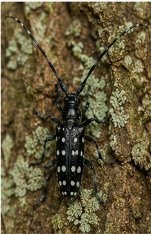
Carolina Pine Sawyer Beetle (Monochamus carolinensis) is a large native longhorn beetle commonly found throughout the southeastern United States in pine forests, timberlands, and wooded landscapes. As a member of the family Cerambycidae, it is instantly recognizable by its exceptionally long antennae and robust body. Although its large size often causes concern, the Carolina Pine Sawyer is considered a secondary forest pest, meaning it primarily attacks weakened, dying, storm-damaged, or recently cut pine trees rather than healthy ones.
Its greatest economic importance comes from serving as one of the principal vectors of the pinewood nematode (Bursaphelenchus xylophilus), the microscopic organism responsible for pine wilt disease. While the beetle itself rarely kills vigorous trees directly, its ability to transport this devastating pathogen has made it one of the most closely monitored insects in commercial forestry throughout North America.
Taxonomy and Classification
The Carolina Pine Sawyer belongs to the order Coleoptera (beetles) and the family Cerambycidae, commonly known as the longhorn beetles because of their extremely long segmented antennae.
- Order: Coleoptera
- Family: Cerambycidae
- Genus: Monochamus
- Species: Monochamus carolinensis
The genus Monochamus contains numerous pine sawyer species throughout North America, Europe, and Asia. All undergo complete metamorphosis, progressing through egg, larva, pupa, and adult stages.
Physical Description
Adult Carolina Pine Sawyer Beetles are among the largest beetles commonly encountered in southeastern pine forests.
- Length: Approximately 15–25 mm (0.6–1 inch).
- Coloration: Grayish-brown to dark brown with irregular mottled markings that camouflage the beetle against pine bark.
- Antennae: Extremely long segmented antennae that may exceed three times the body length in males and are slightly shorter in females.
- Pronotum: Features a sharp spine on each side behind the head, a useful identification characteristic.
- Larvae: Large creamy-white, legless wood-boring grubs with enlarged thoracic segments and strong chewing mandibles.
- Exit Holes: Newly emerged adults leave large round exit holes approximately 6–10 mm in diameter.
Distribution and Habitat
The Carolina Pine Sawyer occurs throughout the southeastern United States, particularly where pine forests dominate the landscape.
Common habitats include:
- Pine forests
- Commercial timber plantations
- Mixed pine-hardwood forests
- Recently logged areas
- Storm-damaged woodlands
- Sawmills and log yards
- Residential properties with mature pine trees
The species develops almost exclusively within weakened, recently dead, lightning-struck, fire-damaged, or freshly harvested pine trees.
Life Cycle and Behavior
Adult beetles emerge during late spring through summer and begin feeding on the tender bark of pine twigs, a behavior known as maturation feeding. Although this causes little direct damage, it provides the opportunity for pinewood nematodes carried by infected beetles to enter healthy trees.
After mating, females chew shallow egg niches into the bark of suitable host trees before depositing individual eggs.
Upon hatching, larvae initially feed beneath the bark before tunneling deeply into the sapwood and heartwood. Their extensive galleries reduce wood quality while providing shelter throughout development.
The larval stage typically lasts one year but may extend longer depending on climate and wood condition. Mature larvae pupate within the wood before emerging as adults through perfectly round exit holes.
Damage and Economic Importance
The Carolina Pine Sawyer causes both direct and indirect economic impacts.
- Wood Boring: Larval tunneling weakens lumber and reduces its commercial value.
- Pine Wilt Disease: Adults transmit the pinewood nematode while feeding on healthy trees, allowing the pathogen to invade the vascular system.
- Timber Degradation: Internal galleries reduce the structural quality of logs destined for lumber, pulp, or veneer.
- Forest Health: Although the beetles normally attack weakened trees, pine wilt disease can rapidly kill susceptible healthy pines.
- Landscape Damage: Valuable ornamental pines may decline rapidly following nematode infection.
Unlike aggressive bark beetles, Carolina Pine Sawyers generally do not initiate attacks against healthy trees unless pine wilt disease becomes involved.
Signs of Infestation
- Large round exit holes in bark
- Coarse sawdust-like frass beneath bark or around tree bases
- Large internal larval tunnels
- Adult beetles with exceptionally long antennae
- Rapid browning or wilting of susceptible pine trees affected by pine wilt disease
- Dead or dying pine trees containing extensive galleries
Management and Prevention (IPM)
An Integrated Pest Management (IPM) program focuses on reducing breeding habitat while protecting healthy pine trees.
- Sanitation: Remove dead, dying, or heavily infested pine trees before adult emergence.
- Timely Processing: Process harvested logs quickly to eliminate breeding sites.
- Debris Removal: Dispose of logging slash and storm-damaged wood that attracts egg-laying females.
- Maintain Tree Health: Healthy, well-watered pines are less susceptible to stress and disease.
- Monitoring: Inspect pine stands regularly for exit holes, larval galleries, and declining trees.
- Firewood Management: Avoid transporting untreated pine firewood to prevent spreading both beetles and pinewood nematodes.
Conservation and Research
Although Carolina Pine Sawyer Beetles are important forestry pests, they also perform valuable ecological functions by accelerating decomposition of dead wood and recycling nutrients within forest ecosystems.
Researchers continue studying their relationship with pinewood nematodes, pheromone communication, host selection, and climate influences to improve forest management. Current work also focuses on better detection methods, biological controls, and integrated management programs that protect commercial pine resources while preserving healthy forest ecosystems.
Conclusion
The Carolina Pine Sawyer Beetle is a large native longhorn beetle that plays both beneficial and harmful roles in pine forests. While its larvae help recycle dead timber, its ability to spread pine wilt disease makes it one of the most significant insects monitored by forest managers. Proper sanitation, timely removal of infested trees, and maintaining healthy forests remain the most effective methods for minimizing its economic impact while preserving its natural ecological function.