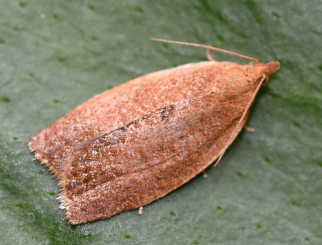
The Privet Tortrix Moth (Archips rosana) is a widespread leaf-rolling moth that attacks a variety of ornamental shrubs, fruit trees, and broadleaf plants. While its common name refers to privet, the caterpillars are highly polyphagous and feed on dozens of plant species, including roses, apples, pears, cherries, hawthorn, oak, maple, and numerous ornamental shrubs. The larvae are responsible for the damage, rolling leaves together with silk to create protective shelters where they feed on foliage, flowers, and developing fruit.
Although light infestations usually cause only cosmetic damage, large populations can reduce the appearance of ornamental plants and affect fruit production in orchards. The Privet Tortrix Moth is therefore considered an occasional horticultural and agricultural pest throughout much of Europe and in areas where it has become established elsewhere.
Taxonomy and Classification
The Privet Tortrix belongs to the family Tortricidae, commonly known as leaf roller moths. This large family contains thousands of species whose caterpillars characteristically fold, tie, or roll leaves together using silk.
- Order: Lepidoptera
- Family: Tortricidae
- Genus: Archips
- Species: Archips rosana
- Common Name: Privet Tortrix Moth
Several Archips species are important pests of fruit trees and ornamental plants because of their broad host range and leaf-rolling behavior.
Physical Description
Adult moths are small but attractive, with cryptic coloration that helps them blend into bark and foliage.
- Wingspan: 20–25 mm
- Color: Light brown to reddish-brown forewings crossed by darker bands
- Body: Slender with folded wings held roof-like over the body
- Larvae: Bright green caterpillars with a brown or black head capsule
- Pupae: Brown and enclosed within rolled leaves
The caterpillars are far more likely to be observed than the adults because they remain hidden within their characteristic leaf shelters.
Distribution and Habitat
The Privet Tortrix is widely distributed throughout Europe and parts of Asia and has also been reported in portions of North America.
Typical habitats include:
- Gardens
- Urban landscapes
- Hedgerows
- Fruit orchards
- Parks
- Woodland edges
- Nurseries
- Ornamental shrub plantings
It is especially common wherever broadleaf shrubs and fruit trees provide abundant food for developing larvae.
Life Cycle
The Privet Tortrix undergoes complete metamorphosis, progressing through egg, larva, pupa, and adult stages.
- Egg: Females lay flattened egg masses on bark or branches during summer.
- Larva: Caterpillars hatch the following spring and immediately begin feeding while constructing rolled-leaf shelters.
- Pupa: Pupation occurs inside rolled leaves or silken shelters.
- Adult: Moths emerge during late spring and summer to mate and begin the next generation.
Most populations complete one generation each year.
Host Plants and Feeding
Unlike many specialist caterpillars, the Privet Tortrix feeds on a wide range of woody plants.
Common host plants include:
- Privet
- Apple
- Pear
- Cherry
- Rose
- Hawthorn
- Oak
- Maple
- Willow
- Numerous ornamental shrubs
Young larvae feed on buds and tender leaves before rolling foliage together with silk. Older caterpillars remain concealed inside these shelters while consuming surrounding plant tissue.
Damage and Economic Importance
The primary damage results from larval feeding.
- Leaf Rolling: Leaves become tightly folded or tied together with silk.
- Defoliation: Heavy infestations reduce leaf area.
- Flower Damage: Caterpillars may consume blossoms and developing buds.
- Fruit Injury: Feeding sometimes scars young fruit in orchards.
- Reduced Ornamentals: Rolled leaves diminish the appearance of landscape shrubs.
Healthy established plants usually recover well, but repeated infestations can reduce vigor and fruit production.
Management and Prevention
Integrated Pest Management provides the most effective long-term control.
- Remove Rolled Leaves: Hand-prune and destroy infested foliage before larvae mature.
- Monitor Early: Inspect plants during spring for newly rolled leaves.
- Encourage Natural Enemies: Birds, lacewings, predatory bugs, spiders, and parasitic wasps help suppress populations.
- Maintain Plant Health: Proper watering and pruning improve plant recovery.
- Use Targeted Treatments: Biological products containing Bacillus thuringiensis (Bt) may be effective against young caterpillars when necessary.
Broad-spectrum insecticides should be avoided whenever possible to protect beneficial insects.
Conservation and Research
The Privet Tortrix remains an important species in horticultural research because of its broad host range and occasional impact on fruit production. Scientists continue studying its seasonal development, pheromone communication, and interactions with natural enemies to improve environmentally sustainable management strategies.
Conclusion
The Privet Tortrix Moth (Archips rosana) is a common leaf roller whose green caterpillars create characteristic rolled-leaf shelters while feeding on privet, fruit trees, roses, and numerous ornamental plants. Although serious infestations are relatively uncommon, the species can become a nuisance in gardens and orchards when populations are high. Early monitoring, manual removal of rolled leaves, and conservation of beneficial predators usually provide excellent long-term management.