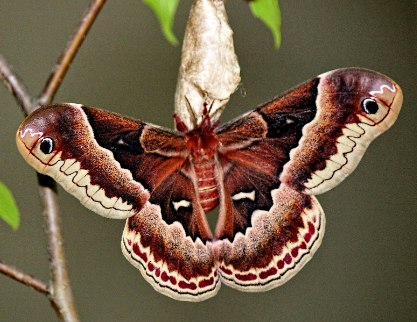
The Promethea Moth (Callosamia promethea) is one of North America’s most spectacular native silk moths. Found throughout much of the eastern United States, this large moth is well known for its remarkable sexual dimorphism, with males appearing almost black while females display rich reddish-brown wings. As a member of the giant silk moth family (Saturniidae), the Promethea Moth does not feed during its short adult life. Instead, adults devote their energy entirely to reproduction, while the caterpillars spend several weeks feeding on a variety of deciduous trees and shrubs before transforming into impressive silk cocoons.
Although the larvae consume foliage from numerous native trees, they rarely occur in numbers high enough to cause significant damage. The Promethea Moth is therefore considered a valuable native species that contributes to forest biodiversity and serves as an important food source for birds and other wildlife.
Taxonomy and Classification
The Promethea Moth belongs to the family Saturniidae, commonly known as the giant silk moths. This family contains many of North America’s largest and most visually impressive moth species.
- Order: Lepidoptera
- Family: Saturniidae
- Genus: Callosamia
- Species: Callosamia promethea
- Common Name: Promethea Moth
Its close relatives include the Tuliptree Silkmoth (Callosamia angulifera) and the Cecropia Moth (Hyalophora cecropia), another iconic giant silk moth.
Physical Description
The Promethea Moth is one of the few giant silk moths whose males and females are dramatically different in appearance.
- Wingspan: 75–100 mm
- Males: Dark brown to nearly black wings with pale tan borders
- Females: Rich reddish-brown wings with cream-colored margins
- Body: Thick, furry body covered in scales
- Antennae: Large feather-like antennae in males used to detect female pheromones from long distances
The caterpillars are bright green with rows of colorful tubercles that provide an equally striking appearance.
Distribution and Habitat
The Promethea Moth is widespread throughout eastern North America.
Common habitats include:
- Deciduous forests
- Woodland edges
- Suburban neighborhoods
- Parks
- Nature preserves
- Gardens containing host trees
- Riparian woodlands
Its range extends from southern Canada through much of the eastern United States and into portions of the southeastern states.
Life Cycle
The Promethea Moth undergoes complete metamorphosis, progressing through egg, larva, pupa, and adult stages.
- Egg: Females lay eggs individually or in small groups on suitable host plants.
- Larva: Bright green caterpillars feed for several weeks while growing through multiple molts.
- Pupa: Mature larvae spin a tough silk cocoon wrapped inside a dead leaf that remains attached to the host tree throughout winter.
- Adult: Adults emerge during late spring and summer, mate, lay eggs, and live for only about one week.
Most populations produce a single generation annually, although southern populations may occasionally produce two generations.
Host Plants and Feeding
Promethea caterpillars feed on a variety of deciduous trees and shrubs.
Common host plants include:
- Sassafras
- Spicebush
- Wild Cherry
- Tuliptree
- Ash
- Sweetbay Magnolia
- Lilac
- Buttonbush
The caterpillars consume leaves but rarely reach populations capable of causing noticeable defoliation.
Behavior and Ecology
Adult Promethea Moths are unusual among giant silk moths because males are active during daylight and early evening, flying rapidly while searching for females using airborne pheromones. Females generally remain stationary after emerging, releasing chemical signals that attract males from surprisingly long distances.
Unlike butterflies and many other moths, adult Promethea Moths lack functional mouthparts and do not feed. All of the energy required for reproduction is stored during the caterpillar stage.
The hanging leaf-wrapped cocoon provides excellent camouflage during winter, protecting the pupa from predators and harsh weather.
Economic Importance
The Promethea Moth is considered a beneficial native insect rather than an economic pest.
- Rarely Causes Defoliation: Caterpillar populations are usually low.
- Supports Biodiversity: Important component of native forest ecosystems.
- Wildlife Food Source: Caterpillars and adults provide food for birds, mammals, and predatory insects.
- Educational Value: Frequently used in classrooms and nature programs to demonstrate complete metamorphosis.
Because damage to host trees is minimal, control measures are almost never recommended.
Management and Conservation
The Promethea Moth should generally be conserved and appreciated as a native species.
- Preserve native host trees and shrubs.
- Avoid unnecessary insecticide applications.
- Protect overwintering cocoons attached to branches.
- Encourage native woodland habitats.
- Plant native trees that support giant silk moths.
Healthy landscapes containing diverse native vegetation often support stable populations of Promethea Moths and other beneficial insects.
Conservation and Research
Scientists study the Promethea Moth because of its striking sexual dimorphism, specialized pheromone communication, and fascinating life history. Researchers continue investigating its evolutionary relationships with other giant silk moths, as well as the effects of habitat fragmentation, artificial lighting, and introduced parasitoids on native populations.
Conclusion
The Promethea Moth (Callosamia promethea) is one of eastern North America’s most beautiful native silk moths. Its dramatic differences between males and females, impressive caterpillars, and distinctive leaf-wrapped cocoons make it a favorite among naturalists and gardeners alike. Although the larvae feed on several tree species, they rarely cause significant damage and instead contribute to healthy forest ecosystems while showcasing the remarkable diversity of North American moths.