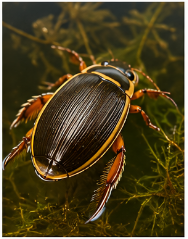
Predaceous diving beetles are aquatic beetles belonging to the family Dytiscidae. Both adults and larvae are active predators that hunt mosquito larvae, aquatic worms, small crustaceans, tadpoles, and other animals. They inhabit ponds, marshes, slow-moving streams, temporary pools, and other freshwater environments throughout the United States.
These beetles are usually considered beneficial aquatic insects because they help regulate populations of mosquitoes and other small organisms. However, large species may occasionally capture fish fry, tadpoles, or other animals in ornamental ponds and aquariums.
Taxonomy and Classification
- Order: Coleoptera
- Family: Dytiscidae
- Common names: Predaceous diving beetle, diving beetle, and true diving beetle
- Larval name: Water tiger
- Habitat: Freshwater ponds, pools, wetlands, and streams
- Diet: Predatory
Dytiscidae is one of the largest and most diverse families of aquatic beetles. Hundreds of species occur in North America, ranging from tiny beetles only a few millimeters long to large species exceeding 1 inch.
Adult Identification
Adult predaceous diving beetles have smooth, oval, streamlined bodies adapted for moving through water. Depending on the species, they may be black, brown, olive, reddish-brown, or yellowish with contrasting spots, lines, or borders.
The flattened hind legs are the beetle’s most noticeable swimming adaptation. These legs are fringed with long hairs and function like oars. Both hind legs usually move together, producing strong, rapid strokes that propel the insect through the water.
Adult diving beetles have hardened front wings, called elytra, covering functional flight wings. Most species can fly between ponds, especially at night or when a temporary pool begins drying. Adults may mistake swimming pools, dark vehicles, glass, or other reflective surfaces for water.
Larval Identification
Predaceous diving beetle larvae are commonly called water tigers. They have long, segmented bodies, prominent heads, six jointed legs, and a pair of large, curved mandibles. Their color varies from cream or tan to brown or nearly black.
The sickle-shaped mandibles contain channels used during feeding. A larva grabs its prey, introduces digestive fluids, and then consumes the liquefied tissues. This feeding method allows water tigers to subdue animals that may be relatively large compared with their own bodies.
Larvae may swim through open water or wait among submerged vegetation for prey to approach. Some species remain near the surface, where they obtain atmospheric oxygen through structures at the end of the abdomen.
Distribution and Habitat
Predaceous diving beetles are found worldwide except in permanently frozen and marine environments. In the United States, they occur in nearly every state wherever suitable freshwater habitats are available.
Common habitats include:
- Permanent and temporary ponds
- Marshes and wetlands
- Woodland pools
- Flooded fields and ditches
- Lake margins
- Slow sections of streams
- Cattle tanks and artificial water features
- Occasionally swimming pools
Many species prefer shallow water containing aquatic plants, fallen leaves, submerged wood, or other material that provides cover. A few are adapted to flowing water, underground habitats, or temporary pools that exist for only part of the year.
How Diving Beetles Breathe
Although they live in water, adult diving beetles breathe atmospheric oxygen. An adult rises to the surface with the tip of its abdomen exposed and collects an air supply beneath its wing covers. The trapped air functions like a portable scuba tank while the beetle swims underwater.
The beetle must return to the surface periodically to renew this air supply. Diving beetles generally approach the surface rear end first, which helps distinguish them from many water scavenger beetles that reach the surface head first.
Life Cycle
Predaceous diving beetles undergo complete metamorphosis through egg, larval, pupal, and adult stages. Females deposit eggs in water, on aquatic vegetation, inside plant tissue, or in moist material near the shoreline, depending on the species.
The eggs hatch into aquatic water tigers. Larvae pass through several growth stages while hunting other organisms. When fully developed, a larva leaves the water and moves onto damp soil near the shoreline.
The mature larva constructs a small chamber in mud or moist soil and transforms into a pupa. Unlike the larva and adult, the pupa cannot swim and does not feed. After transformation is complete, the adult emerges from the chamber and returns to the water.
Generation length and overwintering stage vary by species and climate. Some diving beetles overwinter as adults beneath ice or in protected aquatic habitats, while others survive seasonal conditions as larvae or pupae.
Diet and Hunting Behavior
Both adult and larval diving beetles are predators, although some species may also scavenge dead animals. Their prey can include:
- Mosquito larvae and pupae
- Midge and fly larvae
- Mayfly and caddisfly larvae
- Aquatic worms
- Small crustaceans
- Snails
- Other aquatic beetles
- Tadpoles and amphibian eggs
- Fish eggs and small fish
Large prey may attract several beetles at once. Adult diving beetles have strong chewing mouthparts and can tear pieces from prey. Larvae generally capture animals with their hollow, curved mandibles.
Ecological Importance
Predaceous diving beetles help maintain balance within freshwater food webs. By consuming mosquito larvae and other aquatic insects, they prevent some populations from becoming excessively abundant.
The beetles also serve as food for fish, frogs, turtles, birds, and larger aquatic insects. Because different diving beetle species have distinct habitat requirements, scientists may study their communities when evaluating wetlands and other freshwater environments.
Predaceous Diving Beetles Versus Water Scavenger Beetles
Diving beetles are frequently confused with water scavenger beetles in the family Hydrophilidae. Predaceous diving beetles usually have flattened, streamlined bodies and long, threadlike antennae. Their powerful hind legs move together while swimming.
Water scavenger beetles generally have shorter, clubbed antennae and prominent palps that may look like antennae. Their bodies are often more rounded, and the hind legs usually alternate during swimming. Despite their name, many water scavenger beetle adults and larvae also consume living prey.
Do Predaceous Diving Beetles Bite?
Large predaceous diving beetles can deliver a painful defensive bite if handled or trapped against the skin. Water tiger larvae can also use their sharp mandibles defensively. These bites are not considered medically significant, but they may break the skin.
Do not pick up a large diving beetle with bare fingers. Use a net or container and avoid allowing children or pets to handle it. Seek ordinary medical care if a bite produces persistent pain, swelling, or signs of infection.
Diving Beetles in Swimming Pools
Flying adults sometimes land in swimming pools after mistaking the reflective surface for a natural pond. Their presence does not mean the pool is dirty or structurally infested. Most cannot maintain a permanent population in a properly filtered and chlorinated pool.
- Remove beetles with a pool skimmer or net.
- Keep the pool covered when it is not being used.
- Maintain proper filtration and water chemistry.
- Reduce unnecessary outdoor lighting near the pool.
- Use shielded lights that point downward.
- Repair damaged window and door screens near indoor pools.
Management in Ornamental Ponds
No control is normally needed in a natural or ornamental pond. Diving beetles are part of a healthy aquatic community. Pesticides applied to water can kill fish, amphibians, dragonfly larvae, and other beneficial organisms.
If a large beetle is threatening valuable fish fry in a small artificial pond, remove it with an aquatic net and transfer it only where local regulations permit. Do not introduce captured beetles into unfamiliar natural waterways because moving aquatic organisms can spread diseases or nonnative species.
Conclusion
Predaceous diving beetles are highly adapted freshwater predators recognized by their streamlined bodies and oar-like hind legs. Adults and water tiger larvae consume mosquitoes and many other aquatic animals, making them valuable parts of ponds and wetlands. Although large individuals can bite when mishandled and may occasionally take small fish, they rarely require control.