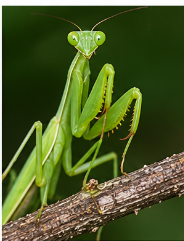
Praying Mantises (order Mantodea) are among the most recognizable predatory insects in the world. Famous for their upright posture, rotating triangular heads, and powerful grasping front legs, mantises are highly effective ambush predators that feed on a wide variety of insects and other small animals. They are commonly found in gardens, farms, forests, grasslands, and residential landscapes, where they help reduce populations of many pest species.
Although often promoted as beneficial garden insects, praying mantises are actually generalist predators. They consume both harmful pests and beneficial insects, including bees, butterflies, and lady beetles. Despite this, their impressive hunting abilities and fascinating behavior have made them one of the most admired insects among gardeners, educators, and entomologists.
Taxonomy and Classification
Praying Mantises belong to the order Mantodea, a group consisting of more than 2,400 known species worldwide. Several native and introduced species occur throughout North America.
- Order: Mantodea
- Family: Mantidae (and several related families)
- Common Groups: Praying Mantises, Mantids
Common North American species include the Carolina Mantis (Stagmomantis carolina), the Chinese Mantis (Tenodera sinensis), and the European Mantis (Mantis religiosa).
Physical Description
Praying Mantises possess several distinctive features that make them easy to recognize.
- Length: Approximately 40–100 mm depending on species.
- Color: Green, brown, tan, gray, or combinations that provide camouflage.
- Head: Large triangular head capable of rotating nearly 180 degrees.
- Eyes: Prominent compound eyes providing exceptional depth perception and motion detection.
- Front Legs: Enlarged raptorial legs armed with sharp spines used to seize prey.
- Wings: Most adults possess two pairs of wings, although some species or females may fly poorly.
Their excellent camouflage allows them to blend into leaves, flowers, stems, and branches while waiting for unsuspecting prey.
Distribution and Habitat
Praying Mantises occur throughout temperate and tropical regions around the world.
Common habitats include:
- Home gardens
- Agricultural fields
- Grasslands
- Woodland edges
- Shrublands
- Flower beds
- Meadows
- Parks and natural landscapes
They are especially abundant where flowering plants attract numerous insect prey.
Behavior and Life Cycle
Praying Mantises undergo simple metamorphosis, developing through egg, nymph, and adult stages.
Females lay dozens to hundreds of eggs inside a protective foamy case called an ootheca, which hardens and protects the eggs throughout winter. During spring, numerous tiny nymphs emerge and immediately begin hunting small insects.
As they grow, mantises molt multiple times before reaching adulthood. Most North American species complete one generation each year, with adults appearing during summer and early autumn.
Mantises are primarily solitary insects and may even prey upon one another when food is scarce.
Feeding Behavior
Praying Mantises are patient ambush predators that rely on camouflage rather than chasing prey.
Common prey includes:
- Flies
- Moths
- Grasshoppers
- Crickets
- Beetles
- Caterpillars
- Leafhoppers
- Aphids
- Spiders
Large mantises may also capture tree frogs, small lizards, hummingbirds, and other small vertebrates under rare circumstances.
Once prey comes within reach, the mantis strikes with incredible speed, grasping it using its spined forelegs before consuming it alive.
Benefits and Limitations
Praying Mantises provide numerous ecological benefits but are not selective predators.
- Natural Pest Control: Consume many insects that damage crops and ornamental plants.
- Educational Value: Frequently used to teach insect biology and predator-prey relationships.
- Generalist Predators: Also consume beneficial insects such as bees, butterflies, lacewings, and lady beetles.
- Biodiversity: Contribute to balanced food webs in natural ecosystems.
- Wildlife Food Source: Serve as prey for birds, reptiles, mammals, and larger insects.
Because they eat both beneficial and pest insects, praying mantises should be viewed as general predators rather than specialized biological control agents.
Management and Conservation
Praying Mantises rarely require management and are generally welcomed in gardens and landscapes.
- Avoid Broad-Spectrum Insecticides: Preserve mantises and other beneficial predators.
- Maintain Diverse Plantings: Flowering plants attract prey and provide excellent habitat.
- Protect Egg Cases: Leave overwintering oothecae attached to shrubs, stems, or fences whenever possible.
- Encourage Natural Habitat: Native vegetation supports healthy mantis populations.
Gardeners should avoid relocating large numbers of introduced mantises into sensitive habitats where they may compete with native species.
Conservation and Research
Scientists continue studying praying mantises because of their remarkable vision, lightning-fast predatory strikes, camouflage, and complex hunting behavior. Research into their visual processing, biomechanics, and neurobiology has contributed to advances in robotics, computer vision, and predator-prey ecology. Native mantis species also serve as valuable indicators of healthy, pesticide-free environments.
Conclusion
Praying Mantises are among nature’s most impressive insect predators. Their unique appearance, extraordinary eyesight, and powerful hunting adaptations make them fascinating members of gardens and natural ecosystems. Although they feed on both pest and beneficial insects, their contribution to biodiversity and natural insect regulation makes them valuable components of healthy landscapes. Protecting native mantis populations helps support balanced ecosystems while providing opportunities to observe one of nature’s most skilled ambush hunters.