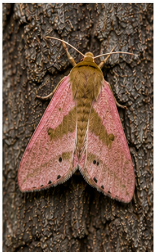
Pink Underwing Moths are a group of striking nocturnal moths best known for their brilliantly colored pink or reddish-pink hindwings, which remain hidden beneath cryptically colored forewings while the moth is at rest. Belonging primarily to the family Erebidae, these moths rely on camouflage to avoid predators during the day, then reveal their vivid hindwings in flight as a defensive startle display. Although their appearance can be dramatic, Pink Underwing Moths are harmless to humans and are not considered significant agricultural or structural pests.
Most species inhabit mature forests and woodland habitats where their caterpillars feed on native trees and shrubs. Adults are important members of nighttime ecosystems, serving as prey for bats, birds, and other wildlife while occasionally contributing to nocturnal pollination.
Taxonomy and Classification
Pink Underwing Moths belong to the order Lepidoptera and are generally classified within the family Erebidae, one of the largest moth families in the world.
- Order: Lepidoptera
- Family: Erebidae
- Common Group: Underwing Moths
Numerous species around the world display pink hindwings, although they vary considerably in size and geographic distribution. Like all moths, they undergo complete metamorphosis, developing through egg, larva, pupa, and adult stages.
Physical Description
Pink Underwing Moths are medium to large moths whose contrasting wing colors make them among the most visually impressive nocturnal insects.
- Wingspan: Approximately 40–55 mm, depending on species.
- Forewings: Gray, brown, or mottled bark-like camouflage with intricate markings that blend into tree bark.
- Hindwings: Bright pink, rosy red, or crimson with darker bands or margins.
- Body: Robust and densely scaled with coloration matching the forewings.
- Antennae: Thread-like in females and often slightly feathered in males.
When resting, the colorful hindwings remain completely hidden beneath the camouflaged forewings, making the moth difficult to detect.
Distribution and Habitat
Pink Underwing Moths are found in woodland environments where suitable host plants occur.
Common habitats include:
- Deciduous forests
- Mixed woodlands
- Forest edges
- Nature reserves
- Parks with mature trees
- Suburban wooded landscapes
Most species prefer relatively undisturbed habitats with abundant native vegetation that supports both caterpillars and adult moths.
Behavior and Ecology
Pink Underwing Moths are primarily nocturnal, becoming active shortly after sunset. Adults are commonly attracted to porch lights, ultraviolet lights, and sugar baits used by moth enthusiasts.
The bright hindwings serve as an effective flash coloration defense. When startled, the moth suddenly exposes its brilliant pink wings while taking flight, momentarily confusing predators such as birds. Once the moth lands and folds its wings, it becomes almost invisible against tree bark.
The larvae feed on the leaves of various native trees and shrubs, depending on the species. In most situations, feeding damage is minor and has little impact on healthy vegetation.
Life Cycle
Pink Underwing Moths undergo complete metamorphosis.
- Eggs: Deposited on or near suitable host plants.
- Larvae: Caterpillars feed on foliage for several weeks while passing through multiple molts.
- Pupae: Pupation occurs within leaf litter, soil, or protected crevices.
- Adults: Emerge during the warmer months to reproduce and continue the life cycle.
Depending on climate and species, there may be one or multiple generations each year.
Pest Status
Pink Underwing Moths are not considered pests. Caterpillars rarely occur in numbers capable of causing significant defoliation, and adults do not feed on household materials, stored foods, or structural wood.
They are generally regarded as beneficial components of forest ecosystems and contribute to overall biodiversity.
Management and Prevention
Control measures are generally unnecessary.
- Conservation: Preserve native woodland habitat whenever possible.
- Lighting: Reduce unnecessary nighttime lighting if adult moth activity becomes a nuisance.
- Natural Predators: Encourage birds and bats that naturally regulate moth populations.
- Avoid Pesticides: Broad-spectrum insecticides can harm beneficial moths and other pollinating insects.
Conservation and Research
Pink Underwing Moths are valuable indicators of healthy woodland ecosystems. Researchers study their camouflage, defensive coloration, nocturnal behavior, and interactions with predators to better understand the evolution of anti-predator defenses in moths. Maintaining mature forests and diverse native plant communities helps support healthy populations of these beautiful insects.
Conclusion
Pink Underwing Moths are fascinating nocturnal insects that combine remarkable camouflage with brilliant hidden wing colors. Although their sudden flashes of pink may surprise predators, they are harmless to humans and play an important role in woodland ecosystems. Their presence is generally considered a sign of healthy forest habitats and balanced biodiversity.