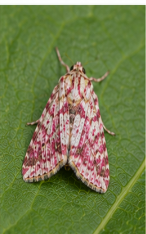
Pink-spotted Dart Moths (Euxoa idahoensis) are medium-sized noctuid moths native to western North America. They are named for the small pink or rosy spots that decorate their otherwise gray-brown forewings, making them one of the more distinctive members of the diverse dart moth group. Like many species in the genus Euxoa, the adult moth is harmless, while the larval stage develops as a cutworm, feeding on grasses and herbaceous plants. Although heavy populations can occasionally affect agricultural crops, Pink-spotted Dart Moths are generally uncommon and rarely become economically important pests.
These moths are most frequently encountered in native grasslands, prairies, and open habitats where both adults and larvae play important ecological roles. Adults provide food for bats, birds, and nocturnal predators, while the larvae contribute to natural nutrient cycling within grassland ecosystems.
Taxonomy and Classification
Pink-spotted Dart Moths belong to the order Lepidoptera and the family Noctuidae, commonly known as owlet moths or dart moths.
- Order: Lepidoptera
- Family: Noctuidae
- Genus: Euxoa
- Species: Euxoa idahoensis
The genus Euxoa contains hundreds of species worldwide, many of which have subterranean cutworm larvae capable of feeding on grasses, cereal crops, and other herbaceous vegetation. Like all moths, Pink-spotted Dart Moths undergo complete metamorphosis.
Physical Description
Pink-spotted Dart Moths are sturdy, well-camouflaged insects adapted for nocturnal activity.
- Wingspan: Approximately 35–45 mm.
- Forewings: Gray to grayish-brown with darker markings and distinctive pink or rosy spots that give the species its common name.
- Hindwings: Pale gray or whitish with darker outer margins.
- Body: Thick, robust, and densely covered with fine scales.
- Larvae: Smooth-bodied gray, brown, or greenish cutworms that curl into a tight “C” shape when disturbed.
- Antennae: Fine and thread-like, typical of most noctuid moths.
The adults rely on cryptic coloration to remain concealed against soil, bark, and dry vegetation during daylight hours.
Distribution and Habitat
Pink-spotted Dart Moths occur primarily throughout western North America, especially in open habitats where grasses dominate the landscape.
Preferred habitats include:
- Native grasslands
- Prairies
- Sagebrush ecosystems
- Agricultural field margins
- Open shrublands
- Mountain valleys and foothills
Adults are most active during the warmer months and are frequently attracted to porch lights and ultraviolet light traps.
Behavior and Ecology
Adult Pink-spotted Dart Moths are strictly nocturnal, spending daylight hours resting among vegetation or on the ground. They become active shortly after sunset, flying in search of mates and nectar sources.
The caterpillars live primarily at or below the soil surface, feeding on grasses and low-growing herbaceous plants during nighttime hours while hiding beneath debris or within the soil during the day. This behavior is characteristic of cutworms and provides protection from predators.
Although larvae occasionally feed on young agricultural crops, populations are typically too low to produce widespread economic damage.
Life Cycle
Pink-spotted Dart Moths undergo complete metamorphosis through four developmental stages.
- Eggs: Deposited on soil or low vegetation near suitable host plants.
- Larvae: Cutworms feed primarily at night while developing through multiple molts.
- Pupae: Pupation occurs within earthen chambers beneath the soil surface.
- Adults: Emerge during the growing season to reproduce and begin another generation.
Most populations produce a single generation each year, although timing varies depending on elevation and climate.
Damage and Pest Status
The adult moth causes no damage. The larval cutworms may occasionally feed on seedlings, grasses, forage crops, and other herbaceous plants by chewing stems near the soil surface. Under normal conditions, damage is scattered and economically insignificant.
Only during localized outbreaks do populations become capable of reducing plant stands or damaging young crops. Such outbreaks are relatively uncommon compared to those caused by more widespread cutworm species.
Management and Prevention
Integrated Pest Management (IPM) practices provide effective control when necessary.
- Field Monitoring: Scout fields for cutworm activity before significant crop injury occurs.
- Weed Management: Reduce alternate host plants prior to planting susceptible crops.
- Encourage Natural Enemies: Birds, ground beetles, parasitic wasps, and predatory insects naturally suppress populations.
- Targeted Treatments: Apply insecticides only when economic thresholds justify intervention.
- Crop Rotation: Rotating susceptible crops can reduce recurring infestations.
Conservation and Research
Researchers monitor Pink-spotted Dart Moths and related Euxoa species to better understand cutworm biology, seasonal population dynamics, and their effects on agricultural systems. Studies also examine their ecological importance within native grasslands, where they serve as prey for numerous wildlife species while contributing to nutrient cycling and food web stability.
Conclusion
The Pink-spotted Dart Moth is an attractive native noctuid whose adult stage is completely harmless while its cutworm larvae occasionally feed on grasses and young crops. Although localized infestations may require management, serious outbreaks are uncommon. Maintaining healthy grassland ecosystems and utilizing Integrated Pest Management practices helps balance agricultural protection with conservation of this native moth.