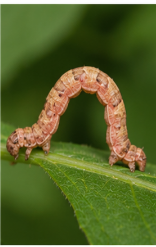
Pink-patched Loopers (Eubaphe mendica) are attractive geometer moths recognized for the soft pink patches that decorate their pale wings and for the distinctive looping movement of their caterpillars. Like other members of the family Geometridae, the larvae are commonly called inchworms because they lack the middle abdominal prolegs found in most caterpillars, forcing them to move by arching their bodies into characteristic loops. Pink-patched Loopers are native to North America and are commonly found in woodland edges, meadows, gardens, and other areas with abundant shrubs and deciduous trees.
Although their caterpillars feed on the leaves of various woody plants, they rarely occur in numbers large enough to cause significant damage. As a result, Pink-patched Loopers are considered harmless native moths that contribute to healthy ecosystems by serving as pollinators, herbivores, and food sources for birds, bats, spiders, and numerous predatory insects.
Taxonomy and Classification
Pink-patched Loopers belong to the order Lepidoptera and the family Geometridae, one of the world’s largest moth families.
- Order: Lepidoptera
- Family: Geometridae
- Genus: Eubaphe
- Species: Eubaphe mendica
Geometer moths are named after their larvae, whose looping gait resembles the action of measuring the ground, giving rise to the common names “loopers” and “inchworms.” Like all moths, Pink-patched Loopers undergo complete metamorphosis.
Physical Description
Pink-patched Loopers are medium-sized moths with subtle but attractive wing coloration.
- Wingspan: Approximately 30–40 mm.
- Forewings: Creamy white to pale gray with delicate pink or rosy patches and fine brown markings.
- Hindwings: Similar in color to the forewings with faint crosslines.
- Body: Slender and lightly scaled.
- Larvae: Thin green or brown inchworms lacking the middle abdominal prolegs, producing the familiar looping movement.
- Antennae: Thread-like and proportionate to body size.
The muted coloration allows adults to blend effectively with bark, leaves, and woodland vegetation during daylight hours.
Distribution and Habitat
Pink-patched Loopers occur throughout portions of North America where suitable woodland habitats exist.
Common habitats include:
- Woodland edges
- Mixed forests
- Shrublands
- Meadows
- Gardens
- Parks and suburban landscapes
Adults are generally active from late spring through summer, depending on latitude and local climate.
Behavior and Ecology
Pink-patched Loopers are nocturnal and become active shortly after sunset. Adults are frequently attracted to porch lights and ultraviolet light traps, making them occasional visitors around homes near wooded areas.
The caterpillars feed on the foliage of various shrubs and deciduous trees. Their looping locomotion allows them to move efficiently through branches while remaining difficult for predators to detect. Adults primarily feed on nectar and other carbohydrate-rich food sources while contributing modestly to nighttime pollination.
Throughout their life cycle, these moths provide an important food source for birds, bats, spiders, and predatory insects, making them valuable members of woodland food webs.
Life Cycle
Pink-patched Loopers undergo complete metamorphosis consisting of four developmental stages.
- Eggs: Deposited individually or in small groups on host plants.
- Larvae: Inchworm caterpillars feed on leaves while passing through several molts.
- Pupae: Pupation occurs within leaf litter or lightly woven cocoons near the ground.
- Adults: Emerge during the growing season to reproduce and begin another generation.
Depending on regional climate, one or more generations may occur annually.
Pest Status
Pink-patched Loopers are not considered significant pests. Although caterpillars consume foliage, feeding is generally light and does not threaten the health of established trees or shrubs. They do not infest homes, stored products, fabrics, or structural wood.
Management and Prevention
Control measures are rarely necessary.
- Monitor Plants: Inspect ornamental shrubs if unusual caterpillar feeding is observed.
- Encourage Natural Predators: Birds, predatory insects, and spiders naturally regulate populations.
- Avoid Broad-spectrum Insecticides: These products can harm beneficial moths and other pollinating insects.
- Maintain Healthy Landscapes: Diverse native vegetation supports balanced insect populations.
Conservation and Research
Pink-patched Loopers contribute to the biodiversity of forests, gardens, and natural landscapes. Scientists study geometer moths and their inchworm larvae to better understand insect locomotion, camouflage, forest ecology, and environmental health. Because many geometer moths are sensitive to habitat disturbance, they are useful indicators of ecosystem quality.
Conclusion
The Pink-patched Looper is a beautiful native geometer moth whose subtle pink wing markings and distinctive inchworm caterpillars make it an interesting member of North America’s insect fauna. While its larvae feed on leaves, populations rarely become damaging, and the species plays an important ecological role as both a pollinator and an important food source for wildlife.