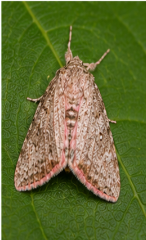
Pink-fringed Dolichomia Moths (Dolichomia olinalis) are small, attractive snout moths native to eastern and central North America. They are recognized by their light brown wings accented with delicate pinkish fringes that give the species its common name. Although they belong to the diverse family Pyralidae, these moths are not considered agricultural, structural, or household pests. Their caterpillars feed on grasses and other low-growing vegetation, while adults serve as an important food source for birds, bats, spiders, and other insect-eating wildlife.
Because of their small size and excellent camouflage, Pink-fringed Dolichomia Moths often go unnoticed except when they are attracted to porch lights or ultraviolet light traps on warm summer evenings. They are considered beneficial members of grassland ecosystems and contribute to overall insect biodiversity.
Taxonomy and Classification
The Pink-fringed Dolichomia Moth belongs to the order Lepidoptera and the family Pyralidae, commonly known as snout moths due to the forward-projecting mouthparts that give many species a distinctive “snout-like” appearance.
- Order: Lepidoptera
- Family: Pyralidae
- Genus: Dolichomia
- Species: Dolichomia olinalis
Like all moths, this species undergoes complete metamorphosis, progressing through egg, larva, pupa, and adult stages.
Physical Description
Pink-fringed Dolichomia Moths are small but attractive insects whose subtle coloration provides excellent camouflage among grasses and dried vegetation.
- Wingspan: Approximately 15–22 mm.
- Forewings: Light tan to brown with fine darker markings and delicate pinkish fringes along the outer margins.
- Hindwings: Pale gray to tan with similarly fringed edges.
- Body: Slender and covered with fine scales.
- Palps: Prominent forward-projecting palps create the characteristic “snout” appearance common to many pyralid moths.
- Antennae: Thin, thread-like, and proportionate to body size.
The combination of muted wing colors and fine pink edging makes this species distinctive while allowing it to blend into dry grasses during daylight hours.
Distribution and Habitat
Pink-fringed Dolichomia Moths occur throughout much of the eastern and central United States and adjacent portions of Canada where suitable grassland habitats exist.
Preferred habitats include:
- Native meadows
- Prairies and grasslands
- Open woodland edges
- Roadside vegetation
- Pastures
- Fields with native grasses
Adults are most active during the warmer months, particularly from late spring through early autumn.
Behavior and Ecology
Pink-fringed Dolichomia Moths are nocturnal and typically remain hidden among vegetation during the day before becoming active shortly after sunset. Adults frequently visit outdoor lights and ultraviolet traps, where they are occasionally observed by naturalists.
The larvae feed on grasses and other low-growing herbaceous plants, although they rarely occur in sufficient numbers to produce noticeable feeding damage. Adults may visit flowers for nectar while also serving as prey for bats, birds, spiders, frogs, and predatory insects.
The species contributes to healthy grassland ecosystems by participating in food webs and supporting biodiversity.
Life Cycle
Pink-fringed Dolichomia Moths complete four distinct developmental stages.
- Eggs: Deposited on grasses or other suitable host plants.
- Larvae: Caterpillars feed on foliage while growing through several molts.
- Pupae: Pupation occurs within leaf litter or protected vegetation near the ground.
- Adults: Emerge during the growing season to mate and lay eggs for the next generation.
Depending on local climate, one or more generations may occur annually.
Pest Status
Pink-fringed Dolichomia Moths are not considered pests. Their caterpillars rarely damage ornamental plants, crops, or turfgrass, and adults do not infest homes, stored foods, fabrics, or wooden structures.
They are generally regarded as harmless native moths that contribute positively to natural ecosystems.
Management and Prevention
No management is normally required.
- Reduce Outdoor Lighting: Limiting unnecessary lighting can reduce adult moth activity around buildings.
- Protect Native Grasslands: Conserving meadows and native vegetation supports healthy moth populations.
- Avoid Broad-spectrum Insecticides: These products can negatively impact beneficial moths and other pollinating insects.
- Encourage Natural Predators: Birds, bats, and spiders naturally regulate moth populations.
Conservation and Research
Pink-fringed Dolichomia Moths are useful indicators of healthy grassland habitats. Entomologists monitor populations of snout moths during biodiversity surveys to better understand habitat quality, insect diversity, and ecosystem stability. Continued conservation of native grasslands and meadow habitats helps maintain healthy populations of this and many other beneficial moth species.
Conclusion
The Pink-fringed Dolichomia Moth is a small but attractive native moth that plays an important ecological role in North American grasslands. Its delicate pink wing fringes, nocturnal habits, and harmless nature make it an interesting species for naturalists while posing no threat to agriculture or homeowners. Preserving native habitats ensures these moths continue contributing to healthy and diverse ecosystems.