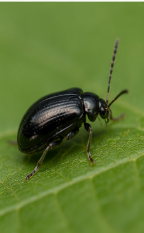
Pigweed Flea Beetle (Disonycha glabrata) is a small jumping leaf beetle that feeds primarily on pigweed (Amaranthus spp.) and closely related plants. As a member of the flea beetle group (family Chrysomelidae), it is equipped with enlarged hind legs that allow it to jump like a flea when disturbed. While pigweed is its preferred host, the beetle may occasionally feed on cultivated leafy greens such as spinach, beets, and Swiss chard. In most situations it is considered a minor agricultural pest, but localized populations can cause noticeable feeding damage to young plants and seedlings.
Taxonomy and Classification
Pigweed Flea Beetles belong to the order Coleoptera (beetles) and the family Chrysomelidae, one of the largest beetle families in the world. Within this family, they are classified in the flea beetle tribe Alticini, whose members are distinguished by their enlarged hind femora that provide exceptional jumping ability.
The species Disonycha glabrata is native to North America and is closely related to other Disonycha species that attack vegetables and ornamental plants. Like all beetles, Pigweed Flea Beetles undergo complete metamorphosis consisting of egg, larva, pupa, and adult stages.
Physical Description
Adult Pigweed Flea Beetles measure approximately 6–8 mm in length and have an oval, somewhat elongated body.
- Color: Adults are typically dark metallic blue, black, or bronze with a slight iridescent sheen depending on lighting.
- Jumping Legs: The enlarged hind legs allow adults to leap several inches when disturbed, making them difficult to capture.
- Antennae: Slender, thread-like antennae help locate suitable host plants.
- Larvae: Cream-colored, slender grubs with brown head capsules that feed on foliage or roots depending on environmental conditions.
- Damage Sign: Adults chew numerous small round holes through leaves, producing the characteristic “shot-hole” appearance associated with flea beetles.
Distribution and Habitat
Pigweed Flea Beetles are found throughout much of the eastern and central United States and into parts of Canada and Mexico wherever suitable host plants occur.
Typical habitats include:
- Agricultural fields
- Vegetable gardens
- Weedy lots
- Roadsides
- Field margins
- Areas containing pigweed and other amaranths
They are especially abundant in locations where pigweed is allowed to grow unchecked, providing a continuous food source throughout the growing season.
Life Cycle and Behavior
Adult beetles overwinter beneath leaf litter, weeds, crop residue, or shallow soil. As temperatures warm during spring, adults emerge and begin feeding on newly growing host plants.
After mating, females deposit eggs near the base of host plants or within the soil. Upon hatching, larvae begin feeding before eventually pupating in the soil. Adults emerge several weeks later to continue feeding and reproduction.
Depending on climate, Pigweed Flea Beetles may complete one to several generations each year, with the greatest populations typically occurring during warm summer months.
When approached, adults immediately spring away using their powerful hind legs, an effective defense against predators that also makes monitoring more challenging.
Damage to Plants
Adult feeding causes the majority of visible injury. Small circular feeding holes appear across leaf surfaces, giving foliage a peppered or shot-hole appearance.
Damage may include:
- Shot-hole feeding injury on leaves
- Reduced photosynthetic area
- Stunted seedling growth
- Delayed crop establishment
- Reduced market quality of leafy vegetables
- Greater susceptibility of stressed plants to drought
Heavy infestations are most damaging to newly emerged seedlings, where relatively little feeding can significantly reduce vigor or even kill young plants. Mature plants generally tolerate considerably more feeding without significant yield loss.
Management and Prevention (IPM)
An effective Integrated Pest Management (IPM) program combines monitoring, cultural practices, biological control, and carefully timed treatments when necessary.
- Weed Management: Removing pigweed and related weeds reduces breeding sites and helps suppress local beetle populations.
- Crop Rotation: Rotating susceptible crops helps interrupt population development from year to year.
- Floating Row Covers: Protect young vegetable seedlings until they become established.
- Monitoring: Regular scouting during spring and early summer allows early intervention before serious damage occurs.
- Encourage Beneficial Insects: Ground beetles, predatory bugs, spiders, and parasitic insects naturally help suppress flea beetle populations.
- Targeted Insecticides: When economic thresholds are exceeded, labeled insecticides may be used while minimizing impacts on pollinators and beneficial insects.
Conservation and Research
Although Pigweed Flea Beetles can become localized crop pests, they also serve as part of native food webs by providing prey for birds, predatory insects, and spiders. Current research focuses on improving sustainable management through biological control, host plant resistance, trap cropping, and reduced-risk insecticides that preserve beneficial organisms while protecting vegetable production.
Studies continue to evaluate how weed management practices influence flea beetle abundance and how integrated pest management programs can reduce pesticide dependence while maintaining crop quality.
Conclusion
The Pigweed Flea Beetle is a common North American leaf beetle whose jumping ability and shot-hole feeding damage make it easily recognizable. While its preferred host is pigweed, it may occasionally damage cultivated vegetables, particularly young leafy crops. Most infestations can be successfully managed through sanitation, weed control, regular monitoring, biological control, and integrated pest management practices. Early detection remains the most effective way to prevent significant crop injury while minimizing unnecessary pesticide applications.