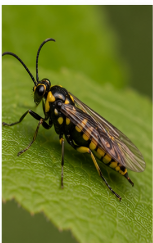
Pigeon Tremex (Tremex columba), also known as the Pigeon Horntail, is one of the largest wood-boring wasps found in North America. Despite its impressive size and intimidating appearance, this insect is harmless to humans and cannot sting. The long, needle-like structure extending from the female’s abdomen is not a stinger but an ovipositor used exclusively for laying eggs deep inside weakened or dying hardwood trees.
Pigeon Tremex wasps are beneficial members of forest ecosystems because their larvae help decompose dead wood while providing food for numerous predators and specialized parasitoid wasps. Although they occasionally emerge from firewood or logs stored outdoors, they do not infest structural lumber or healthy trees and are not considered structural pests.
Overview
The Pigeon Tremex belongs to the family Siricidae, commonly known as horntails or wood wasps. Unlike social wasps such as yellowjackets or paper wasps, horntails do not build nests, defend colonies, or sting people.
The species is most often encountered in forests, parks, woodlots, and wooded residential areas where dead or declining hardwood trees provide ideal egg-laying sites. Adults are most active during summer when females search for suitable trees in which to deposit their eggs.
Taxonomy and Classification
- Order: Hymenoptera
- Family: Siricidae
- Genus: Tremex
- Species: Tremex columba
- Common Names: Pigeon Tremex, Pigeon Horntail
Although often mistaken for giant wasps because of their size, horntails represent an ancient lineage of wood-boring insects that differ significantly from stinging wasps.
Identification
Pigeon Tremex wasps are among the largest wood-boring insects in North America.
- Length: Approximately 25–40 mm.
- Body Color: Brown to reddish-brown with yellow, orange, or amber markings.
- Wings: Transparent with amber or smoky coloration.
- Female Ovipositor: Long, rigid egg-laying structure extending well beyond the abdomen.
- Horn: Small spine-like projection at the tip of the abdomen characteristic of horntails.
Despite the formidable appearance of the ovipositor, it cannot inject venom and is used only to place eggs deep within wood.
Life Cycle
Pigeon Tremex undergoes complete metamorphosis, progressing through four developmental stages:
- Egg
- Larva
- Pupa
- Adult
Females drill into weakened hardwood trees using their ovipositor and deposit eggs beneath the bark. At the same time, they introduce spores of a specialized wood-decaying fungus that begins breaking down the wood, making it easier for developing larvae to feed.
The larvae tunnel through the wood for one to several years before pupating. Mature adults eventually chew large circular exit holes through the wood and emerge during the summer months.
Distribution and Habitat
Pigeon Tremex occurs throughout much of eastern and central North America wherever suitable hardwood forests are present.
Common habitats include:
- Deciduous forests
- Mixed woodlands
- Wooded parks
- Forest edges
- Urban trees
- Dead or dying hardwood trees
- Recently fallen logs
Preferred host trees include maple, beech, elm, oak, sycamore, and other hardwood species experiencing stress or decline.
Behavior and Ecology
Adult Pigeon Tremex wasps are solitary insects that spend much of their short lives locating suitable trees for reproduction.
- Wood Boring: Females drill deep into hardwood using the ovipositor.
- Fungal Association: Eggs are deposited along with beneficial fungal spores that aid larval development.
- Larval Feeding: Larvae consume fungus-infested wood within tunnels.
- No Stinging Behavior: Adults are completely non-aggressive toward humans.
One of the Pigeon Tremex’s most fascinating ecological relationships involves the Giant Ichneumon Wasp (Megarhyssa spp.), whose females use their exceptionally long ovipositors to locate and parasitize Tremex larvae hidden deep within wood.
Damage and Economic Importance
Pigeon Tremex is generally considered a secondary wood-boring insect because it attacks trees that are already weakened, dying, or dead.
Potential impacts include:
- Wood Tunneling: Larvae create galleries within declining hardwood.
- Accelerated Decomposition: Introduced fungi assist wood decay.
- Occasional Firewood Emergence: Adults sometimes emerge from stored logs indoors.
- Minimal Economic Damage: Healthy trees and structural lumber are rarely attacked.
The species plays a much larger ecological role than it does as a pest.
Management and Prevention
Control is rarely necessary because Pigeon Tremex primarily attacks trees that are already compromised.
- Maintain Tree Health: Healthy trees are highly resistant to attack.
- Remove Dead Trees: Eliminate breeding sites if desired.
- Store Firewood Outdoors: Prevent adults from emerging indoors.
- Avoid Unnecessary Insecticides: Chemical treatments are rarely justified.
If adults emerge indoors from stored firewood, they are simply a temporary nuisance and cannot establish infestations inside homes.
Conservation and Research
Pigeon Tremex contributes significantly to forest nutrient cycling by helping break down dead hardwood. Researchers continue studying its remarkable relationship with wood-decaying fungi and the specialized parasitoid wasps that regulate its populations.
These interactions represent one of the most fascinating examples of ecological specialization among wood-boring insects.
Conclusion
Pigeon Tremex (Tremex columba) is an impressive but harmless wood-boring wasp that plays an important ecological role in North American forests. Although its large size and long ovipositor often alarm homeowners, it poses no threat to people or healthy trees. Instead, it contributes to natural decomposition processes while supporting an intricate community of fungi and beneficial parasitoid insects that help maintain balanced forest ecosystems.