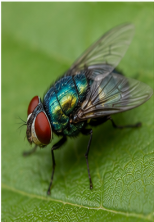
Peacock Flies (Callopistromyia annulipes) are fascinating members of the picture-winged fly family (Ulidiidae) and are best known for one of the most unusual defensive and courtship displays in the insect world. Rather than holding their wings flat over their bodies like most flies, Peacock Flies raise them vertically and fan them outward, creating a striking display that resembles the colorful tail feathers of a peacock. This remarkable behavior has made the species a favorite among photographers, entomologists, and nature enthusiasts.
Despite their dramatic appearance, Peacock Flies are completely harmless to humans, pets, and plants. They are not agricultural pests, do not bite, and do not spread disease. Instead, they contribute to woodland ecosystems by helping recycle decaying organic matter and serving as prey for birds, spiders, and predatory insects.
Overview
The Peacock Fly belongs to the family Ulidiidae, commonly known as picture-winged flies because many species possess boldly patterned wings. Among these insects, Callopistromyia annulipes stands out for its extraordinary habit of displaying its wings vertically while walking across tree trunks, logs, and other surfaces.
Scientists believe this display serves multiple purposes, including attracting mates, confusing predators, and signaling to other flies. The behavior is so distinctive that the species has become one of the most recognizable picture-winged flies in North America.
Taxonomy and Classification
- Order: Diptera
- Family: Ulidiidae
- Genus: Callopistromyia
- Species: Callopistromyia annulipes
- Common Name: Peacock Fly
Like all true flies, Peacock Flies undergo complete metamorphosis, progressing through egg, larva, pupa, and adult stages.
Identification
Although small, Peacock Flies are remarkably distinctive.
- Length: Approximately 5–7 mm.
- Color: Black with white markings.
- Legs: Banded black and white.
- Wings: Transparent with bold dark bands.
- Display: Wings are held upright in a fan-like position while walking.
- Eyes: Large compound eyes typical of flies.
The upright wing posture immediately distinguishes Peacock Flies from nearly every other fly species found in North America.
Life Cycle
The complete life cycle of the Peacock Fly is not as thoroughly documented as that of many agricultural pests, but it follows the typical pattern of other picture-winged flies.
Females deposit eggs on suitable decaying organic material, particularly rotting wood.
After hatching, larvae feed on decomposing plant tissues and microorganisms before pupating within protected organic debris. Adults emerge several weeks later to mate and continue the cycle.
Multiple generations may occur each year depending on local climate.
Distribution and Habitat
Peacock Flies are widespread throughout much of North America.
They commonly inhabit:
- Deciduous forests
- Mixed woodlands
- Urban parks
- Tree-lined streets
- Nature preserves
- Woodlots
- Residential landscapes
Adults are frequently observed walking across fallen logs, dead tree trunks, fence posts, and other weathered wooden surfaces.
Behavior and Ecology
The Peacock Fly is famous for its elaborate wing display.
Rather than flying away immediately when disturbed, individuals often:
- Raise both wings vertically.
- Fan the patterned wings outward.
- Move sideways across bark.
- Rotate slowly while displaying.
- Wave their wings during courtship.
This behavior likely serves multiple purposes.
The bold wing patterns may imitate the appearance of larger animals, making predators hesitate before attacking. During courtship, the displays probably allow females to evaluate potential mates.
Feeding Habits
Adult Peacock Flies consume a variety of organic materials and microorganisms associated with decaying vegetation.
Larvae primarily develop within:
- Rotting wood
- Decaying bark
- Moist organic debris
- Dead tree tissues
By breaking down decomposing material, the larvae contribute to nutrient recycling within forest ecosystems.
Pest Status
Peacock Flies are not considered pests.
They do not:
- Bite humans.
- Damage living plants.
- Attack crops.
- Infest homes.
- Transmit diseases.
Because they rely on decaying wood rather than healthy vegetation, they provide ecological benefits instead of causing economic damage.
Management and Prevention
No pest control measures are necessary for Peacock Flies.
If individuals are found around homes or gardens, they should simply be left alone.
Maintaining dead wood in natural areas supports their populations and benefits numerous other beneficial insects, fungi, and wildlife.
Natural Predators
Peacock Flies are preyed upon by numerous insectivorous animals.
- Birds
- Spiders
- Dragonflies
- Robber flies
- Predatory wasps
- Praying mantises
Their unusual wing displays likely reduce predation by creating visual confusion during attacks.
Ecological Importance
Peacock Flies contribute to forest ecosystems by recycling organic material and serving as food for numerous predators. Their larvae help accelerate decomposition of dead wood, returning nutrients to the soil.
The species also serves as an excellent example of behavioral adaptation and visual communication among insects.
Conservation and Research
Researchers continue studying Peacock Flies because of their extraordinary wing displays, mating behavior, and predator avoidance strategies. Their unique signaling system has become a model for understanding visual communication and sexual selection in insects.
Conservation of mature forests and dead wood habitats helps ensure healthy populations of Peacock Flies and many other beneficial decomposer species.
Conclusion
Peacock Flies (Callopistromyia annulipes) are among North America’s most visually remarkable flies. Their spectacular wing displays, harmless nature, and role in woodland ecosystems make them fascinating insects rather than pests. Although small in size, they demonstrate how complex behavior and striking appearance can evolve even among the tiniest members of the insect world.