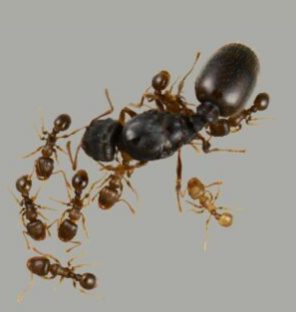
Pavement Ants (Tetramorium caespitum complex) are small, dark ants commonly found nesting under sidewalks, driveways, patios, foundations, and pavement cracks. They are among the most familiar nuisance ants in urban and suburban areas, especially where concrete, stone, and compacted soil provide protected nesting spaces. Although Pavement Ants do not usually cause serious structural damage or major health risks, they frequently invade homes, restaurants, offices, garages, and commercial buildings while searching for food.
The primary conflict with Pavement Ants is nuisance activity and food contamination. Workers enter buildings through tiny gaps around foundations, doors, windows, expansion joints, utility lines, and slab cracks. Once indoors, they trail to crumbs, grease, pet food, sweets, meat, and other available food sources. Their persistence, large colonies, and ability to nest close to structures make them one of the most common ants encountered by homeowners and pest control professionals.
Taxonomy and Classification
Pavement Ants belong to the family Formicidae, which includes all ants. They are part of the genus Tetramorium, a diverse group of small ants found in many parts of the world.
- Order: Hymenoptera
- Family: Formicidae
- Genus: Tetramorium
- Species Complex: Tetramorium caespitum complex
- Common Name: Pavement Ant
The name Tetramorium caespitum has historically been used for Pavement Ants in North America, although modern research recognizes that several closely related species may be involved. For practical pest management purposes, they are usually grouped together as Pavement Ants.
Physical Description
Pavement Ant workers are small, usually measuring about 1/8 inch long. They are dark brown to blackish, with lighter legs and antennae. Under magnification, their bodies show fine grooves or ridges on the head and thorax.
- Worker Size: About 1/8 inch long
- Color: Dark brown to blackish
- Legs and Antennae: Often lighter than the body
- Waist: Two distinct nodes between thorax and abdomen
- Body Texture: Fine parallel grooves on the head and thorax
- Stinger: Present, but rarely important to humans
Winged reproductive Pavement Ants, known as alates, are larger than workers and may appear indoors during swarming periods. Swarmers are sometimes mistaken for termites, but ants have elbowed antennae, a pinched waist, and unequal wing pairs.
Distribution and Habitat
Pavement Ants are believed to have originated in Europe and were introduced to North America, where they are now widespread. They thrive in cities, towns, suburban neighborhoods, commercial properties, parks, schools, and landscaped areas.
Common nesting sites include:
- Under sidewalks
- Driveway cracks
- Patio stones
- Foundation edges
- Garage slabs
- Landscape pavers
- Retaining walls
- Lawns and garden soil
- Wall voids near moisture or food sources
Outdoors, their nests are often recognized by small piles of excavated soil or sand along cracks in pavement. Indoors, they may nest near slab floors, heat sources, insulation, or wall voids if conditions are favorable.
Colony Structure and Behavior
Pavement Ant colonies contain workers, brood, males, and one or more queens depending on colony structure and local conditions. Workers forage in organized trails and recruit nestmates when they locate food.
These ants are opportunistic feeders. Their diet includes:
- Sugary foods
- Grease and fats
- Meat scraps
- Pet food
- Seeds
- Dead insects
- Honeydew from aphids and scale insects
- Human food crumbs
Pavement Ants are also known for territorial battles between neighboring colonies. Large groups of workers may fight on sidewalks or driveways, creating noticeable clusters of dead or struggling ants.
Life Cycle and Reproduction
Pavement Ants undergo complete metamorphosis with egg, larval, pupal, and adult stages. Queens lay eggs that hatch into small larvae. Workers feed and care for the larvae until they pupate and emerge as adults.
Reproductive swarms usually occur during warm periods, often in spring or early summer, although indoor swarms may occur at other times if nests are located in heated buildings. Winged males and females leave the colony to mate. After mating, females shed their wings and attempt to start new colonies.
Colony growth can be slow at first, but established nests may contain many workers and multiple foraging trails. Because colonies often nest under slabs or pavement, they can be difficult to eliminate with surface sprays alone.
Damage and Human Conflict
Pavement Ants are primarily nuisance pests. They do not eat wood like termites and are not known to cause major structural damage. However, their nesting activity can move soil from beneath pavement cracks, pavers, and slab edges. Over long periods, this may contribute to minor settling or instability in already vulnerable areas.
They may occasionally sting if handled or pressed against skin, but stings are uncommon and usually mild.
Management and Prevention
Effective Pavement Ant management requires integrated pest management (IPM). The goal is to reduce food access, block entry points, and target the colony rather than only killing visible workers.
Slow-acting baits are often more effective than contact sprays because workers share food with nestmates. Spraying visible trails may kill foragers temporarily but fail to reach the queen and brood. Bait preference may change by season, so both sugar-based and protein- or grease-based baits may be useful.
Prevention Tips
- Store food in sealed containers.
- Clean kitchen counters and floors regularly.
- Remove pet food after feeding.
- Seal gaps around pipes and utility penetrations.
- Keep mulch and soil below siding level.
- Trim vegetation away from foundations.
- Repair pavement cracks where nests are recurring.
- Use ant baits before populations become severe.
Conservation and Ecological Role
Although Pavement Ants are nuisance pests in buildings, they also play ecological roles outdoors. They scavenge dead insects, aerate soil, move small seeds, and serve as food for birds, spiders, and other predators. Management should focus on colonies causing indoor problems rather than eliminating every ant outdoors.
Conclusion
Pavement Ants are common urban ants that nest beneath sidewalks, driveways, foundations, and other hard surfaces. Their small size, adaptable nesting habits, and broad diet make them frequent invaders of homes and businesses. While they are not dangerous or structurally destructive in the way termites are, they can contaminate food and create persistent nuisance trails. Successful control depends on sanitation, exclusion, moisture management, and slow-acting baits that reach the colony. With proper integrated pest management, Pavement Ant problems can usually be reduced without excessive pesticide use.