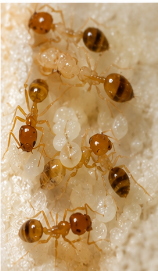
Pharaoh Ants (Monomorium pharaonis) are tiny, persistent indoor ants that are considered among the most difficult household and commercial ant pests to control. Their small size allows them to travel through extremely narrow cracks, wall voids, electrical outlets, plumbing penetrations, and other hidden spaces. They are particularly troublesome in apartments, hospitals, nursing homes, hotels, restaurants, food-handling facilities, and other heated buildings where warmth, moisture, and food are available throughout the year.
The primary conflict caused by Pharaoh Ants is food contamination, persistent indoor infestation, and potential mechanical movement of microorganisms. Their ability to establish multiple interconnected nests makes them especially difficult to eliminate. Unlike many ants that form a single colony with one queen, Pharaoh Ant colonies may contain multiple queens and numerous satellite nesting sites. Improper treatment can cause colonies to divide through a process known as budding, spreading the infestation into additional rooms or neighboring units.
Taxonomy and Classification
Pharaoh Ants belong to the family Formicidae, which includes all ants. They are members of the genus Monomorium, a large group containing many small ant species.
- Order: Hymenoptera
- Family: Formicidae
- Genus: Monomorium
- Species: Monomorium pharaonis
- Common Name: Pharaoh Ant
- Primary Pest Status: Indoor nuisance and sanitation pest
Despite their common name, Pharaoh Ants are not necessarily native to Egypt. Their exact original range is uncertain, but they are believed to have originated in a warm tropical region. Human transportation and commerce have spread them around the world.
In cooler climates, Pharaoh Ants survive primarily inside heated structures. Their dependence on warm indoor environments has allowed them to become closely associated with people.
Physical Description
Pharaoh Ant workers are extremely small, usually measuring only about 1.5 to 2 millimeters long. Their tiny size is one reason infestations can remain unnoticed until colonies are well established.
- Worker Size: Approximately 1.5 to 2 millimeters long
- Color: Pale yellow, golden yellow, or light reddish-brown
- Abdomen: Often darker than the rest of the body
- Waist: Two distinct nodes
- Antennae: Twelve segments ending in a three-segmented club
- Queens: Larger and darker than workers
The workers may appear almost translucent on light-colored surfaces. Homeowners sometimes describe them as tiny moving specks or crumbs. Their pale coloration helps distinguish them from darker household ants, although accurate identification may require magnification.
Because several small ant species may occur indoors, identification should not be based on color alone. The combination of tiny body size, pale coloration, two waist nodes, indoor nesting behavior, and persistent trailing activity provides a stronger indication of Pharaoh Ants.
Distribution and Habitat
Pharaoh Ants are now found worldwide. They are especially successful in buildings where temperatures remain warm throughout the year. In the United States, they can occur in nearly any region when suitable indoor conditions are available.
Common infestation sites include:
- Apartment buildings
- Hospitals and healthcare facilities
- Nursing homes
- Hotels
- Restaurants
- Commercial kitchens
- Food-processing facilities
- Office buildings
- Schools and universities
- Residential homes
Pharaoh Ants do not usually construct obvious outdoor mounds. Instead, they nest in protected indoor voids where temperatures and humidity remain relatively stable.
Common nesting locations include:
- Wall voids
- Electrical outlets
- Behind baseboards
- Under floors
- Inside insulation
- Behind appliances
- Near heating pipes
- Inside furniture
- Near plumbing fixtures
- Other warm, protected structural spaces
Colony Structure and Budding
The colony structure of Pharaoh Ants is one of the primary reasons these insects are so difficult to control. Colonies may contain multiple queens, thousands of workers, and numerous brood stages. Separate nests within a building may remain connected through worker movement and shared resources.
Their most important survival strategy is known as budding. During budding, one or more queens leave the original nesting area with workers and brood to establish another nest nearby. This process may occur naturally as a colony expands, but disturbance can also contribute to colony fragmentation.
Improper treatment with repellent sprays may scatter foraging ants and disrupt established trails. Instead of eliminating the infestation, poorly planned treatment can make the ants harder to track and may contribute to the development of additional satellite nesting sites.
This is why Pharaoh Ant infestations require a different approach from many other household ants. Killing only the workers visible on a countertop does not eliminate the queens, brood, or hidden nests.
Life Cycle and Reproduction
Pharaoh Ants undergo complete metamorphosis with four developmental stages: egg, larva, pupa, and adult. Queens lay eggs that hatch into small larvae. Workers feed, clean, and protect the developing brood until new adults emerge.
Under favorable indoor conditions, development from egg to adult may occur in approximately five to seven weeks. Because heated buildings provide stable temperatures throughout the year, reproduction may continue during every season.
The presence of multiple queens gives the colony an important survival advantage. Even if one queen dies, others may continue producing eggs. A relatively small group containing workers, brood, and a queen may be capable of establishing a new colony.
Feeding Behavior
Pharaoh Ants are opportunistic feeders with broad dietary preferences. Workers establish chemical trails between nesting areas and reliable food sources.
Common foods include:
- Sugar and syrups
- Honey and sweet foods
- Grease and fats
- Meat
- Pet food
- Dead insects
- Bakery products
- Food scraps
- Other protein-rich materials
The colony’s food preference may change depending on the nutritional requirements of queens, workers, and developing larvae. This is important during baiting because ants may accept a sugar-based bait at one time and show greater interest in protein- or grease-based food at another.
Damage and Health Concerns
Pharaoh Ants do not eat wood and are not major structural pests. Their importance comes from their ability to enter food, move through unsanitary areas, and infest sensitive environments.
Common problems include:
- Contamination of food and food-preparation surfaces
- Persistent ant trails in kitchens and bathrooms
- Infestation of multiple rooms or apartments
- Activity around sinks, drains, and plumbing
- Movement through healthcare and food-handling environments
- Repeated infestations after ineffective treatments
Pharaoh Ants are of particular concern in hospitals and other healthcare facilities because workers can move between contaminated and sensitive locations. They have been associated with various microorganisms, including species of Salmonella, Staphylococcus, and Streptococcus. Their presence in sterile or patient-care environments requires prompt professional attention.
Signs of a Pharaoh Ant Infestation
- Tiny yellow or reddish ants moving in indoor trails
- Activity around sinks, toilets, drains, or other moisture sources
- Ants feeding on sweet, greasy, or protein-rich foods
- Workers emerging from electrical outlets or wall cracks
- Ant activity in several separate rooms
- Recurring infestations despite repeated spraying
- Sudden appearance of ants in neighboring apartments or units
Finding the actual nest can be difficult because colonies are often hidden deep inside structural voids. Monitoring worker trails is usually more useful than attempting to locate every nesting chamber.
Management and Control
Effective Pharaoh Ant control requires integrated pest management (IPM) with a strong emphasis on inspection, monitoring, sanitation, and slow-acting baits. Random spraying of visible workers is generally not an effective long-term strategy.
| Management Strategy | Description | Purpose |
|---|---|---|
| Slow-Acting Baiting | Place appropriate ant baits along active foraging trails. | Allows workers to carry bait back to queens, larvae, and nestmates. |
| Avoid Repellent Sprays | Do not randomly spray trails or nesting areas. | Reduces the risk of scattering ants and disrupting bait acceptance. |
| Sanitation | Clean food spills and store food in sealed containers. | Reduces competing food sources. |
| Moisture Control | Repair leaks and reduce condensation. | Removes important water sources. |
| Monitoring | Track trails and bait activity over time. | Identifies active areas and measures treatment progress. |
| Building-Wide Coordination | Treat connected areas or units as part of one program. | Reduces movement between rooms and neighboring units. |
Why Baiting Is Important
Slow-acting baits are generally the foundation of Pharaoh Ant control. Workers feed on the bait and share food with other colony members through social feeding. This allows the active ingredient to move beyond the visible workers and reach hidden portions of the colony.
Baits should be placed where ants are actively traveling but should not be contaminated by cleaners, insecticide sprays, or strong odors. The ants should be allowed to feed without disturbance.
Because food preferences can change, monitoring is important. A bait that is ignored may need to be replaced with a different formulation. Treatment may require patience because rapid worker mortality is not the objective. The goal is gradual transfer of the bait throughout the colony.
Prevention
- Store food in tightly sealed containers.
- Clean crumbs, grease, and spills promptly.
- Do not leave pet food exposed overnight.
- Repair leaking pipes and faucets.
- Reduce condensation around plumbing and appliances.
- Seal cracks around pipes, baseboards, and utility penetrations where practical.
- Inspect deliveries and stored materials in sensitive facilities.
- Avoid carrying infested items between rooms or apartments.
- Monitor previously infested areas for renewed activity.
When to Call a Professional
Professional pest control is recommended when Pharaoh Ants are widespread, occur in multiple rooms or apartments, or are found in hospitals, nursing homes, food facilities, or other sensitive environments. Large infestations may involve numerous hidden nests that require coordinated treatment.
A pest management professional can identify the ant species, map active trails, select appropriate baits, monitor colony activity, and coordinate treatment across connected areas. Correct identification is especially important because a control method that works for another ant species may be ineffective or counterproductive against Pharaoh Ants.
Ecological Considerations
Pharaoh Ants are primarily associated with human structures in many parts of their introduced range. Unlike native outdoor ants that may provide important benefits such as soil aeration and seed movement, Pharaoh Ants are mainly managed as invasive indoor pests.
Control should still rely on targeted methods rather than unnecessary widespread pesticide applications. Bait-based programs can reduce pesticide exposure while directing treatment toward the colony itself.
Conclusion
Pharaoh Ants are among the most challenging indoor ants because of their tiny size, multiple queens, hidden nesting habits, year-round reproduction, and ability to spread through budding. They are particularly serious pests in apartments, hospitals, nursing homes, hotels, restaurants, and food-handling facilities. Although they do not damage wood or structures, they can contaminate food and create sanitation concerns in sensitive environments. Successful control depends on accurate identification, careful monitoring, sanitation, moisture reduction, and the strategic use of slow-acting baits. Repellent spraying of visible workers should be avoided because killing a few foragers does not eliminate the hidden colony and may complicate long-term management.