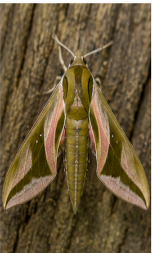
Pandorus Sphinx Moths (Eumorpha pandorus) are among the largest and most striking hawk moths found in North America. Belonging to the family Sphingidae, these impressive insects are famous for their beautiful camouflage, rapid flight, and important role as nighttime pollinators. Their olive-green, tan, and brown wing patterns closely resemble dead or mottled leaves, making them difficult to spot when resting during the day.
Although the caterpillars feed on grapevines, Virginia creeper, and related plants, the Pandorus Sphinx Moth rarely causes enough damage to justify pest control. In fact, this species is generally considered a beneficial part of woodland and garden ecosystems because adult moths pollinate numerous flowering plants while serving as an important food source for birds, bats, and other wildlife.
Overview
The Pandorus Sphinx Moth is one of several large sphinx moths commonly encountered throughout eastern North America. Adults are powerful nocturnal fliers capable of hovering while feeding, much like hummingbirds. Their long proboscis allows them to reach nectar deep within tubular flowers that many other insects cannot access.
Gardeners occasionally notice the large green caterpillars feeding on grape or Virginia creeper leaves. While heavy infestations may remove portions of foliage, healthy vines usually recover quickly without long-term injury.
Taxonomy and Classification
- Order: Lepidoptera
- Family: Sphingidae
- Genus: Eumorpha
- Species: Eumorpha pandorus
- Common Names: Pandorus Sphinx Moth, Pandorus Hawk Moth
Like all moths, the Pandorus Sphinx undergoes complete metamorphosis, progressing through egg, caterpillar, pupa, and adult stages.
Identification
The adult Pandorus Sphinx is unmistakable due to its size and camouflage coloration.
- Wingspan: Approximately 8–11 cm (3–4.5 inches).
- Color: Olive green, tan, cream, and brown.
- Pattern: Angular patches resembling dead leaves.
- Body: Thick, streamlined, and heavily scaled.
- Antennae: Thickened toward the tips.
- Flight: Fast, direct, and capable of hovering while feeding.
The camouflage allows adults to rest unnoticed on tree trunks, branches, or leaf litter during daylight hours.
Caterpillar Identification
The larval stage is large and colorful.
- Length: Up to 3 inches.
- Color: Bright green or orange-brown depending on age.
- Eyespots: Large false eye markings near the front of the body.
- Horn: Curved horn on the rear end typical of sphinx moth caterpillars.
- Body: Smooth with small white spots.
When threatened, caterpillars often rear their front body segments, making the eyespots appear larger to discourage predators.
Distribution and Habitat
Pandorus Sphinx Moths occur throughout much of eastern North America, extending from southern Canada through the eastern United States and into parts of Mexico.
They commonly inhabit:
- Deciduous forests
- Woodland edges
- Residential gardens
- Parks
- Vineyards
- Riparian corridors
- Suburban landscapes
Their distribution closely follows the availability of grapevines and other host plants.
Life Cycle
Females lay individual eggs on suitable host plants during late spring and summer.
After hatching, caterpillars feed heavily on foliage for several weeks before dropping to the ground to pupate beneath leaf litter or within shallow soil.
The pupal stage overwinters in cooler climates, with adults emerging the following spring. In warmer southern regions, two or more generations may occur each year.
Host Plants
Larvae feed primarily on members of the grape family (Vitaceae).
- Wild grape (Vitis spp.)
- Cultivated grapevines
- Virginia creeper
- Boston ivy
These host plants provide all of the nutrients necessary for caterpillar development.
Behavior and Ecology
Adult Pandorus Sphinx Moths are active after sunset and are frequently attracted to fragrant flowers rich in nectar.
Their hovering flight resembles that of hummingbirds, allowing them to feed efficiently without landing.
Adults visit numerous flowering plants, including:
- Petunias
- Phlox
- Evening primrose
- Honeysuckle
- Moonflowers
- Jimsonweed
During the day they remain hidden among vegetation, relying on camouflage for protection.
Damage and Pest Status
The Pandorus Sphinx is generally considered a minor pest.
Potential damage includes:
- Leaf feeding on grapevines.
- Defoliation of Virginia creeper.
- Occasional feeding on ornamental vines.
Even when caterpillars are numerous, established vines usually recover quickly. Significant economic damage is uncommon.
Integrated Pest Management (IPM)
Control is rarely necessary because the species provides ecological benefits and seldom threatens healthy plants.
Monitoring
- Inspect grape foliage for large hornworms.
- Look for feeding damage during summer.
Mechanical Control
- Hand-pick caterpillars from valuable ornamental vines.
- Relocate larvae when practical.
Biological Control
Numerous predators naturally regulate populations.
- Birds
- Parasitic wasps
- Predatory bugs
- Ground beetles
- Small mammals
Conserving beneficial insects helps maintain balanced populations.
Ecological Importance
Pandorus Sphinx Moths are valuable nighttime pollinators that support native flowering plants. Their caterpillars provide food for birds and beneficial insects, while adults contribute to pollination of numerous wildflowers and ornamental plants.
Because they rarely reach damaging numbers, they are generally viewed as beneficial members of healthy ecosystems.
Conservation and Research
Researchers study Pandorus Sphinx Moths to better understand nocturnal pollination, insect migration, camouflage evolution, and flight mechanics. Their hovering ability and efficient wing design continue to inspire research in aerodynamics and biomimicry.
Maintaining native habitats and reducing unnecessary insecticide use helps preserve healthy populations of these remarkable moths.
Conclusion
Pandorus Sphinx Moths (Eumorpha pandorus) are spectacular native hawk moths admired for their leaf-like camouflage, powerful flight, and important role as nighttime pollinators. Although their caterpillars occasionally feed on grapevines and related plants, they rarely cause significant damage and are best appreciated as beneficial members of North America’s natural ecosystems.