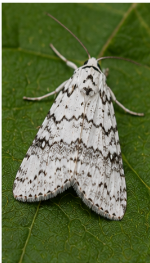
Pale Metarranthis (Metarranthis indeclinata) is a small native geometer moth found throughout eastern North America. Although it is rarely noticed by homeowners, this attractive woodland species plays an important ecological role as both a leaf-feeding caterpillar and a food source for birds, bats, spiders, and other wildlife. Like many members of the geometer moth family, the Pale Metarranthis relies on exceptional camouflage, allowing both the adult moth and its inchworm caterpillar to blend into tree bark, branches, and foliage.
Despite feeding on deciduous trees during its larval stage, the Pale Metarranthis is not considered an economic pest. Its populations are typically low, and healthy trees easily tolerate the limited feeding damage. Instead, the species is regarded as a beneficial component of native woodland ecosystems.
Overview
The Pale Metarranthis belongs to the family Geometridae, commonly known as the geometer moths. This family includes more than 23,000 species worldwide and is famous for its caterpillars, which move with a distinctive looping motion that has earned them the common names inchworms or loopers.
Adults are primarily nocturnal and may occasionally be attracted to porch lights or outdoor lighting near wooded areas. During daylight hours they rest quietly on tree trunks or branches, where their muted coloration provides excellent camouflage.
Taxonomy and Classification
- Order: Lepidoptera
- Family: Geometridae
- Subfamily: Ennominae
- Genus: Metarranthis
- Species: Metarranthis indeclinata
- Common Name: Pale Metarranthis
Like all butterflies and moths, Pale Metarranthis undergoes complete metamorphosis, progressing through egg, caterpillar, pupa, and adult stages.
Identification
The adult Pale Metarranthis is a relatively small moth with subtle markings that allow it to blend almost perfectly into tree bark.
- Wingspan: Approximately 20–30 mm.
- Color: Pale gray, tan, or light brown.
- Wing Pattern: Fine crossbands and delicate wavy lines.
- Body: Slender with fine scales.
- Antennae: Threadlike, slightly more feathery in males.
- Resting Position: Wings spread flat against the resting surface.
Because coloration varies slightly among individuals, the species may appear gray, cream, or light brown depending on age and environmental conditions.
Larval Identification
The caterpillar is a typical geometer larva, commonly referred to as an inchworm.
- Body: Long, slender, and twig-like.
- Color: Green, brown, or gray.
- Movement: Characteristic looping motion.
- Camouflage: Often resembles small twigs when resting.
When disturbed, the caterpillar frequently extends its body stiffly away from the branch, closely mimicking a small twig and avoiding detection by predators.
Distribution and Habitat
Pale Metarranthis occurs throughout much of eastern North America wherever suitable deciduous forests exist.
Common habitats include:
- Deciduous forests
- Mixed woodlands
- Forest edges
- Wooded parks
- Nature preserves
- Tree-lined suburban neighborhoods
- Riparian woodlands
The species is most commonly associated with mature hardwood forests containing diverse native tree species.
Life Cycle
Adult females deposit eggs on suitable host trees during the growing season. After hatching, young caterpillars begin feeding on fresh leaves.
The larvae pass through several molts before reaching full size. Mature caterpillars eventually descend to protected locations where they pupate among leaf litter, beneath loose bark, or within shallow soil.
Adult moths emerge during spring or early summer, depending on local climate. Most populations complete a single generation each year.
Host Plants and Feeding Habits
The caterpillars feed primarily on the leaves of deciduous hardwood trees.
Documented or suspected host plants include:
- Oak
- Maple
- Birch
- Beech
- Hickory
- Other native hardwood species
Larvae consume small amounts of leaf tissue, producing minor chewing damage that healthy trees readily tolerate.
Adult moths may visit flowers, tree sap, or other sugary food sources but generally feed very little during their relatively short lifespan.
Behavior and Ecology
Pale Metarranthis adults are active primarily after sunset. During the day they rely almost entirely on camouflage to avoid predators.
Their muted wing patterns closely resemble weathered bark, making them difficult to detect even at close range. Likewise, the inchworm larvae depend on twig mimicry rather than speed or chemical defenses.
Adults are occasionally attracted to outdoor lighting but do not establish infestations inside buildings.
Damage and Pest Status
The Pale Metarranthis is not considered a pest species.
Although caterpillars feed on tree foliage, populations remain relatively small and rarely produce noticeable defoliation. Feeding damage is usually limited to scattered holes or minor leaf-edge chewing.
The species does not damage:
- Homes
- Stored food
- Furniture
- Clothing
- Landscape structures
Healthy deciduous trees easily replace the small amount of foliage consumed each year.
Integrated Pest Management (IPM)
No management is typically necessary.
If individual caterpillars are found on ornamental trees, recommended practices include:
- Hand removal when practical.
- Maintaining healthy trees through proper irrigation.
- Encouraging birds and beneficial insects.
- Avoiding unnecessary pesticide applications.
Broad-spectrum insecticides are discouraged because they eliminate beneficial insects and natural predators while providing little benefit against this harmless native species.
Natural Predators
Numerous wildlife species feed on Pale Metarranthis throughout its life cycle.
- Songbirds
- Bats
- Spiders
- Ground beetles
- Parasitic wasps
- Predatory flies
- Small mammals
These predators naturally regulate populations and contribute to balanced woodland ecosystems.
Ecological Importance
Pale Metarranthis contributes to forest biodiversity by converting plant material into food for higher levels of the food web. Caterpillars provide an important protein source for nesting birds, while adults become prey for bats and nocturnal predators.
The species also serves as an indicator of healthy native forests containing diverse deciduous tree communities.
Conservation and Research
Researchers continue studying geometer moths to better understand camouflage, host-plant specialization, forest biodiversity, and the effects of habitat fragmentation and climate change on native insect populations.
Protecting mature forests, maintaining native hardwood diversity, and reducing unnecessary pesticide use help conserve Pale Metarranthis and countless other beneficial woodland insects.
Conclusion
Pale Metarranthis (Metarranthis indeclinata) is a well-camouflaged geometer moth that quietly inhabits eastern North American forests. Its inchworm caterpillars feed modestly on deciduous trees without causing significant damage, while adults contribute to healthy woodland ecosystems by serving as prey for numerous wildlife species.
Because it poses little risk to landscapes or agriculture, the Pale Metarranthis is best appreciated as a beneficial native moth rather than treated as a pest.
Related Articles
“`