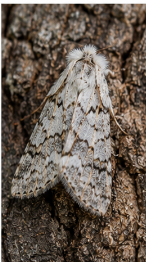
Pale Lichen Moths are a group of small, delicately colored moths belonging to the subfamily Arctiinae within the family Erebidae. Rather than referring to a single species, the common name is often applied to several pale-colored lichen moths that inhabit forests, woodlands, and other natural areas where lichens are abundant. Their muted gray, cream, or silvery-white coloration allows them to blend almost perfectly with lichen-covered tree bark and rocks, making them difficult for predators to detect.
Unlike many moth species that become agricultural, household, or structural pests, Pale Lichen Moths are considered beneficial native insects. Their caterpillars feed primarily on lichens, algae, and microscopic organic material growing on bark, rocks, and fallen logs rather than on healthy leaves, crops, or ornamental plants. As a result, they are not considered pest insects and require no control.
Overview
Pale Lichen Moths are members of a specialized group commonly called lichen moths. These insects have evolved to occupy a unique ecological niche by feeding on lichens instead of foliage. Because lichens grow slowly and are sensitive to pollution, many lichen moth species are associated with mature forests and relatively undisturbed habitats.
Adult moths are generally active during warm evenings and may occasionally be attracted to outdoor lights. During daylight hours they rest quietly on tree trunks, branches, rocks, or wooden fences where their coloration provides exceptional camouflage.
Taxonomy and Classification
- Order: Lepidoptera
- Family: Erebidae
- Subfamily: Arctiinae
- Tribe: Lithosiini (Lichen Moths)
- Common Name: Pale Lichen Moth
The tribe Lithosiini contains hundreds of species distributed throughout the world. Many closely related species share similar pale gray, cream, or white coloration, making precise identification difficult without examining wing patterns or microscopic characteristics.
Like all moths, Pale Lichen Moths undergo complete metamorphosis, progressing through egg, caterpillar, pupa, and adult stages.
Identification
Adult Pale Lichen Moths are small, slender moths with understated coloration that blends into their surroundings.
- Wingspan: Approximately 18–25 mm.
- Color: Pale gray, cream, white, or silvery.
- Wing Pattern: Fine gray lines, small dots, or subtle markings depending on the species.
- Body: Slender and lightly covered with scales.
- Antennae: Threadlike, sometimes slightly feathery in males.
- Resting Position: Wings folded roof-like over the body.
Their soft coloration allows them to blend remarkably well with lichen-covered bark, making them almost invisible unless disturbed.
Larval Identification
The caterpillars are typically darker than the adults and are often covered with short hairs.
- Body: Long and segmented.
- Color: Gray, brown, black, or mottled.
- Surface: Fine hairs or scattered bristles.
- Habitat: Found on bark, rocks, fallen logs, and branches supporting lichen growth.
The larvae are well camouflaged and may closely resemble patches of lichen or moss while feeding.
Distribution and Habitat
Pale Lichen Moths occur throughout many temperate regions wherever lichens are abundant. Their distribution depends largely upon the availability of mature trees and clean environmental conditions that support healthy lichen communities.
Common habitats include:
- Deciduous forests
- Mixed woodlands
- Conifer forests
- Woodland edges
- Parks
- Nature preserves
- Rock outcrops
- Tree-lined suburban landscapes
Because lichens are sensitive to severe air pollution, Pale Lichen Moths are often more common in cleaner environments with relatively undisturbed vegetation.
Life Cycle
Female moths lay eggs on or near surfaces supporting suitable lichen growth. After hatching, the young caterpillars begin feeding almost immediately.
The larvae pass through several molts while consuming lichens, algae, fungi, and associated organic material. Development may take several weeks or months depending on temperature, moisture, and food availability.
When fully grown, the caterpillars spin a small cocoon beneath loose bark, within leaf litter, or in another protected location where pupation occurs.
Adult moths emerge during the warmer months, mate, and begin the next generation. Most species produce one generation annually, although warmer climates may support additional generations.
Feeding Habits
Pale Lichen Moth caterpillars have highly specialized diets compared to most moth larvae.
Primary food sources include:
- Lichens growing on tree bark
- Lichens on rocks
- Algae
- Microscopic fungi
- Organic films on woody surfaces
Adults generally feed very little, although some species may obtain nectar or moisture from flowers, tree sap, or damp soil.
Behavior and Ecology
Pale Lichen Moths are primarily nocturnal. Adults spend daylight hours resting motionless against bark where their coloration provides excellent camouflage.
At night they fly in search of mates and suitable egg-laying sites. Like many moths, they may occasionally be attracted to porch lights or illuminated windows.
The caterpillars remain close to their food source and move slowly while grazing across lichen-covered surfaces.
Damage and Pest Status
Pale Lichen Moths are not considered pests.
The caterpillars feed almost exclusively on lichens rather than healthy leaves or economically important crops. They do not damage homes, clothing, furniture, stored foods, trees, or ornamental plants.
Adults occasionally enter homes after being attracted to lights but cannot establish indoor infestations.
Management and Prevention
No pest control measures are recommended or necessary.
If adults are found indoors, they can simply be captured and released outside.
To reduce accidental entry:
- Keep doors closed during evening hours.
- Maintain window screens.
- Reduce unnecessary outdoor lighting.
- Seal gaps around windows and doors.
Pesticide applications should be avoided because they provide no practical benefit and may harm beneficial insects, butterflies, and pollinators.
Natural Predators
Pale Lichen Moths provide food for numerous wildlife species.
- Birds
- Bats
- Spiders
- Ground beetles
- Predatory insects
- Parasitic wasps
- Small mammals
Their cryptic coloration significantly reduces predation but does not eliminate it entirely.
Ecological Importance
Pale Lichen Moths play an important ecological role by participating in nutrient cycling and serving as prey for many forest animals.
Because their larvae depend on healthy lichen communities, these moths are often regarded as indicators of relatively clean air and stable woodland ecosystems.
They contribute to biodiversity while causing no measurable economic damage.
Conservation and Research
Scientists continue studying lichen moths to better understand woodland ecology, camouflage, habitat specialization, and the effects of air pollution on insect populations.
Conservation efforts that preserve mature forests, reduce unnecessary pesticide use, and protect lichen-rich habitats benefit Pale Lichen Moths and many other native woodland species.
Conclusion
Pale Lichen Moths are beautiful native insects that thrive in forests and woodlands where lichens grow abundantly. Their caterpillars consume lichens rather than living plant tissue, making them harmless to gardens, landscapes, and agriculture.
Although they may occasionally be seen resting on trees or attracted to outdoor lights, Pale Lichen Moths should be appreciated as beneficial members of healthy woodland ecosystems rather than treated as pests.