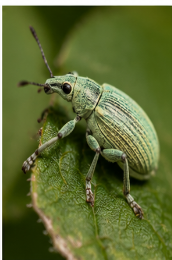
Pale Green Weevils are a group of small, plant-feeding beetles in the family Curculionidae. While “Pale Green Weevil” is not a single scientific species, the name is commonly applied to several green-colored weevils found in gardens, forests, orchards, and agricultural landscapes throughout North America, Europe, and other temperate regions. These beetles are recognized by their elongated snout, compact oval body, and metallic or pale green scales that help camouflage them among leaves and stems.
Most Pale Green Weevils are minor plant feeders that rarely cause significant damage. However, some closely related species can become agricultural or ornamental pests when populations increase, feeding on leaves, buds, flowers, stems, or developing fruit. Understanding their biology is an important part of effective integrated pest management (IPM).
Overview
Weevils represent one of the largest beetle families in the world, with more than 60,000 described species. Nearly all possess the distinctive elongated snout, or rostrum, used for feeding and egg-laying.
Pale Green Weevils are primarily herbivorous insects. Adults typically feed on foliage while larvae develop within soil, stems, roots, seeds, or other plant tissues depending on the species. Their attractive green coloration allows them to blend into surrounding vegetation, making them difficult for predators to detect.
Although most species are not considered serious pests, monitoring is recommended where valuable ornamental plants, fruit trees, vegetables, or nursery stock are being grown.
Taxonomy and Classification
- Order: Coleoptera
- Family: Curculionidae
- Common Group: Green Weevils
- Common Name: Pale Green Weevil
Numerous green-colored weevil species exist worldwide, including members of the genera Polydrusus, Phyllobius, and related groups. Many species are difficult to distinguish without microscopic examination because their scales, body shape, and coloration are quite similar.
Like all beetles, Pale Green Weevils undergo complete metamorphosis, progressing through egg, larva, pupa, and adult stages.
Identification
Adult Pale Green Weevils are relatively small beetles with a distinctive appearance.
- Length: Approximately 4–8 mm.
- Color: Pale green to metallic green, often produced by tiny overlapping scales.
- Body: Oval and compact.
- Snout: Elongated rostrum typical of all weevils.
- Antennae: Elbowed and attached to the snout.
- Legs: Six strong walking legs used for climbing vegetation.
As individuals age, the delicate scales may wear away, causing older beetles to appear brownish or gray instead of bright green.
Larval Identification
The larvae differ greatly from the adults and are rarely noticed unless soil or plant roots are examined.
- Body: Cream-colored and legless.
- Shape: Curved into a characteristic C-shape.
- Head: Light to dark brown head capsule.
- Habitat: Usually found feeding on roots or beneath the soil surface.
Because the larvae remain hidden underground, root damage may go unnoticed until plants begin showing signs of stress.
Distribution and Habitat
Pale Green Weevils occur throughout many temperate regions wherever suitable host plants are available.
Common habitats include:
- Home gardens
- Agricultural fields
- Orchards
- Woodlands
- Parks
- Shrub borders
- Nurseries
- Landscaped properties
Adults are most commonly observed during spring and early summer when fresh foliage is abundant.
Life Cycle
Most Pale Green Weevils complete one generation each year, although development varies among species and climates.
Adult females deposit eggs in soil, leaf litter, stems, or directly on host plants. After hatching, the larvae begin feeding on roots or other protected plant tissues.
As they mature, larvae pass through several growth stages before pupating in the soil or another sheltered location. Adults emerge during the growing season and begin feeding on leaves before reproducing.
In colder climates, adults or larvae often overwinter beneath leaf litter, bark, or in the soil.
Feeding Habits
Adult Pale Green Weevils primarily feed on foliage.
Typical feeding damage includes:
- Irregular notches along leaf edges.
- Small holes in leaves.
- Minor chewing damage on buds.
- Occasional feeding on flowers or developing fruit.
The larvae generally feed below ground on plant roots. Heavy infestations may reduce water and nutrient uptake, resulting in poor growth, wilting, or reduced vigor in young plants.
Behavior and Damage
Most Pale Green Weevils are slow-moving insects that spend much of the day resting on foliage or hiding beneath leaves.
Adults typically feed during cooler parts of the day or at night, reducing exposure to predators.
In gardens, damage is usually cosmetic and does not threaten healthy established plants. However, seedlings, nursery stock, and recently planted ornamentals may be more susceptible if large numbers of weevils are present.
Some related green weevil species can become localized pests in orchards and vineyards, making accurate identification important before management decisions are made.
Integrated Pest Management (IPM)
Most Pale Green Weevil infestations can be managed using environmentally responsible practices.
- Monitoring: Regularly inspect leaves for characteristic notching and adult beetles.
- Hand Removal: Pick adults from ornamental plants during evening hours.
- Encourage Natural Enemies: Birds, spiders, ground beetles, and parasitic wasps help suppress populations.
- Healthy Plants: Proper irrigation and fertilization improve plant tolerance to feeding.
- Sanitation: Remove heavily infested plant material and fallen debris where insects may overwinter.
- Biological Control: Beneficial nematodes may reduce soil-dwelling larvae of some species.
Chemical treatments are rarely necessary unless economically important crops experience severe infestations.
Natural Predators
Numerous natural enemies help regulate Pale Green Weevil populations.
- Ground beetles
- Birds
- Spiders
- Parasitic wasps
- Predatory bugs
- Small mammals
Maintaining diverse landscapes encourages these beneficial organisms and often eliminates the need for pesticide applications.
Ecological Importance
Although some weevils damage crops, many species play valuable ecological roles. They participate in nutrient cycling, serve as prey for wildlife, and contribute to natural food webs.
Most Pale Green Weevils occur at low population levels where their feeding has little measurable impact on healthy vegetation.
Conservation and Research
Scientists continue studying green weevils to improve species identification, understand host-plant relationships, and develop sustainable biological control methods for economically important species.
Current research emphasizes integrated pest management, reduced pesticide use, conservation of beneficial insects, and improved monitoring techniques for nursery and agricultural production.
Conclusion
Pale Green Weevils are attractive plant-feeding beetles recognized by their green scales, elongated snout, and characteristic leaf-feeding habits. While some related species may occasionally damage ornamental plants or crops, most are minor pests that cause only cosmetic injury.
Routine monitoring, conservation of natural predators, and integrated pest management practices are usually sufficient to maintain healthy plantings without unnecessary pesticide applications.