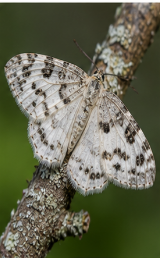
The Pale Enargia Moth (Enargia decolor) is a medium-sized nocturnal moth associated primarily with northern forests, mixed woodlands, and areas containing poplar, willow, birch, and alder trees. Its pale brown, tan, and gray wing patterns provide effective camouflage against tree bark, fallen leaves, and weathered wood.
Although its caterpillars feed on deciduous trees, the Pale Enargia Moth is not normally considered a serious forest, landscape, or agricultural pest. Its feeding is generally scattered, and healthy trees can tolerate the small amount of foliage removed by individual larvae.
Overview
The Pale Enargia belongs to the family Noctuidae, a large group commonly known as owlet moths. Many noctuid moths are active at night and possess muted wing patterns that allow them to remain hidden during daylight hours.
The species is most frequently encountered in forested regions where its larval host trees are abundant. Adults may rest on bark during the day and become active after sunset, when they fly in search of mates and suitable locations for egg laying.
Adult moths are sometimes attracted to porch lights, illuminated walls, and moth-observation lights. Their appearance around a building does not indicate an indoor infestation.
Taxonomy and Classification
- Order: Lepidoptera
- Family: Noctuidae
- Genus: Enargia
- Species: Enargia decolor
- Common Name: Pale Enargia
The Pale Enargia should not be confused with Enargia paleacea, a related Eurasian moth commonly called the Angle-striped Sallow. Older records and similar appearances among members of the genus can occasionally create confusion during identification.
Like other moths and butterflies, the Pale Enargia undergoes complete metamorphosis, developing through egg, caterpillar, pupa, and adult stages.
Identification
Adult Pale Enargia Moths have broad forewings marked with subtle lines and patches that resemble bark or dried vegetation. Their coloration varies among individuals, but most are pale gray, tan, brown, or slightly reddish-brown.
- Wingspan: Generally around 30–40 mm, although size may vary.
- Forewings: Pale tan, gray-brown, or reddish-brown with fine wavy crosslines.
- Hindwings: Usually lighter and less heavily patterned than the forewings.
- Body: Moderately robust and covered with fine scales.
- Antennae: Slender and threadlike.
- Resting Position: Wings held roof-like or slightly flattened over the body.
The understated pattern makes the moth difficult to see when it rests on bark. Close examination may be required to distinguish it from related sallow and noctuid moths.
Larval Identification
Pale Enargia caterpillars are less frequently seen than the adults. They are generally smooth-bodied and colored to blend with foliage, stems, or bark.
- Body: Elongated and segmented.
- Color: Green, brown, gray, or a combination of these shades.
- Markings: Fine lines or patches may run along the body.
- Behavior: Caterpillars feed on leaves and may rest along stems during the day.
The larvae lack the dense hairs found on tiger moth caterpillars and do not possess medically significant spines.
Distribution and Habitat
Pale Enargia Moths occur in northern portions of North America. They are particularly associated with boreal, mixed, and northern deciduous forests.
Typical habitats include:
- Boreal forests
- Mixed conifer and deciduous forests
- Aspen and poplar stands
- Willow thickets
- Woodland edges
- Forest clearings
- Parks containing mature deciduous trees
- Tree-lined suburban landscapes
The species is most likely to occur where suitable host trees grow naturally or have been planted in landscapes.
Host Plants
The caterpillars feed primarily on the leaves of deciduous trees and shrubs. Important host groups include:
- Poplar and aspen trees
- Willows
- Birches
- Alders
Poplar and aspen appear to be especially important hosts. Larval feeding typically creates irregular holes or missing areas along leaf margins.
Life Cycle
The life cycle begins when females lay eggs on or near suitable host trees. After hatching, the caterpillars feed on foliage and pass through several growth stages, shedding their outer skin as they increase in size.
Mature larvae eventually leave the feeding area and pupate in a protected location. Pupation may occur among leaf litter, in shallow soil, beneath bark, or within another sheltered space near the host tree.
Adults emerge during the warmer portion of the year. Most populations are believed to produce one generation annually, although development and flight periods vary according to latitude, elevation, and seasonal temperature.
Behavior and Ecology
Adult Pale Enargia Moths are primarily nocturnal. During the day, they remain motionless on bark, branches, leaves, or other protected surfaces. Their muted colors help conceal them from birds and other visual predators.
After sunset, adults fly in search of mates and host trees. Like many noctuid moths, they may visit sugary substances, flower nectar, fermenting fruit, or tree sap for energy.
Artificial lights can attract adults away from their normal habitat. A moth resting near a doorway or porch can be gently moved outside if necessary.
Damage and Pest Status
The Pale Enargia Moth is not considered a significant pest. Caterpillars feed on leaves, but populations rarely become dense enough to cause serious defoliation.
Possible signs of feeding include:
- Small irregular holes in leaves
- Chewed leaf margins
- Minor scattered foliage loss
- Occasional caterpillars on host trees
Healthy, established trees normally replace the limited leaf tissue consumed. The moth does not infest stored food, clothing, carpets, structural wood, or household materials.
Management and Prevention
No treatment is normally required. The moth is a native forest insect that contributes to local biodiversity and food webs.
If caterpillars are found on a small ornamental tree, practical options include:
- Removing individual caterpillars by hand
- Pruning only heavily affected leaves or twigs
- Maintaining proper watering and tree health
- Allowing birds and beneficial insects to provide natural control
Broad-spectrum insecticides are not recommended for isolated feeding because they can kill pollinators, predators, parasitoids, and other beneficial insects.
To reduce adult moths around buildings, repair window screens, keep doors closed at night, and limit unnecessary exterior lighting. Warm-colored bulbs are generally less attractive to many nocturnal insects than bright white or ultraviolet-rich lights.
Natural Predators
Pale Enargia Moths and their caterpillars provide food for numerous forest animals, including:
- Insect-eating birds
- Bats
- Spiders
- Predatory beetles
- Parasitic wasps
- Parasitic flies
- Small mammals
These natural enemies usually prevent populations from increasing to damaging levels.
Ecological Importance
The Pale Enargia Moth contributes to forest food webs as both an herbivore and a prey species. Caterpillars transfer energy from trees to birds, parasitoids, and predatory insects, while adults provide food for bats and nocturnal predators.
Minor feeding is part of the normal ecological relationship between native moths and woodland plants. The presence of the species generally reflects the availability of suitable host trees rather than unhealthy forest conditions.
Conservation and Research
Research on Enargia moths focuses on species identification, geographic distribution, host-plant relationships, forest ecology, and the evolutionary separation of closely related species.
Maintaining diverse native forests, preserving aspen and willow stands, limiting unnecessary pesticide use, and reducing excessive nighttime lighting can help support this moth and other native nocturnal insects.
Conclusion
The Pale Enargia Moth (Enargia decolor) is a well-camouflaged noctuid moth associated with northern forests and deciduous host trees such as poplar, aspen, willow, birch, and alder.
Although its caterpillars consume leaves, feeding is normally minor and does not justify pest control. The species is a natural part of woodland ecosystems and serves as an important food source for birds, bats, spiders, and beneficial parasitic insects.