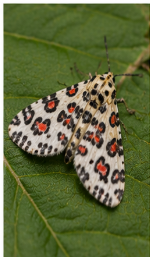
Painted Lichen Moths (Hypoprepia fucosa) are small, brightly colored moths native to North America. They are best known for their attractive pink, red, orange, and yellow wing patterns and their close association with lichens growing on tree bark, rocks, fallen logs, and other surfaces in wooded habitats.
Unlike many moth larvae that feed on leaves, crops, fabrics, or stored foods, Painted Lichen Moth caterpillars primarily consume lichens and related organic material. As a result, this species is not considered a household, agricultural, or structural pest. It is generally viewed as a harmless and beneficial part of forest and woodland ecosystems.
Overview
The Painted Lichen Moth belongs to a group commonly known as lichen moths or footman moths. These insects are associated with environments where lichens, algae, and microscopic organic growth are abundant. The larvae often move slowly across bark and rocks while feeding on the thin layers of material growing on these surfaces.
Adult Painted Lichen Moths are usually active during the warmer months. They may be seen resting on leaves, tree trunks, siding, fences, or outdoor structures during the day and are sometimes attracted to lights at night.
Their bright coloration may appear similar to warning patterns found in some toxic or unpalatable insects. Scientists believe the colors may help discourage predators, although the exact effectiveness of this defense can vary.
Taxonomy and Classification
- Order: Lepidoptera
- Family: Erebidae
- Subfamily: Arctiinae
- Tribe: Lithosiini
- Genus: Hypoprepia
- Species: Hypoprepia fucosa
- Common Name: Painted Lichen Moth
Painted Lichen Moths are related to tiger moths and other members of the subfamily Arctiinae. Like other moths and butterflies, they undergo complete metamorphosis, developing through egg, larval, pupal, and adult stages.
Identification
Adult Painted Lichen Moths are small, slender insects with narrow wings and vivid coloration. Their bright pattern distinguishes them from most gray or brown moths commonly found around homes and wooded areas.
- Wingspan: Approximately 22–30 mm, or about 7/8 to 1 1/4 inches.
- Forewings: Pink, reddish, or rose-colored with broad yellow or orange markings.
- Hindwings: Usually pale yellow, orange, or pinkish.
- Body: Slender and covered with colored scales.
- Antennae: Fine and threadlike.
- Resting Position: Wings are often folded closely over the body.
The exact shade of the wings can vary between individuals. Some appear more pink and yellow, while others have deeper red or orange tones.
Larval Identification
The caterpillars are much less colorful than the adults. They are usually grayish, brownish, or dark-colored and covered with short hairs.
Larvae may be difficult to notice because they blend into bark, lichens, rocks, and decaying wood. Their camouflage helps protect them while they feed in exposed locations.
- Body: Narrow and segmented.
- Color: Gray, brown, blackish, or mottled.
- Surface: Covered with short hairs or bristles.
- Location: Commonly found on lichen-covered bark, stones, or logs.
Distribution and Habitat
Painted Lichen Moths occur across much of eastern and central North America. Their range extends from southern Canada through many parts of the United States.
They are most often associated with habitats that support abundant lichen growth, including:
- Deciduous forests
- Mixed woodlands
- Forest edges
- Parks
- Shaded suburban landscapes
- Wooded gardens
- Rocky areas with lichens
- Old fences and fallen logs
Moist, shaded environments often support the largest variety of lichens, although the moth can also be found in relatively dry woodlands where suitable food is present.
Life Cycle
The life cycle begins when females lay eggs on or near surfaces containing lichens. After hatching, the young caterpillars begin feeding on lichen, algae, fungi, and other microscopic organic material.
The larvae grow through several stages, shedding their outer skin as they increase in size. Because their food is relatively low in nutrients, development may be slower than that of caterpillars feeding on fresh leaves.
When fully grown, the caterpillar forms a small cocoon or protected pupal structure. The adult moth later emerges, mates, and begins the next generation.
Depending on climate, the species may complete one or more generations each year. In colder regions, it may overwinter as a larva or pupa.
Feeding Behavior
Painted Lichen Moth caterpillars feed primarily on lichens, which are complex organisms formed through a partnership between fungi and algae or cyanobacteria. They may also consume algae, moss fragments, fungi, and organic debris growing on bark and rock surfaces.
This feeding behavior is unusual among caterpillars and allows lichen moths to occupy habitats that many other moth species cannot use.
Adults do not damage trees, buildings, clothing, or stored foods. They may drink nectar or other liquids, although they are not considered major pollinators.
Behavior and Ecology
Adult Painted Lichen Moths may be active during both the day and night. Their bright coloration is easier to see than the camouflage patterns of many nocturnal moths.
At night, adults may be attracted to porch lights, security lights, windows, and illuminated walls. Finding one near a building does not mean the structure is infested. The moth has usually flown in from nearby vegetation.
The larvae contribute to the breakdown and recycling of organic material on tree bark, rocks, and logs. Their feeding may influence small lichen communities without causing meaningful damage to healthy trees.
Predators and Defenses
Painted Lichen Moths may be eaten by birds, bats, spiders, predatory insects, and small mammals. Their colorful wings may function as warning coloration, also known as aposematic coloration.
Some lichen-feeding moths may obtain defensive chemicals from their food. These compounds can make the insects less attractive or less palatable to predators. The degree to which Painted Lichen Moths use this type of defense continues to be studied.
The larvae rely more heavily on camouflage, remaining difficult to see against lichen-covered surfaces.
Damage and Pest Status
Painted Lichen Moths are not considered pests. They do not consume wood, structural materials, clothing, carpets, stored food, or healthy plant foliage.
The caterpillars feed on surface-growing lichens and microscopic organic matter. This feeding does not normally harm mature trees because lichens grow on the bark surface and do not take nutrients from the tree itself.
Adults may occasionally enter homes through open doors or windows, but they cannot reproduce indoors without suitable outdoor habitat and food for their larvae.
Management and Prevention
No control measures are normally required. A Painted Lichen Moth found indoors can be captured gently and released outside.
To reduce accidental entry:
- Repair damaged window and door screens.
- Keep doors closed during periods of moth activity.
- Use curtains or blinds near bright indoor lights.
- Replace unnecessary exterior lighting with less attractive lighting options.
- Seal gaps around windows, doors, and utility openings.
Pesticide applications are unnecessary and may harm beneficial moths, pollinators, and other non-target insects.
Ecological Importance
Painted Lichen Moths are part of the natural food web in forests and woodlands. Their larvae consume lichens and organic material, while both larvae and adults provide food for predators.
The presence of lichen moths can indicate that an area supports mature trees, relatively stable bark surfaces, and diverse lichen communities. However, their presence alone should not be used as a complete measure of environmental quality.
Conservation and Research
Researchers study lichen moths to better understand insect evolution, chemical defenses, forest biodiversity, and relationships between caterpillars and lichens.
Changes in air quality, forest structure, humidity, and lichen availability may influence local populations. Protecting wooded habitats, reducing unnecessary pesticide use, and maintaining mature trees can support Painted Lichen Moths and other native insects.
Conclusion
Painted Lichen Moths (Hypoprepia fucosa) are colorful, harmless moths associated with lichen-rich forests, parks, and suburban woodlands. Their caterpillars feed primarily on lichens growing on bark, rocks, and fallen wood, while the adults are recognized by their vivid pink, red, yellow, and orange wings.
They do not damage trees, homes, clothing, or stored products and require no pest control. In most situations, they should be appreciated as native members of healthy woodland ecosystems.