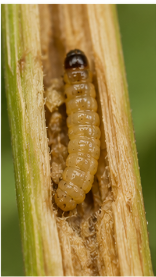
Paddy Stem Borers, also known as Rice Stem Borers, are a group of moth pests whose larvae tunnel into the stems and tillers of rice plants. They are among the most destructive insect pests of rice in Asia and other major rice-growing regions because their feeding interrupts the movement of water and nutrients inside the plant.
Several species are included under the name Paddy Stem Borers. Two of the most important are the Yellow Stem Borer (Scirpophaga incertulas) and the Striped Stem Borer (Chilo suppressalis). Other regional species may also attack rice, sugarcane, maize, and related grasses.
The larvae are responsible for the damage. After hatching from eggs laid on rice leaves, they move to the base of a tiller and bore into the stem. Once inside, they are protected from many predators and surface-applied insecticides. Their internal feeding causes two classic symptoms known as dead heart and white head.
Overview
Paddy Stem Borers are especially damaging because they attack the central tissues that allow rice plants to grow and produce grain. Early-season infestations may kill the central shoot of a young tiller, while later infestations can prevent developing grain heads from filling properly.
A rice plant may compensate for limited early damage by producing additional tillers. However, severe or repeated infestations can reduce plant density, delay maturity, and lower the number of productive panicles. Damage during panicle development is often more serious because affected heads may remain completely empty.
Stem borers can complete several generations during a rice-growing season. Warm temperatures, continuous rice cultivation, leftover stubble, and nearby grass hosts allow populations to survive and increase from one planting to the next.
Taxonomy and Classification
Paddy Stem Borers belong to the order Lepidoptera, which includes moths and butterflies. Important rice stem borer species are found mainly in the families Crambidae and Pyralidae.
- Order: Lepidoptera
- Important Families: Crambidae and Pyralidae
- Yellow Stem Borer: Scirpophaga incertulas
- Striped Stem Borer: Chilo suppressalis
- Common Names: Paddy Stem Borers and Rice Stem Borers
These insects undergo complete metamorphosis, developing through egg, larval, pupal, and adult stages. The adult moths do not cause crop damage. Their primary role is mating, dispersal, and egg laying. The caterpillars are the destructive stage.
Identification
Adult stem borer moths are generally small, slender, and pale in color. Their appearance varies among species.
- Yellow Stem Borer Adult: Pale yellow, straw-colored, or cream. Females often have a distinct black spot on each forewing and a tuft of yellowish or brown hairs at the tip of the abdomen.
- Striped Stem Borer Adult: Pale brown or straw-colored with darker longitudinal lines or streaks on the wings.
- Egg Masses: Usually flat or slightly raised and laid on rice leaves. Yellow Stem Borer egg masses are often covered with hairs or scales from the female’s abdomen.
- Larvae: Creamy white, pale yellow, or light brown caterpillars with darker head capsules.
- Striped Larvae: Some species have visible longitudinal stripes or rows of spots.
- Pupae: Brown and commonly formed inside the rice stem or in plant residue.
Mature larvae may approach one inch long, although size depends on species and developmental stage. Because they remain hidden inside stems, field identification often depends more on plant symptoms than on seeing the insects themselves.
Distribution and Habitat
Paddy Stem Borers occur in many tropical, subtropical, and temperate rice-growing areas. They are especially important across South Asia, Southeast Asia, East Asia, parts of Africa, Australia, and other regions where irrigated or rain-fed rice is cultivated.
Their main habitat is the rice plant itself. Eggs are laid on leaves, larvae feed inside stems and tillers, and pupae often remain concealed within damaged plant tissue. Adults rest on rice foliage, weeds, grasses, or nearby vegetation during the day and become more active after sunset.
Continuous rice production can create ideal conditions because host plants remain available for long periods. Larvae may also survive in rice stubble, volunteer rice, ratoon crops, and related grasses between planting cycles.
Host Plants
Rice is the most important host, but some stem borer species may also develop on other grasses and cereal crops.
- Rice
- Wild rice relatives
- Sugarcane
- Maize
- Millet
- Sorghum
- Reeds and wetland grasses
- Volunteer rice and ratoon growth
The host range varies by species. Yellow Stem Borers are strongly associated with rice, while some Chilo species can use a broader range of cultivated and wild grasses.
Life Cycle
The life cycle begins when female moths lay clusters of eggs on rice leaves. Egg masses may contain dozens or hundreds of eggs depending on the species and female size.
After hatching, the young larvae may remain together briefly before dispersing. They crawl down the leaf or may use silk threads to move between plants. The larvae then bore into the leaf sheath or stem near a node.
Once inside, they tunnel through the central tissues and feed upward or downward. The larval stage may last several weeks. During this time, one caterpillar may move between nearby tillers, especially when the first stem becomes unsuitable.
Mature larvae often pupate inside the stem. Before pupating, they may prepare a thin exit window in the outer plant tissue. The adult moth later pushes through this weakened area and emerges.
Depending on climate and crop availability, Paddy Stem Borers may complete three to six generations in a year. In warm areas with continuous rice cultivation, reproduction may occur almost year-round.
Behavior and Feeding
Adult moths are primarily nocturnal. They fly, mate, and lay eggs during the evening and nighttime hours. Lights may attract some species, but pheromone traps are generally more specific for monitoring.
Young larvae are the most exposed and vulnerable stage. Once they enter the rice stem, they become difficult to reach. Inside the plant, the caterpillar feeds on the pith and vascular tissues that carry water, carbohydrates, and nutrients.
The position of feeding determines the type of symptom. Damage to young vegetative tillers creates dead hearts, while damage near the reproductive stage creates white heads.
Damage and Problems
Paddy Stem Borer damage can occur from seedling establishment through grain filling. The severity depends on plant age, pest density, rice variety, growing conditions, and the generation involved.
Dead Heart
Dead heart occurs when a larva feeds inside a young rice tiller and destroys the central growing shoot. The youngest central leaf wilts, turns yellow or brown, and can often be pulled out easily.
The surrounding outer leaves may remain green for a period, making the dead central shoot stand out. The damaged tiller may die or produce little useful growth.
White Head
White head, also called white ear or white panicle, occurs when feeding severs the stem after the rice panicle has formed. The panicle emerges but appears pale, white, or straw-colored because nutrients cannot reach the developing grains.
The grains remain empty or poorly filled. Affected panicles may stand upright while healthy, grain-filled panicles bend under their weight.
Reduced Tillering
Severe early infestations can reduce the number of productive tillers. Although rice plants may compensate by producing new shoots, repeated injury can delay crop development and lower yield.
Weak Stems and Lodging
Internal tunneling weakens stems and may make them more likely to break or lodge. Lodged plants are difficult to harvest and may suffer additional disease or grain-quality problems.
Yield Loss
White heads represent nearly complete grain loss from each affected tiller. At high infestation levels, field-wide yield losses can be severe. Early dead-heart injury can also reduce final productivity when plants are unable to replace destroyed tillers.
Inspection and Monitoring
Regular field inspection is essential because control measures are most effective before larvae enter the stems.
- Inspect leaves for egg masses.
- Look for dead hearts during vegetative growth.
- Check for white heads during panicle emergence and grain filling.
- Split damaged stems to search for larvae, frass, and feeding tunnels.
- Use pheromone traps to monitor adult male moth activity.
- Record the number of damaged tillers or panicles in sample areas.
Light traps may also detect moth activity, but they can attract many non-target insects. Pheromone traps provide more species-specific information when suitable lures are available.
Management and Control
Paddy Stem Borer management requires an integrated pest management approach. Prevention, crop sanitation, biological control, resistant varieties, and correctly timed treatments are more effective than relying on repeated insecticide applications.
Stubble Management
Rice stubble can contain larvae or pupae after harvest. Plowing, flooding, grazing, chopping, or otherwise destroying crop residue can reduce the number of borers that survive between seasons.
Stubble management is most effective when neighboring growers coordinate their actions. Untreated fields can serve as sources of moths that move into newly planted rice.
Synchronized Planting
Planting rice over a shorter, coordinated period can reduce the continuous availability of suitable host stages. Widely staggered planting dates allow stem borers to move from older fields into younger ones throughout the season.
Planting Time
Adjusting planting dates may help crops avoid peak moth flights. Local pest records, pheromone trap data, rainfall, irrigation schedules, and regional recommendations should guide timing decisions.
Removal of Alternate Hosts
Volunteer rice, ratoon plants, and grassy weeds can support stem borer populations between crops. Managing these hosts around fields, canals, and bunds can reduce carryover.
Balanced Fertilization
Excessive nitrogen can produce lush, tender growth that may be more attractive or suitable for stem borers. Fertilizer should be applied according to crop needs rather than at unnecessarily high rates.
Water Management
Water management may influence larval survival and movement. In some systems, temporary drainage or carefully timed flooding can suppress certain stages. The response varies by species, crop stage, and local production method.
Resistant Rice Varieties
Planting resistant or tolerant varieties is one of the most sustainable control methods. Resistant plants may have tougher stems, chemical defenses, or growth characteristics that reduce larval survival and damage.
Resistance is rarely complete, so resistant varieties should still be combined with monitoring and cultural controls.
Biological Control
Many natural enemies attack Paddy Stem Borers. These organisms can significantly reduce egg and larval survival when broad-spectrum insecticides are minimized.
- Egg Parasitoids: Tiny wasps such as Trichogramma species attack stem borer eggs.
- Larval Parasitoids: Several wasps and flies develop in or on stem borer larvae.
- Predators: Spiders, dragonflies, predatory bugs, beetles, and ants consume exposed eggs or young larvae.
- Birds: Some birds feed on moths and larvae exposed during field operations.
- Pathogens: Fungi, bacteria, and viruses may infect caterpillars under favorable conditions.
Releases of Trichogramma wasps are used in some rice-growing regions. Success depends on correct species selection, timing, release rate, and field conditions.
Pheromone Trapping
Pheromone traps attract male moths and help determine when adult flights begin. Trap catches can guide field scouting and treatment timing.
Monitoring traps are usually more valuable for prediction than for direct population reduction. In some situations, mass trapping or mating disruption may contribute to management, but these approaches require suitable trap density and coordinated use across a large area.
Chemical Control
Insecticides are most effective against eggs or newly hatched larvae before they bore into the stems. Once the larvae are inside, contact sprays provide limited control.
Systemic or translaminar products may reach some internal feeders, but applications should be based on economic thresholds, monitoring, and local recommendations. Repeated calendar spraying can increase costs, kill natural enemies, contaminate water, and promote insecticide resistance.
Paddy fields support fish, frogs, aquatic insects, birds, and other wildlife. Pesticide selection and application must therefore consider the sensitivity of the surrounding aquatic ecosystem.
Prevention
Preventive management begins after harvest and continues through the next planting. Destroy infested stubble, control volunteer rice and grass hosts, coordinate planting dates, use resistant varieties, and install pheromone traps before expected moth flights.
Farmers should inspect nurseries and transplanted seedlings for egg masses or early damage. Moving infested seedlings can spread larvae into new fields.
Accurate records of planting date, trap catches, weather, dead-heart levels, white-head levels, and treatment results can improve management in future seasons.
Conservation and Research
Paddy Stem Borers are major subjects of agricultural research because rice is a staple food for billions of people. Even moderate reductions in borer damage can improve food security and farm income.
Research focuses on resistant rice varieties, improved pheromone systems, biological control, pest-resistant transgenic crops, gene-editing technologies, and better economic thresholds. Scientists also study how climate change may affect moth migration, generation number, and seasonal outbreaks.
Another important area is the conservation of parasitoids and predators within rice ecosystems. Reduced-risk insecticides and habitat management may allow farmers to suppress stem borers without eliminating beneficial species.
Conclusion
Paddy Stem Borers are destructive moth pests whose larvae tunnel inside rice stems and disrupt the movement of water and nutrients. Important species include the Yellow Stem Borer (Scirpophaga incertulas) and Striped Stem Borer (Chilo suppressalis).
Early feeding causes dead hearts, while later feeding causes white heads with empty or poorly filled grain. Because the larvae are protected once they enter the stem, prevention and early intervention are essential. Stubble destruction, synchronized planting, resistant varieties, biological control, pheromone monitoring, and carefully timed insecticides provide the most effective long-term management.