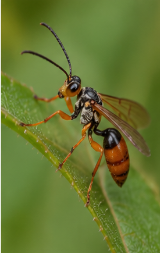
Parasitic Wasps, also known as parasitoid wasps, are a large and ecologically important group of insects that develop by feeding on or inside another arthropod host. Unlike social wasps that defend nests and may sting people, most parasitic wasps are tiny, solitary, and harmless to humans. They are among the most valuable natural enemies of agricultural, garden, greenhouse, and forest pests.
A female parasitic wasp locates a suitable host, such as an insect egg, caterpillar, aphid, beetle larva, pupa, or scale insect. She deposits one or more eggs on or inside the host. The developing wasp larva then feeds on the host and eventually kills it. This relationship distinguishes a parasitoid from a true parasite, which usually does not kill its host.
Overview
Parasitic Wasps play a major role in keeping insect populations under control. Many species are highly specialized and attack only one pest species or a narrow group of related hosts. Others can develop in several kinds of caterpillars, flies, beetles, aphids, or scale insects.
Because they naturally reduce pest populations, parasitic wasps are widely used in biological pest control. Commercial growers may release them in greenhouses, orchards, vegetable fields, nurseries, and indoor production systems. Native parasitoids also provide free pest suppression in gardens and natural habitats.
Taxonomy and Classification
Parasitic Wasps belong to the order Hymenoptera, which also includes ants, bees, and social wasps. They occur in many families, including:
- Ichneumonidae: Often attack caterpillars, beetle larvae, and other concealed hosts.
- Braconidae: Common parasitoids of aphids, caterpillars, beetles, and flies.
- Chalcididae and Related Families: Usually small, often metallic, and associated with eggs, larvae, or pupae.
- Mymaridae: Extremely tiny egg parasitoids sometimes called fairy wasps.
- Trichogrammatidae: Minute wasps widely used against moth and butterfly eggs.
They undergo complete metamorphosis, developing through egg, larval, pupal, and adult stages. More than 100,000 species have been described, and many more remain undiscovered.
Identification
Parasitic Wasps vary greatly in size and appearance. Some are smaller than one millimeter, while large ichneumon wasps may be several inches long when the ovipositor is included.
- Color: Black, brown, orange, yellow, or metallic green and blue.
- Body Shape: Usually slender, with a narrow waist and delicate wings.
- Ovipositor: Females possess a specialized egg-laying structure used to place eggs in or near a host.
- Antennae: Often long and threadlike.
- Behavior: Adults may walk over leaves, bark, stems, or soil while searching for hosts.
A long ovipositor may look threatening, but in most species it is not used to sting people. It is designed for reaching hosts hidden inside wood, stems, fruit, or other protected locations.
Distribution and Habitat
Parasitic Wasps are found in nearly every terrestrial habitat where suitable hosts occur. They live in forests, grasslands, wetlands, gardens, crop fields, orchards, greenhouses, woodlands, and urban landscapes.
Their distribution is closely tied to the insects they attack. A parasitoid of aphids may be found on vegetable crops and ornamentals, while a species that attacks wood-boring beetles may be associated with forests, logs, or damaged trees.
Life Cycle and Parasitism
The female locates hosts by using sight, movement, plant odors, host waste, feeding damage, and chemical signals called kairomones. Once a suitable host is found, she may sting or temporarily paralyze it before laying an egg.
Endoparasitoids
Endoparasitoids develop inside the host. The larva feeds internally and may allow the host to continue moving and feeding for part of its development. Aphid parasitoids are a familiar example. A parasitized aphid eventually becomes a swollen, brown or gold-colored mummy.
Ectoparasitoids
Ectoparasitoids develop on the outside of the host. They are common on concealed insects such as beetle larvae living under bark, in soil, or inside plant stems.
Egg Parasitoids
Egg parasitoids lay their eggs inside pest eggs. The developing wasp kills the host before the pest larva hatches. Species of Trichogramma are widely used against moth eggs.
Ecological and Economic Importance
Parasitic Wasps help regulate populations of aphids, whiteflies, mealybugs, scale insects, leafminers, caterpillars, flies, beetles, and many other pests. Their benefits include:
- Natural Pest Suppression: They reduce pest populations without leaving chemical residues.
- Host Specificity: Many species attack only a narrow range of hosts.
- Reduced Pesticide Use: Effective parasitoids can lower the need for repeated insecticide applications.
- Self-Sustaining Control: Some populations reproduce and remain active as long as suitable hosts are available.
Important commercially used species include Encarsia formosa for whiteflies, Aphidius species for aphids, and Trichogramma species for caterpillar eggs.
Management and Conservation
Parasitic Wasps are beneficial, so management usually focuses on protecting and encouraging them rather than eliminating them.
Reduce Broad-Spectrum Insecticides
Broad-spectrum pesticides can kill parasitoids along with the target pests. Selective products, spot treatments, insecticidal soaps, oils, and correctly timed applications are generally less disruptive.
Provide Flowering Plants
Adult parasitic wasps often feed on nectar, pollen, or honeydew. Small, open flowers are especially useful because many species have short mouthparts.
- Dill
- Fennel
- Yarrow
- Sweet alyssum
- Cilantro
- Parsley
- Queen Anne’s lace
Maintain Habitat
Flowering field borders, hedgerows, native plants, and reduced mowing can provide food and shelter. Avoid removing every aphid or caterpillar immediately, since a low pest population may help maintain beneficial wasps.
Commercial Releases
Purchased parasitoids are commonly released in greenhouses and controlled growing environments. Success depends on correct species identification, release timing, temperature, humidity, pesticide compatibility, and the presence of suitable host stages.
Human Safety
Most Parasitic Wasps are non-aggressive and too small to sting people effectively. Even large species usually attempt to escape rather than defend themselves. They do not build large defensive nests, infest food, or damage buildings.
Their presence on plants is generally a positive sign that natural pest control is taking place.
Conservation and Research
Research focuses on host-finding behavior, parasitoid genetics, mass rearing, pesticide compatibility, climate tolerance, and improved release methods. Scientists also study how plant diversity and agricultural practices influence parasitoid survival.
Accurate species identification is important because closely related wasps may attack very different hosts. Better identification methods continue to improve biological control programs worldwide.
Conclusion
Parasitic Wasps are highly beneficial insects that kill pest eggs, larvae, pupae, or adults during their development. They play a critical role in natural ecosystems and are widely used in agriculture and greenhouse production.
Reducing broad-spectrum pesticide use, planting nectar-producing flowers, maintaining habitat, and releasing suitable commercial species can help increase their effectiveness. In most situations, Parasitic Wasps should be protected rather than controlled.