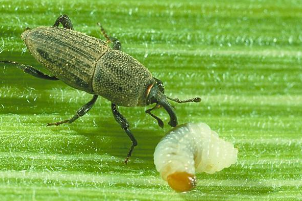
Kentucky Bluegrass Billbugs (Sphenophorus parvulus) are destructive turfgrass weevils found throughout much of North America. They are especially associated with Kentucky bluegrass, but they may also damage perennial ryegrass, fine fescues, and other cool-season turf species. Adult billbugs feed on grass stems and leaf tissue, but the most serious injury is caused by the developing larvae.
Billbug larvae begin feeding inside grass stems and later move into the crown and root zone. This feeding cuts off the plant’s ability to transport water and nutrients, causing affected turf to turn yellow, wilt, and eventually die. Damage often appears during hot, dry weather and is frequently mistaken for drought stress, heat injury, disease, or white grub damage.
Infestations are especially important in residential lawns, golf courses, athletic fields, parks, cemeteries, sod farms, and other intensively managed turf areas. Early identification and properly timed management are essential because mature larvae are difficult to reach once they have moved deep into the crown and soil surface.
Taxonomy and Classification
Kentucky Bluegrass Billbugs belong to the order Coleoptera, which includes beetles, and the family Curculionidae, commonly known as weevils. Adults possess the characteristic elongated snout, or rostrum, associated with this family.
- Kingdom: Animalia
- Phylum: Arthropoda
- Class: Insecta
- Order: Coleoptera
- Family: Curculionidae
- Genus: Sphenophorus
- Species: Sphenophorus parvulus
- Common Name: Kentucky Bluegrass Billbug
Kentucky Bluegrass Billbugs undergo complete metamorphosis, developing through egg, larval, pupal, and adult stages. Most populations produce one generation each year, although development and seasonal timing may vary according to climate and location.
Physical Description
Adult Kentucky Bluegrass Billbugs are compact, cylindrical weevils measuring approximately 1/4 to 3/8 inch long. They are usually black, dark brown, or reddish brown.
- Adult Length: Approximately 6–10 millimeters.
- Color: Black, dark reddish brown, or nearly charcoal.
- Body Shape: Hard, cylindrical, and somewhat elongated.
- Snout: Prominent, narrow rostrum projecting from the head.
- Movement: Adults usually walk slowly and rarely fly when disturbed.
Adults may be seen walking across sidewalks, driveways, curbs, golf course paths, and other paved surfaces during spring and early summer. Their slow, awkward movement and extended snout help distinguish them from many other turf insects.
Larval Identification
The larvae are creamy white, legless grubs with brown head capsules. They may appear curved into a C-shape when found near the crown or soil surface, but younger larvae can remain relatively straight while feeding inside grass stems.
- Color: Creamy white or pale yellow.
- Head: Distinct brown head capsule.
- Legs: Completely absent.
- Body: Soft, thickened, and slightly curved.
- Location: Inside stems, at the crown, or in the upper root zone.
The absence of legs is a critical identification feature. White grub larvae from scarab beetles possess three pairs of visible legs near the head, while billbug larvae are entirely legless.
Distribution and Habitat
Kentucky Bluegrass Billbugs are native to North America and are widely distributed across the northern United States and southern Canada. They are most problematic where Kentucky bluegrass and other cool-season turfgrasses are heavily planted.
Common habitats include:
- Residential lawns
- Golf course fairways and roughs
- Athletic fields
- Parks and recreational areas
- Cemeteries
- Commercial landscapes
- Sod farms
- School and municipal grounds
Adults remain near the soil surface, within turf thatch, or beneath debris during much of the year. Larvae remain closely associated with grass stems, crowns, and roots.
Host Grasses
Kentucky bluegrass is the primary host, but billbugs may also feed on several other turf species.
- Kentucky bluegrass
- Perennial ryegrass
- Fine fescues
- Tall fescue
- Other cool-season grasses
Some cultivars are more susceptible than others. Turf containing beneficial endophytic fungi may experience reduced feeding because these grasses produce compounds that discourage billbugs and certain other turf pests.
Life Cycle
Most Kentucky Bluegrass Billbugs complete one generation per year. The seasonal cycle begins with adult emergence and movement during spring.
- Overwintering Adult: Adults survive winter in thatch, turf edges, leaf litter, and protected areas.
- Spring Activity: Adults become active as temperatures warm and begin walking into suitable turf.
- Egg Laying: Females chew small holes near the base of grass stems and insert eggs.
- Young Larvae: Newly hatched larvae feed inside the stems.
- Older Larvae: Larvae move downward into the crown and root zone.
- Pupal Stage: Mature larvae pupate in small soil chambers.
- New Adults: Adults emerge later in summer and eventually enter overwintering sites.
Seasonal timing varies, but adult movement is often greatest during April and May. Larval injury typically becomes most noticeable from late spring through midsummer.
Internal Stem Feeding
Young larvae begin feeding inside the hollow portions of grass stems. Because they are concealed within plant tissue, early infestations can be difficult to detect.
Internal feeding may cause:
- Yellowing of individual grass blades
- Wilting or thinning turf
- Hollowed stems
- Fine sawdust-like frass inside the stem
- Premature breakage near the plant base
At this stage, the larvae are relatively small and may still be vulnerable to properly timed preventive treatments.
Crown and Root Feeding
As the larvae grow, they leave the stems and move downward into the crown and upper root zone. This is when the most serious damage occurs.
Larvae feed on:
- The grass crown
- Basal stem tissue
- Roots
- Growing points
Feeding may completely sever grass shoots from the root system. Once the crown is destroyed, the affected plant cannot recover.
Damage Symptoms
Billbug damage usually begins as small yellow or brown areas that gradually expand into irregular dead patches. Injury is often most severe during hot, dry weather because damaged roots cannot supply enough water to the turf.
Common symptoms include:
- Scattered yellow grass blades
- Irregular brown patches
- Thinning turf
- Dead grass that pulls free easily
- Hollow or chewed stems
- Sawdust-like frass near the crown
- Legless larvae in the root zone
Severely affected turf may appear drought-stressed even when adequate irrigation is being provided.
The Tug Test
The tug test is a useful field method for diagnosing billbug injury. Select several yellowing or brown grass stems near the edge of an affected patch and pull upward gently.
Billbug-damaged stems usually break away easily at or near the crown. The lower portion may appear hollow or filled with fine, powdery frass resembling sawdust.
If the entire turf mat lifts away from the soil like loose carpet and white, legged grubs are visible underneath, scarab white grubs may be responsible instead.
Damage Compared with Drought Stress
Billbug injury and drought stress can look similar because both cause yellowing, wilting, and brown turf. However, drought-stressed grass generally remains firmly attached to the soil, while billbug-damaged stems often pull out easily.
Other clues suggesting billbugs include:
- Adults walking across pavement in spring
- Hollow stems containing frass
- Legless larvae near the crown
- Damage that does not improve after irrigation
- Patches beginning near sunny or stressed turf areas
Behavior and Seasonal Movement
Adult billbugs overwinter in protected locations and become active when spring temperatures rise. Unlike many beetles, they are more commonly observed walking than flying.
They may migrate across:
- Sidewalks
- Driveways
- Curbs
- Golf course paths
- Parking areas
These sightings can provide an early warning that egg laying will soon begin in nearby turf.
Inspection and Monitoring
Monitoring should begin during early spring before serious larval damage develops.
Pavement Monitoring
Inspect sidewalks, driveways, curbs, and paved areas for walking adults. Regular sightings may indicate that adults are moving into nearby turf to lay eggs.
Pitfall Traps
Pitfall traps can help detect active adults. A cup or container is placed level with the soil surface so walking insects fall inside. Traps should be checked frequently and positioned where adult movement is expected.
Stem Inspection
Pull suspicious stems and split them lengthwise. Look for:
- Internal tunneling
- Fine frass
- Small legless larvae
- Brown or hollow stem tissue
Soil and Crown Sampling
Cut small sections of turf from the edge of damaged patches and inspect the crowns, roots, and upper soil for larger larvae or pupae.
Integrated Pest Management
Management is most effective when monitoring, resistant turf varieties, proper lawn care, biological controls, and accurately timed insecticide applications are combined.
Maintain Healthy Turf
Healthy turf can tolerate moderate billbug feeding better than drought-stressed or poorly rooted grass.
- Irrigate deeply but not excessively.
- Avoid repeated shallow watering.
- Fertilize according to soil test recommendations.
- Mow at the proper height for the grass species.
- Avoid removing more than one-third of the leaf blade at once.
- Reduce soil compaction through aeration when necessary.
- Manage excessive thatch.
Use Resistant Turfgrasses
Endophyte-enhanced perennial ryegrass and tall fescue cultivars may resist billbug feeding. Endophytic fungi live within the grass and produce compounds that discourage several insects.
When reseeding damaged turf, choose cultivars recommended for the region and verify that the seed contains viable endophytes when resistance is desired.
Irrigation During Recovery
Supplemental irrigation may help lightly damaged turf survive while roots recover. However, watering cannot restore plants whose crowns have been completely severed.
Severely damaged areas may require reseeding, overseeding, or sod replacement after the active infestation has been controlled.
Biological Control
Several natural enemies may attack billbugs or their larvae, including:
- Ground beetles
- Predatory insects
- Birds
- Insect-pathogenic fungi
- Beneficial nematodes
Beneficial nematodes may provide suppression when applied to moist soil under appropriate temperature conditions. Results depend on species selection, timing, irrigation, and environmental conditions.
Chemical Control
Insecticide performance depends heavily on timing. Preventive treatments usually provide better results than applications made after large larvae have damaged the crowns and roots.
Adult-Targeted Treatments
Some treatment programs target overwintered adults during spring movement before extensive egg laying occurs. Timing should be based on local monitoring rather than the calendar alone.
Preventive Larval Treatments
Preventive insecticides are generally applied when eggs are hatching and larvae are still small. In many northern areas, this may occur during late May or early June, but actual timing varies with seasonal temperatures.
Applications may need to be irrigated into the turf according to label instructions so the active ingredient reaches the feeding zone.
Curative Treatments
Curative treatment during midsummer is often less reliable because larger larvae may be protected within crowns or deeper in the root zone. By this stage, much of the visible injury may already be irreversible.
Before applying any insecticide:
- Confirm that billbugs are present.
- Determine the current life stage.
- Follow the product label.
- Use locally recommended application timing.
- Protect pollinators and beneficial organisms.
- Avoid treating unaffected turf unnecessarily.
Repairing Billbug-Damaged Turf
Lightly damaged lawns may recover with proper irrigation and fertilization. Areas containing dead crowns will need renovation.
Repair options include:
- Removing loose dead grass
- Loosening compacted soil
- Adding suitable topsoil when necessary
- Reseeding with resistant cultivars
- Installing sod in severely damaged sections
- Maintaining consistent moisture during establishment
Renovation should be combined with a prevention plan so new turf is not damaged by the next generation.
Economic Importance
Kentucky Bluegrass Billbugs can cause significant expenses in professionally maintained turf. Costs may include insecticide treatment, monitoring, irrigation, reseeding, sod replacement, labor, and lost use of recreational surfaces.
Golf courses and sod farms may experience especially high losses because appearance, uniformity, and turf density directly affect the value of the site or product.
Conservation and Research
Kentucky Bluegrass Billbugs are managed as important turfgrass pests. Research focuses on improving monitoring methods, identifying resistant grass cultivars, expanding the use of endophyte-enhanced turf, refining treatment thresholds, and improving biological control.
Researchers also study degree-day models and seasonal adult activity to help turf managers apply treatments only when vulnerable life stages are present. These methods can reduce unnecessary pesticide use while improving control.
Conclusion
Kentucky Bluegrass Billbugs (Sphenophorus parvulus) are serious pests of Kentucky bluegrass and other cool-season turfgrasses. Although adults cause limited feeding injury, their legless larvae can hollow out stems, destroy crowns, and sever roots, producing irregular brown patches that resemble drought damage.
Successful management depends on early spring monitoring, correct diagnosis, resistant turf varieties, healthy lawn care, and accurately timed preventive treatments. Once mature larvae have destroyed the crowns, insecticides cannot restore the dead grass, and reseeding or sod replacement may be necessary. Using an integrated approach helps protect turf while reducing unnecessary pesticide applications.