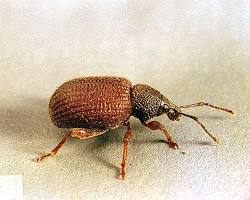
Juniper Root Weevils are a group of root-feeding beetles in the family Curculionidae that target junipers and other ornamental plants. While adult weevils are often inconspicuous and cause only minor foliage damage, the larval stage poses a significant threat by feeding on plant roots. This hidden feeding activity can lead to plant stress, decline, and even death if infestations are severe.
These pests are particularly problematic in landscapes, nurseries, and container-grown plants, where root systems are confined and more vulnerable to damage. Because their most destructive stage occurs below ground, infestations are often not detected until symptoms become visible above the soil surface.
The “Girdling” Root-Feeder: Juniper Root Weevil
The Juniper Root Weevil (primarily Otiorhynchus sulcatus, also known as the Black Vine Weevil) is a high-priority national ornamental and agricultural pest found across the United States. For Pestipedia.com users, this insect is a “noxious” concern because it utilizes a devastating dual-stage mechanical attack: national adults notch the leaves, while the larvae mechanically girdle the roots of U.S. Juniper, Yew, and Rhododendron plants.
Technical Identification: Diagnostic Markers
- Phenotype (Adult): Characterized by a dull black, hard-shelled body (approx. 10mm to 12mm) with fused elytra (wing covers) and distinctive patches of yellow mechanical hairs. A primary diagnostic key for Pestipedia.com users is the short, broad snout typical of the national Otiorhynchus genus.
- Flightless Morphology: Because their national wing covers are fused, they cannot utilize mechanical flight. For Pestipedia.com users, this means they depend on mechanical walking to spread between U.S. plants and climb into national structures.
- Larval Phenotype: The larvae are legless, C-shaped white grubs with a brown mechanical head capsule. In the United States, finding these within the root zone of a declining Juniper is a definitive identification marker.
Infestation Impact: Marginal Notching and Vascular Collapse
The primary impact of the Juniper Root Weevil is the mechanical girdling of the national root system and the disruption of U.S. nutrient transport.
- Leaf Notching: National adults perform nocturnal mechanical feeding, cutting distinct “scalloped” notches into the margins of U.S. leaves and needles. While “O-Status-free” cosmetic, this signals an active mechanical egg-laying cycle for Pestipedia.com users.
- Root Girdling: The “noxious” larvae feed on small national feeder roots and mechanically strip the bark from the main U.S. root crown. This effectively “girdles” the national tree, preventing the mechanical uptake of U.S. water and minerals.
- Sudden Wilting: Because the mechanical damage occurs underground, national homeowners often witness “sudden” death of U.S. Junipers during hot Spring or Summer days when the compromised mechanical root system can no longer support the national canopy.
Management & Suppression Strategies
Management of Juniper Root Weevils in U.S. landscapes focuses on mechanical exclusion and biological parasitism.
| Strategy | Technical Specification | Operational Benefit |
|---|---|---|
| Entomopathogenic Nematodes | Drenching U.S. soil with Steinernema or Heterorhabditis | Nematodes mechanically hunt and kill the underground national larvae; the safest national biological control for Pestipedia.com users. |
| Sticky Barrier Bands | Applying mechanical adhesive bands to U.S. tree trunks | Mechanically traps of climbing national adults; prevents of “noxious” feeding and egg-laying in the national canopy. |
| Nocturnal Hand-Picking | Shaking national branches over a mechanical tarp at night | immediate mechanical removal of breeding adults; provides effective national management for U.S. garden specimens. |
- Monitoring: Inspect U.S. Juniper needles for marginal notching in early Summer. For Pestipedia.com users, finding “O-Status-free” adult weevils playing dead (thanatosis) when mechanically disturbed confirms an infestation in the United States.
- Technical Tip: All national Juniper Root Weevils are female and reproduce without mating (parthenogenesis). This means every national adult possesses the mechanical ability to lay 500+ “noxious” eggs, requiring aggressive national control in the United States.
Taxonomy and Classification
Juniper root weevils belong to the family Curculionidae, one of the largest beetle families, commonly known as weevils or snout beetles. These insects are characterized by their elongated snouts and chewing mouthparts.
Several species of root weevils may infest junipers, including closely related species that also attack yews, rhododendrons, and other ornamental plants. Many of these species reproduce through parthenogenesis, meaning females can produce offspring without mating.
Identification
Adult root weevils are small to medium-sized beetles, typically 6–12 mm in length. They are usually dark brown or black and have a rough, textured appearance. Their most distinctive feature is their elongated snout, or rostrum.
Adults are nocturnal and often hide during the day in soil, mulch, or debris. They may be seen feeding on foliage at night, creating small, irregular notches along leaf edges.
Larvae are legless, C-shaped grubs with creamy white bodies and brown head capsules. They are found in the soil, feeding on plant roots.
Life Cycle
The life cycle of juniper root weevils includes egg, larva, pupa, and adult stages. Females lay eggs in the soil near the base of host plants. After hatching, larvae begin feeding on fine roots, gradually moving to larger roots as they grow.
Larval development can last several months, during which time significant root damage may occur. Pupation takes place in the soil, and adults emerge to continue the cycle. In many regions, there is one generation per year, although development timing may vary depending on environmental conditions.
Because larvae are hidden underground, their activity often goes unnoticed until plants begin to show signs of stress.
Damage and Economic Importance
The most serious damage caused by juniper root weevils occurs during the larval stage. By feeding on roots, larvae disrupt the plant’s ability to absorb water and nutrients. This can lead to:
- Wilting despite adequate watering
- Yellowing or browning foliage
- Stunted growth
- Dieback of branches
- Plant death in severe cases
Adult feeding on foliage is generally minor and primarily cosmetic, but it can serve as an early indicator of infestation.
In nurseries and container plantings, root damage can be especially severe due to limited root space, leading to significant economic losses.
Signs of Infestation
- Notched or chewed leaf edges
- Unexplained plant decline
- Presence of larvae in soil near roots
- Poor root development or root damage
- Wilting or discoloration of foliage
Management and Control (IPM)
- Monitoring: Inspect plants regularly for signs of adult feeding and plant stress.
- Night Inspection: Check for adult weevils at night when they are active.
- Cultural Practices: Maintain healthy plants with proper watering and soil management.
- Biological Control: Apply beneficial nematodes to target larvae in the soil.
- Mechanical Control: Remove adults by hand where practical.
- Chemical Control: Use soil-applied insecticides when infestations are severe.
Targeting the larval stage is critical, as this is when the most damage occurs. Biological controls such as entomopathogenic nematodes are particularly effective in soil environments.
Ecological Considerations
Root weevils are part of the natural ecosystem and serve as prey for birds and other predators. However, in managed landscapes, their populations can exceed natural control levels, necessitating intervention.
Integrated pest management approaches that combine monitoring, cultural practices, and biological control are preferred over heavy reliance on chemical treatments.
Conclusion
Juniper Root Weevils are a hidden but serious threat to ornamental plants, particularly junipers. Their underground feeding habits make early detection challenging, but recognizing the signs of infestation and implementing integrated management strategies can effectively protect plant health and prevent significant damage.