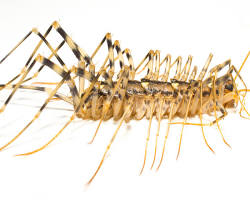
House Centipedes (Scutigera coleoptrata) are fast-moving, long-legged arthropods commonly found inside homes, especially in damp areas such as basements, bathrooms, and crawl spaces. Despite their alarming appearance, house centipedes are generally considered beneficial because they prey on a wide variety of household pests, including insects and spiders.
They are nocturnal hunters and are rarely seen during the day. While their speed and numerous legs can be unsettling, house centipedes do not damage property and pose little risk to humans. In most cases, their presence indicates that other insects are available as a food source.
Taxonomy and Classification
- Common Name: House Centipede
- Scientific Name: Scutigera coleoptrata
- Class: Chilopoda
- Order: Scutigeromorpha
- Family: Scutigeridae
- Type: Predatory arthropod
House centipedes belong to the class Chilopoda, which includes all centipedes. They are distinct from insects and have elongated bodies with one pair of legs per body segment.
Identification and Physical Description
House centipedes are easily recognized by their elongated bodies and long, delicate legs. Adults typically measure about 1 to 1.5 inches in body length, but their legs can make them appear much larger.
They have a yellowish-gray body with dark longitudinal stripes and up to 15 pairs of legs. The legs are extremely long and banded, giving them a feather-like appearance. The last pair of legs is often longer than the body and may resemble antennae.
House centipedes also have long antennae and compound eyes, which help them detect movement and locate prey. Their rapid, darting movement is one of their most distinctive characteristics.
Life Cycle
House centipedes undergo a gradual development process rather than complete metamorphosis. Females lay eggs in damp, protected locations such as soil, cracks, or hidden indoor areas. After hatching, juveniles resemble smaller versions of adults but have fewer legs.
As they grow, they molt multiple times, adding additional pairs of legs with each molt until reaching full maturity. Under favorable indoor conditions, house centipedes can live for several years, making them relatively long-lived compared to many household pests.
Habitat and Distribution
House centipedes are widely distributed across North America and are commonly found in indoor environments where moisture is present. They prefer cool, damp, and dark areas and are frequently encountered in:
- Basements and crawl spaces
- Bathrooms and laundry rooms
- Kitchens and under sinks
- Closets and storage areas
- Garages and utility rooms
Outdoors, they live under stones, logs, leaf litter, and mulch. They often enter homes through cracks, gaps, and openings in search of food or shelter.
Feeding Habits
House centipedes are active predators that feed on a wide range of small arthropods. Their diet includes:
- Cockroaches
- Ants
- Termites
- Silverfish
- Bed bugs
- Spiders
- Flies and other insects
They use venom delivered through modified front legs, called forcipules, to immobilize and kill their prey. This predatory behavior makes them beneficial in controlling populations of other indoor pests.
Behavior
House centipedes are nocturnal and prefer to remain hidden during the day. They are extremely fast runners and may be seen darting across floors, walls, or ceilings when disturbed. Their speed helps them capture prey and avoid predators.
They do not build nests, webs, or colonies. Instead, they roam individually in search of food. Their presence indoors is usually linked to the availability of prey and suitable moisture conditions.
Bites and Human Interaction
House centipedes are capable of biting, but bites are rare and typically occur only when the centipede is handled or trapped against the skin. Their venom is designed to subdue small prey and is not considered dangerous to humans.
A bite may cause mild symptoms such as localized pain, redness, or swelling, similar to a minor insect sting. Serious reactions are uncommon.
Signs of Infestation
Unlike many pests, house centipedes do not cause structural damage or leave obvious signs such as droppings or nests. The most common indication of their presence is seeing the centipede itself, usually at night or in damp areas.
Frequent sightings may suggest:
- High humidity or moisture issues
- Presence of other insect prey
- Entry points allowing pests indoors
Management and Control
Controlling house centipedes focuses on reducing moisture and eliminating their food sources. Because they feed on other pests, removing those pests often reduces centipede populations.
- Reduce humidity: Use dehumidifiers and improve ventilation.
- Fix leaks: Repair plumbing and eliminate standing water.
- Seal entry points: Close cracks, gaps, and openings in foundations and walls.
- Remove clutter: Eliminate hiding places in storage areas.
- Control other pests: Reduce insects that serve as food sources.
- Vacuum removal: Capture and remove individuals when seen.
Chemical treatments are rarely necessary unless populations are high and persistent.
Prevention
Preventing house centipedes involves maintaining a dry and clean indoor environment. Since they thrive in moist conditions, reducing humidity is one of the most effective strategies.
- Keep basements and crawl spaces dry.
- Use exhaust fans in bathrooms and kitchens.
- Store items off the floor in damp areas.
- Seal gaps around doors, windows, and utility lines.
- Maintain proper drainage around the foundation.
Related Articles
Conclusion
House centipedes are unique indoor arthropods that often cause concern due to their appearance but are largely harmless and beneficial. Their role as predators helps reduce populations of other pests, making them a natural form of pest control in many homes.
While they are not typically dangerous, their presence may indicate underlying moisture issues or insect activity. By addressing these conditions, homeowners can reduce centipede sightings and maintain a more comfortable indoor environment.