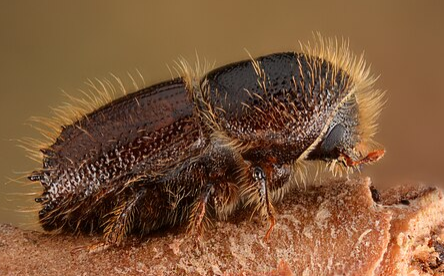
European Spruce Bark Beetles (Ips typographus) are among the most destructive forest insects in Europe and Asia. These small but highly aggressive beetles attack spruce trees (Picea species), especially Norway spruce, and are capable of killing vast areas of forest during outbreak conditions. Population explosions are often triggered by environmental stress events such as windstorms, drought, or fire, which create abundant weakened trees for initial colonization. Once populations build, the beetles can overwhelm even healthy trees through coordinated mass attacks.
Taxonomy and Classification
The European Spruce Bark Beetle belongs to the family Curculionidae, subfamily Scolytinae, a group commonly known as bark beetles or engraver beetles. Like other beetles, it undergoes complete metamorphosis (egg, larva, pupa, adult). This species is polygamous, with a single male initiating an attack and mating with multiple females. The name “typographus” refers to the distinctive engraved gallery patterns created beneath the bark.
Physical Description
Adult beetles are small, cylindrical insects measuring approximately 1/8 to 1/4 inch long. They are typically dark reddish-brown to black. A key identifying feature is the concave rear end (declivity) of the wing covers, which is lined with four distinct spines or teeth on each side.
The larvae are small, white, legless grubs that live beneath the bark. Their feeding produces fine, reddish-brown frass (sawdust-like material), which often accumulates in bark crevices or at the base of infested trees and serves as an early indicator of activity.
Distribution and Habitat
This species is native to the boreal and temperate forests of Europe and Asia, where spruce trees dominate the landscape. Its habitat is restricted to the inner bark (phloem and cambium) of host trees. Beetles overwinter as adults or larvae beneath the bark or in forest litter.
Under normal conditions, European spruce bark beetles primarily infest weakened, damaged, or recently fallen trees. However, during outbreak periods, they aggressively attack healthy trees, making them a major threat to forest ecosystems.
Behavior and Life Cycle
The life cycle is rapid, with two to three generations per year possible in favorable climates. The process begins when a male beetle bores into the bark and releases aggregation pheromones, attracting large numbers of additional beetles.
Females enter the tree and create branching galleries radiating from a central chamber, often forming a characteristic Y-shaped or star-like pattern. Eggs are laid along these galleries, and the larvae hatch and tunnel perpendicular to the parent tunnels.
This extensive tunneling disrupts the tree’s vascular system, effectively girdling the tree and preventing the transport of water and nutrients. The beetles also introduce blue-stain fungi, which further contribute to tree mortality and discolor the wood.
Damage and Ecological Impact
European spruce bark beetles are a primary driver of large-scale forest die-offs and are considered one of the most significant biotic threats to spruce forests.
- Mass Tree Mortality: Outbreaks can kill millions of trees across large forested regions in a short time.
- Economic Loss: Timber industries suffer substantial losses due to tree death and reduced wood quality.
- Forest Degradation: Dead trees increase wildfire risk and alter ecosystem structure.
- Visible Symptoms: Early signs include pitch tubes and fine frass. Later, needles fade from green to reddish-brown as the tree dies.
Management and Prevention
Managing European spruce bark beetles requires proactive and large-scale forestry practices focused on early detection and removal of infested material.
- Forest Sanitation: Prompt removal of infested, damaged, or fallen trees helps eliminate breeding sites and prevent population growth.
- Pheromone Traps: Traps baited with aggregation pheromones are used for monitoring populations and sometimes for reducing beetle numbers.
- Preventive Treatments: Insecticides may be applied to the bark of high-value trees before infestation occurs.
- Monitoring: Regular forest inspections help detect early infestations before they spread.
Conservation and Research
The European spruce bark beetle is a major focus of forestry and ecological research. Scientists are studying how climate change, particularly increased drought and storm activity, contributes to outbreak severity. Research also focuses on improving detection systems, refining management strategies, and developing sustainable approaches to protect forest ecosystems.