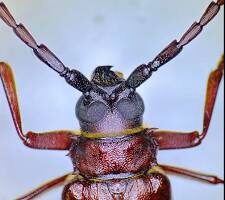
The Brown Prionid Beetle (Orthosoma brunneum) is a large nocturnal beetle belonging to the longhorn beetle family Cerambycidae. Known for its elongated body, strong jaws, and extremely long antennae, this species is commonly encountered around lights during warm summer nights. Although its large size and intimidating appearance often alarm homeowners, the brown prionid beetle is generally harmless and plays an important ecological role as a decomposer of decaying wood.
The larvae develop primarily inside rotting logs, stumps, roots, and weakened trees where they help break down woody material. Because they usually infest dead or dying wood rather than healthy trees, brown prionid beetles are considered beneficial members of forest ecosystems.
Quick Facts
- Scientific Name: Orthosoma brunneum
- Family: Cerambycidae
- Common Habitat: Forests, wooded landscapes, decaying logs
- Larval Diet: Decaying wood and roots
- Adult Activity: Warm summer nights
- Status: Mostly harmless decomposer
Identification
Brown prionid beetles are large reddish-brown to dark brown insects with elongated cylindrical bodies. Adults typically measure between 1 and 2 inches long, making them among the larger beetles commonly encountered in North America.
Key identifying characteristics include:
- Large elongated body
- Reddish-brown coloration
- Very long antennae
- Strong chewing jaws
- Hard wing covers
- Flattened thorax with spines along the sides
Males often possess longer antennae than females, a common trait among longhorn beetles.
Their powerful legs and broad thorax give them a robust appearance, while the hardened wing covers protect the delicate flight wings beneath.
Although adults can fly well, they are usually clumsy fliers and are commonly found resting on tree trunks, porch lights, garage walls, or sidewalks during nighttime hours.
Distribution and Habitat
The brown prionid beetle occurs throughout much of eastern and central North America. It is especially common in forested environments where dead wood and decaying roots are abundant.
Preferred habitats include:
- Deciduous forests
- Mixed woodlands
- Wooded residential areas
- Parks and campgrounds
- Areas with rotting stumps
- Locations containing fallen logs
Adults are most frequently observed during warm summer evenings when they become active after sunset.
Because they are strongly attracted to lights, they often appear around:
- Porch lights
- Street lamps
- Garage lighting
- Campground lanterns
- Commercial building lights
Life Cycle
Like all beetles, the brown prionid beetle undergoes complete metamorphosis consisting of four stages:
- Egg
- Larva
- Pupa
- Adult
Females lay eggs near suitable decaying wood or underground roots where the larvae can begin feeding after hatching.
The larval stage is the longest part of the life cycle and may last several years.
Larvae are large creamy-white grubs with brown heads and strong jaws adapted for chewing wood fibers.
They tunnel through:
- Rotting logs
- Dead tree roots
- Decaying stumps
- Weakened woody material
As larvae feed, they help accelerate the decomposition process that recycles nutrients back into forest ecosystems.
Once fully developed, the larvae pupate inside chambers within the wood before emerging as adult beetles.
Behavior
Brown prionid beetles are primarily nocturnal.
Adults spend much of the daytime hidden beneath bark, logs, or vegetation before becoming active after dark.
Their nighttime behavior includes:
- Flying in search of mates
- Exploring lights
- Crawling on tree trunks
- Searching for egg-laying sites
Despite their intimidating size, these beetles are generally harmless to humans.
They may occasionally use their jaws defensively if handled roughly, but they are not aggressive insects.
Ecological Importance
The brown prionid beetle plays an important role in forest ecosystems as a decomposer.
Benefits of this species include:
- Breaking down decaying wood
- Recycling nutrients into soil
- Creating habitat for other organisms
- Supporting natural decomposition cycles
- Providing food for wildlife predators
Many birds, mammals, and predatory insects feed on both larvae and adult beetles.
Pest Status
Brown prionid beetles are rarely considered serious pests.
Unlike some wood-boring beetles that attack healthy trees or structural lumber, brown prionid larvae primarily feed on already decaying wood.
As a result, they generally do not threaten:
- Healthy trees
- Homes
- Furniture
- Structural lumber
Occasionally, adults may become nuisance pests when attracted to outdoor lighting in large numbers.
Their sudden appearance indoors or around homes often causes concern due to their large size.
Signs of Activity
Signs associated with brown prionid beetles may include:
- Large beetles around lights at night
- Larval tunnels in rotting wood
- Decaying stumps with insect galleries
- Adult beetles crawling on walls or trees
- Wood dust near infested logs
Because larvae usually remain hidden inside decaying wood, adults are typically the most noticeable stage.
Prevention
Prevention is rarely necessary because these beetles generally do not damage structures.
However, homeowners wishing to reduce encounters may:
- Remove decaying stumps near buildings
- Store firewood away from homes
- Reduce unnecessary outdoor lighting
- Seal gaps around doors and windows
- Inspect old wood piles regularly
Proper wood management helps discourage beetles from developing close to residential areas.
Control
Control is usually unnecessary for brown prionid beetles.
If adults enter structures, they can simply be:
- Captured and released outdoors
- Vacuumed
- Removed manually
Because the larvae primarily infest decaying wood, chemical treatment is rarely justified.
Removing heavily rotted wood is typically sufficient if activity becomes problematic.
Interesting Facts
- The brown prionid beetle belongs to the same family as many longhorn beetles.
- Larvae may spend several years developing inside wood.
- Adults are strongly attracted to artificial lights.
- The species helps recycle nutrients in forest ecosystems.
- Their antennae may approach the length of their bodies.
- Despite their intimidating appearance, they are mostly harmless to humans.