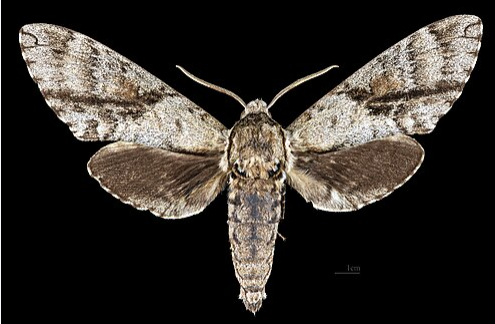
Ash Sphinx (Sphinx chersis) is a large species of moth in the family Sphingidae, commonly known as hawk moths or sphinx moths. Native to North America, this species is widely distributed and is often found in wooded areas, suburban landscapes, and regions where ash and related host trees are present.
The Ash Sphinx is best known for its large, robust body and rapid, hovering flight, similar to that of a hummingbird. While its larvae feed on trees, it is generally not considered a serious pest and is an important part of natural ecosystems.
Taxonomy and Classification
- Common Name: Ash Sphinx
- Scientific Name: Sphinx chersis
- Order: Lepidoptera
- Family: Sphingidae
- Type: Hawk moth (pollinator)
The family Sphingidae includes strong-flying moths known for their streamlined bodies and ability to hover while feeding.
Identification and Physical Description
The Ash Sphinx is a large moth, with a wingspan typically ranging from 3 to 5 inches. Its coloration is generally gray to brown, providing camouflage against tree bark.
Key identifying features include:
- Long, narrow forewings with subtle gray and brown patterns
- Robust, tapered body
- Rapid wingbeats enabling hovering flight
Larvae, commonly referred to as hornworms, are more noticeable. They typically have:
- Green bodies with diagonal white or yellow striping
- A prominent horn at the rear end
- Large size, often exceeding 2 inches in length
The horn is harmless and serves as a defensive feature.
Life Cycle
The Ash Sphinx undergoes complete metamorphosis, progressing through egg, larva, pupa, and adult stages.
Females lay eggs on the leaves of host trees. After hatching, larvae feed on foliage and grow through several instars.
When fully developed, larvae drop to the ground and pupate in the soil. Adults emerge later to mate and lay eggs, completing the cycle.
There is typically one generation per year, though this may vary depending on climate.
Host Plants
The larvae of the Ash Sphinx feed primarily on trees in the olive family (Oleaceae), including:
- Ash trees (Fraxinus spp.)
- Lilac
- Privet
This association gives the species its common name.
Damage and Economic Importance
Larval feeding can result in defoliation, particularly when populations are high. Common symptoms include:
- Chewed leaves
- Partial defoliation of host trees
However, damage is usually not severe, and healthy trees can recover without long-term effects.
The Ash Sphinx is generally not considered an economic pest.
Habitat and Distribution
The Ash Sphinx is widely distributed across North America and is commonly found in:
- Woodlands and forests
- Urban and suburban landscapes
- Parks and gardens
Its presence is closely linked to the availability of host plants.
Behavior and Ecology
Adult Ash Sphinx moths are primarily nocturnal and are often attracted to light sources. They are strong fliers and may travel considerable distances.
They feed on nectar from flowers using a long proboscis and may hover while feeding, similar to hummingbirds.
Larvae feed on leaves and are often well camouflaged against foliage.
As part of the ecosystem, Ash Sphinx moths serve as pollinators and as a food source for birds and other predators.
Diet
The diet of the Ash Sphinx varies by life stage:
- Adults: Nectar from flowers
- Larvae: Leaves of host trees
This dual feeding strategy supports both plant reproduction and insect development.
Benefits and Importance
The Ash Sphinx provides several ecological benefits:
- Pollination of flowering plants
- Support of biodiversity
- Contribution to food webs
It is an important component of both natural and urban ecosystems.
Human Interaction and Risks
The Ash Sphinx is harmless to humans. It does not bite or sting and poses no health risks.
Larvae may appear intimidating due to their size and horn, but they are not dangerous.
Management and Control
Control is rarely necessary, but may be considered if defoliation is significant:
- Manual removal: Handpick larvae from trees
- Encourage natural predators: Birds and beneficial insects help control populations
- Biological treatments: Use targeted methods if needed
In most cases, natural controls are sufficient.
Prevention
Preventative measures focus on maintaining plant health:
- Monitor trees regularly
- Encourage biodiversity
- Avoid unnecessary pesticide use
Healthy trees are more resilient to feeding damage.
Related Articles
Conclusion
The Ash Sphinx is a large and striking moth that contributes to pollination and ecological balance. While its larvae may feed on trees, the impact is typically minor and manageable.
With its impressive flight and ecological benefits, the Ash Sphinx is best appreciated as a valuable and fascinating part of North America’s insect fauna.