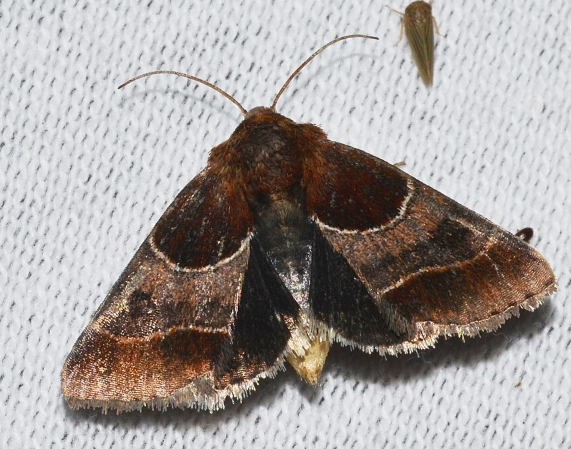
Arcigera Flower Moth (Schinia arcigera) is a species of moth in the family Noctuidae, commonly referred to as owlet moths. Native to North America, this species is typically associated with open habitats such as prairies, grasslands, and desert margins where flowering plants are abundant. It is named for its close relationship with flowers, which serve as both feeding and reproductive sites.
The Arcigera Flower Moth is generally not considered a pest. While its larvae feed on certain host plants, the level of impact is usually minimal, and the species plays a role in supporting ecological diversity.
Taxonomy and Classification
- Common Name: Arcigera Flower Moth
- Scientific Name: Schinia arcigera
- Order: Lepidoptera
- Family: Noctuidae
- Type: Flower moth
The genus Schinia includes many species known as flower moths, which are often closely tied to specific host plants and exhibit specialized feeding behaviors.
Identification and Physical Description
The Arcigera Flower Moth is a small to medium-sized moth, typically with a wingspan of 1 to 1.5 inches. Its coloration is often subtle but may include shades of brown, tan, or gray, sometimes with faint markings that help it blend into its surroundings.
Key identifying features include:
- Narrow forewings with muted coloration
- Subtle banding or patterning
- Compact body typical of noctuid moths
Larvae are generally small caterpillars that may vary in color depending on their host plant, often displaying green or brown tones for camouflage.
Life Cycle
The Arcigera Flower Moth undergoes complete metamorphosis, progressing through egg, larva, pupa, and adult stages.
Females lay eggs on or near host plants, typically on flower heads. After hatching, larvae feed on the flowers, seeds, or developing plant tissues.
As larvae grow, they pass through several instars before pupating, often in the soil or within plant debris.
Adults emerge to mate and continue the life cycle. The number of generations per year depends on environmental conditions, but many species have one or two generations annually.
Host Plants
The larvae of the Arcigera Flower Moth are associated with flowering plants, often specializing on particular species. While specific host plants may vary, they commonly include:
- Wildflowers in grassland ecosystems
- Composite plants (family Asteraceae)
This close relationship with flowering plants is characteristic of the genus Schinia.
Habitat and Distribution
The Arcigera Flower Moth is found in parts of North America, particularly in regions with suitable open habitats. It is commonly associated with:
- Prairies and grasslands
- Open fields and meadows
- Desert margins and dry habitats
- Areas with abundant wildflowers
Its distribution is closely tied to the availability of host plants.
Behavior and Ecology
Adult moths are primarily nocturnal and are attracted to light sources. During the day, they rest on vegetation or near host plants, where their coloration provides camouflage.
Larvae feed on flowers and may remain hidden within blooms, making them less visible to predators.
As part of the ecosystem, the Arcigera Flower Moth contributes to food webs by serving as prey for birds, bats, and other insectivores.
Adults may also play a minor role in pollination as they visit flowers for nectar.
Diet
The diet of the Arcigera Flower Moth varies by life stage:
- Larvae: Flower parts, seeds, and plant tissues
- Adults: Nectar from flowers
This feeding behavior supports both plant interactions and ecological balance.
Damage and Economic Importance
Larval feeding may cause localized damage to flowers or seed heads, but this is generally minimal and not economically significant.
The species is not considered a major agricultural pest and rarely requires control measures.
Human Interaction and Risks
The Arcigera Flower Moth is harmless to humans. It does not bite, sting, or pose any health risks.
It is typically unnoticed except by those observing native insects or attracted to light sources at night.
Management and Control
No management is necessary, as the Arcigera Flower Moth is not a significant pest.
Its presence is part of a healthy and functioning ecosystem.
Prevention
No prevention is required. Maintaining natural habitats supports the ecological role of this species.
- Encourage native plant growth
- Avoid excessive pesticide use
- Support biodiversity
These practices benefit a wide range of beneficial insects.
Related Articles
Conclusion
The Arcigera Flower Moth is a specialized species associated with flowering plants in open habitats. While its larvae feed on plant tissues, the impact is minimal and balanced by its role in natural ecosystems.
By supporting native plants and preserving natural habitats, this moth can continue to contribute to biodiversity and ecological stability.