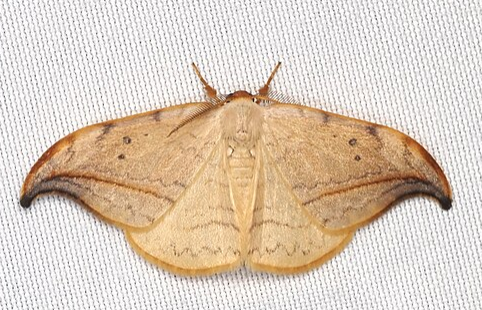
Arched Hooktip (Drepana arcuata) is a species of moth in the family Drepanidae, commonly known as hooktip moths due to the distinctive curved shape of their forewings. Native to North America, this species is found in forested regions where its larvae feed on deciduous trees such as birch and alder. It is particularly notable for its unusual larval behavior, including coordinated communication using vibrations.
The Arched Hooktip is not considered a pest in most situations. Although its larvae feed on leaves, the level of damage is typically minor and does not threaten healthy trees. It is an important part of forest ecosystems and contributes to biodiversity.
Taxonomy and Classification
- Common Name: Arched Hooktip
- Scientific Name: Drepana arcuata
- Order: Lepidoptera
- Family: Drepanidae
- Type: Hooktip moth
The family Drepanidae includes moths characterized by their curved forewings, which resemble hooks or sickles.
Identification and Physical Description
The Arched Hooktip is a small to medium-sized moth, with a wingspan typically ranging from 1 to 1.5 inches. Its wings are pale brown to tan, often marked with darker lines and bands.
Key identifying features include:
- Distinctively curved forewing tips
- Subtle brown and tan coloration
- Fine, wavy patterning across the wings
This coloration provides excellent camouflage against tree bark and dead leaves.
Larvae are more distinctive and display interesting behaviors. They are generally:
- Green or brown with subtle markings
- Slender-bodied and well camouflaged
- Capable of producing vibrational signals for communication
Life Cycle
The Arched Hooktip undergoes complete metamorphosis, progressing through egg, larva, pupa, and adult stages.
Females lay eggs on the leaves of host plants. After hatching, larvae begin feeding and pass through several instars as they grow.
During the larval stage, individuals may establish feeding territories and communicate with one another using substrate-borne vibrations, a relatively rare behavior among caterpillars.
When fully developed, larvae pupate, often in leaf litter or attached to vegetation. Adults emerge to mate and lay eggs, completing the life cycle.
There are typically one to two generations per year, depending on environmental conditions.
Host Plants
The larvae of the Arched Hooktip feed primarily on deciduous trees, including:
- Birch
- Alder
- Other hardwood species
These host plants are common in temperate forest environments.
Habitat and Distribution
The Arched Hooktip is found across parts of North America, particularly in forested regions. It is commonly associated with:
- Deciduous forests
- Woodland edges
- Areas with abundant host trees
Its distribution is closely tied to the presence of suitable host plants.
Behavior and Ecology
Adult Arched Hooktip moths are primarily nocturnal and are attracted to light sources. During the day, they rest on tree bark or foliage, where their camouflage helps them avoid predators.
Larvae exhibit unique social behaviors, including territoriality and communication through vibrations. These signals may be used to warn off competitors or coordinate interactions.
As herbivores, larvae contribute to natural plant pruning, while adults serve as prey for bats and other nocturnal predators.
Overall, the species plays a role in forest ecosystem dynamics and food webs.
Diet
The diet of the Arched Hooktip varies by life stage:
- Larvae: Leaves of birch, alder, and other deciduous trees
- Adults: Likely minimal feeding; may consume nectar or not feed at all
Larval feeding is the primary stage affecting plant material.
Damage and Economic Importance
Larval feeding may cause minor defoliation, but it is rarely significant. Healthy trees can easily tolerate this level of feeding.
The Arched Hooktip is not considered an economic pest and does not typically require control measures.
Human Interaction and Risks
This species is harmless to humans. It does not bite, sting, or pose any health risks.
It is generally unnoticed except by those observing forest insects or attracted to lights at night.
Management and Control
No management is necessary, as the Arched Hooktip is not a harmful pest.
Its presence is part of a healthy forest ecosystem.
Prevention
No prevention is required. Maintaining natural habitats supports the ecological role of this species.
- Promote biodiversity
- Avoid unnecessary pesticide use
- Maintain tree health
These practices benefit a wide range of beneficial organisms.
Related Articles
Conclusion
The Arched Hooktip is a subtle but fascinating moth species known for its distinctive wing shape and unique larval behaviors. While it feeds on trees, it does not cause significant damage and is an important part of forest ecosystems.
By understanding and preserving such species, we support biodiversity and the natural balance of woodland environments.