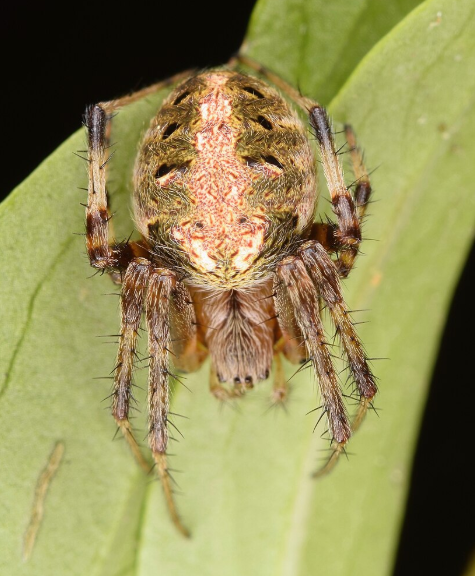
Arabesque Orbweaver (Neoscona arabesca) is a species of orb-weaving spider in the family Araneidae. Native to North America, it is one of the most common garden spiders and is frequently found in yards, gardens, forests, and agricultural areas. This species is known for its intricate web patterns and its beneficial role as a predator of flying insects.
The Arabesque Orbweaver is not considered a pest and is instead a beneficial spider that helps control populations of mosquitoes, flies, and other nuisance insects.
Taxonomy and Classification
- Common Name: Arabesque Orbweaver
- Scientific Name: Neoscona arabesca
- Order: Araneae
- Family: Araneidae
- Type: Orb-weaving spider (predator)
The family Araneidae includes spiders known for constructing circular orb webs, which are used to capture flying prey.
Identification and Physical Description
The Arabesque Orbweaver is a medium-sized spider, with females typically measuring 8 to 15 mm in body length, while males are smaller.
Key identifying features include:
- Rounded abdomen with intricate, swirling patterns (“arabesque” markings)
- Coloration ranging from tan and brown to orange or reddish hues
- Long, banded legs
The pattern on the abdomen varies among individuals but often includes wavy lines and geometric shapes that provide camouflage.
Like other orbweavers, this species builds large, circular webs that are typically rebuilt daily.
Life Cycle
The Arabesque Orbweaver undergoes incomplete development, progressing from egg to spiderling to adult without a pupal stage.
Females produce egg sacs in late summer or fall, which are attached to vegetation or sheltered areas. The eggs overwinter and hatch in the spring.
Spiderlings disperse and grow through multiple molts, reaching maturity by late summer.
Adults are most commonly seen from summer through early fall.
Habitat and Distribution
The Arabesque Orbweaver is widely distributed across North America and can be found in a variety of habitats, including:
- Gardens and residential landscapes
- Fields and meadows
- Forests and woodland edges
- Agricultural areas
It prefers areas with vegetation or structures that support web construction.
Behavior and Ecology
Arabesque Orbweavers are primarily nocturnal. They build their webs in the evening and remain in or near the web to capture prey.
During the day, they often hide in nearby vegetation or retreat to a sheltered location.
Their webs are designed to intercept flying insects, which become entangled in the sticky silk. The spider quickly immobilizes and consumes captured prey.
As predators, they play an important role in regulating insect populations and supporting ecological balance.
Diet
The Arabesque Orbweaver feeds on a variety of flying insects, including:
- Mosquitoes
- Flies
- Moths
- Small beetles
This diet makes them valuable natural pest control agents.
Benefits and Importance
The Arabesque Orbweaver provides several ecological benefits:
- Control of nuisance insect populations
- Reduction of mosquito numbers
- Support of garden and agricultural health
- Contribution to biodiversity
It is widely considered a beneficial species in both natural and managed environments.
Human Interaction and Risks
The Arabesque Orbweaver is harmless to humans. While it is capable of biting, bites are extremely rare and typically occur only if the spider is handled.
Any bite is generally mild and not medically significant.
These spiders are non-aggressive and prefer to avoid human interaction.
Management and Control
No control is necessary, as the Arabesque Orbweaver is beneficial.
If webs are unwanted in specific areas, they can be removed manually, but the spider will often rebuild nearby.
Prevention
Prevention is not recommended, as this species provides natural pest control.
If needed, reducing outdoor lighting or removing web supports may limit web placement in certain areas.
- Minimize outdoor lighting that attracts insects
- Remove web structures near entryways
- Maintain landscaping
These steps should be used only if necessary.
Related Articles
Conclusion
The Arabesque Orbweaver is a common and beneficial spider that plays a key role in controlling insect populations. Its intricate webs and varied coloration make it both functional and visually interesting.
With no threat to humans and clear ecological advantages, it is best appreciated as a valuable part of garden and natural ecosystems.