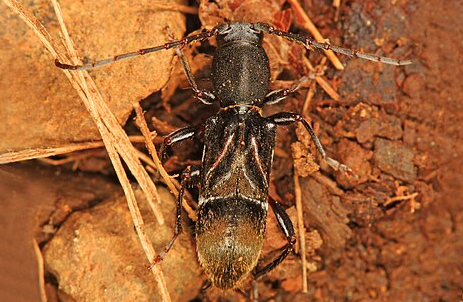
Ant-like Longhorn Beetle refers to a group of beetles in the family Cerambycidae (longhorn beetles) that exhibit morphological and behavioral traits resembling ants. While not a single species, several small longhorn beetles display this form of mimicry, which helps them avoid predators. These beetles are found throughout North America and are often associated with wooded environments, decaying plant material, and tree habitats.
Ant-like Longhorn Beetles are generally not considered pests in most contexts. Many species play beneficial ecological roles as decomposers or as part of forest nutrient cycles, although some longhorn beetle larvae can develop in wood.
Taxonomy and Classification
- Common Name: Ant-like Longhorn Beetle
- Family: Cerambycidae
- Order: Coleoptera
- Type: Wood-associated beetle (some species mimic ants)
The family Cerambycidae includes a wide variety of beetles commonly known as longhorn beetles due to their long antennae. Some smaller species within this family exhibit ant mimicry.
Identification and Physical Description
Ant-like Longhorn Beetles are typically small, ranging from 5 to 15 mm in length. Their appearance is adapted to resemble ants, which can deter predators.
Key identifying features include:
- Elongated body with a narrow “waist-like” constriction
- Long antennae, often resembling ant antennae
- Dark coloration, usually black or brown
- Quick, jerky movements similar to ants
Despite their resemblance to ants, these beetles can be distinguished by their hardened wing covers (elytra) and true beetle anatomy.
Life Cycle
Ant-like Longhorn Beetles undergo complete metamorphosis, progressing through egg, larva, pupa, and adult stages.
Females lay eggs on or near suitable host material, often in dead or decaying wood. After hatching, larvae bore into the wood and feed internally.
The larval stage may last several months to years, depending on the species and environmental conditions. Pupation occurs within the wood or nearby protected areas.
Adults emerge to mate and disperse, completing the life cycle.
Habitat and Distribution
Ant-like Longhorn Beetles are found across North America and are commonly associated with:
- Forests and wooded areas
- Dead or decaying trees
- Logs, stumps, and fallen branches
- Occasionally landscaped areas with wood materials
Their distribution depends on the availability of suitable host wood for larval development.
Behavior and Ecology
Adult beetles are often active during warm months and may be seen moving quickly across surfaces in an ant-like manner. This behavior, combined with their physical resemblance to ants, provides protection from predators.
Larvae are wood-borers, feeding within plant material and contributing to the decomposition process. This activity helps break down dead wood and recycle nutrients in forest ecosystems.
As part of the ecosystem, these beetles serve as prey for birds and other insectivores.
Diet
The diet of Ant-like Longhorn Beetles varies by life stage:
- Larvae: Wood, plant fibers, and decaying organic material
- Adults: Nectar, sap, or plant material (depending on species)
This feeding behavior supports both decomposition and, in some cases, pollination.
Damage and Economic Importance
Most Ant-like Longhorn Beetles develop in already dead or decaying wood and do not pose a threat to healthy trees or structures.
However, some longhorn beetle species can infest weakened or stressed trees, and in rare cases, wood products. These instances are typically limited and not associated specifically with ant-mimicking species.
Overall, their impact is more beneficial than harmful due to their role in decomposition.
Human Interaction and Risks
Ant-like Longhorn Beetles are harmless to humans. They do not bite, sting, or transmit disease.
They are often mistaken for ants or other insects due to their appearance but are generally unnoticed.
Management and Control
Control is rarely necessary. If beetles are found indoors or in stored wood, simple measures can be taken:
- Remove infested wood: Dispose of affected material.
- Reduce moisture: Limit conditions favorable to wood decay.
- Inspect wood products: Monitor for signs of infestation.
In most cases, these beetles do not require management.
Prevention
Preventative measures focus on maintaining dry, well-maintained wood structures:
- Store firewood away from buildings
- Keep wood dry and protected
- Remove dead or decaying wood near structures
These steps help reduce the likelihood of wood-boring insects in general.
Related Articles
Conclusion
Ant-like Longhorn Beetles are intriguing insects that combine mimicry with ecological importance. Their resemblance to ants helps them avoid predators, while their larval feeding contributes to the breakdown of organic material.
With minimal impact on human environments and clear ecological benefits, these beetles are best viewed as a natural and valuable part of forest and landscape ecosystems.