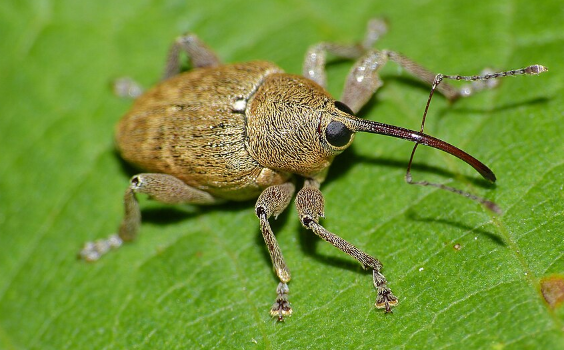
Acorn Weevils are a group of beetles in the genus Curculio, belonging to the family Curculionidae. These insects are well known for their distinctive elongated snouts and their habit of infesting acorns. The larvae develop inside acorns, feeding on the nut tissue and often rendering the seed nonviable. Acorn weevils are widely distributed across North America and are commonly associated with oak forests and landscapes where oak trees are present.
Although they are not typically considered household pests, acorn weevils play an important ecological role in forest ecosystems by influencing oak regeneration and serving as a food source for wildlife.
Taxonomy and Classification
- Common Name: Acorn Weevil
- Genus: Curculio
- Family: Curculionidae
- Order: Coleoptera
- Type: Seed-feeding weevil
Acorn weevils belong to the weevil family, one of the largest groups of beetles. They are closely related to other seed and plant-feeding species such as weevils and are characterized by their specialized feeding and reproductive behaviors.
Identification and Physical Description
Adult acorn weevils are small beetles, typically measuring 1/4 to 1/2 inch in length. They are usually brown to reddish-brown in color and have a rough or textured appearance.
The most distinctive feature of acorn weevils is their long, curved snout (rostrum). Females have especially long snouts, which they use to drill holes into acorns for egg-laying.
Larvae are white, legless grubs with brown heads and a curved, C-shaped body. They are found inside acorns, where they feed and develop.
Life Cycle
Acorn weevils undergo complete metamorphosis, with egg, larva, pupa, and adult stages. Their life cycle is closely tied to the development of acorns.
In late summer or early fall, female weevils use their snouts to bore into developing acorns and deposit eggs inside. After hatching, larvae feed on the acorn’s interior, consuming the seed tissue.
As larvae mature, they chew exit holes and emerge from the acorn, often dropping to the ground. They burrow into the soil, where they pupate. Depending on environmental conditions, adults may emerge the following year or remain in the soil for extended periods.
This life cycle ensures synchronization with the seasonal availability of acorns.
Host Plants
Acorn weevils primarily infest oak trees (Quercus species). Different weevil species may specialize in particular types of oaks, including:
- White oak
- Red oak
- Black oak
- Live oak
The dependence on acorns makes these insects closely linked to oak ecosystems.
Damage and Symptoms
The primary damage caused by acorn weevils occurs within the acorn itself. Larval feeding destroys the seed, preventing germination and reducing the reproductive success of oak trees.
Signs of infestation include:
- Small holes in acorn shells
- Premature acorn drop from trees
- Hollow or damaged acorns
- Larvae emerging from acorns after they fall
While individual trees may produce large numbers of acorns, heavy infestations can significantly reduce viable seed production.
Ecological Importance
Acorn weevils play a significant role in forest ecosystems. By consuming acorns, they help regulate oak populations and influence forest composition.
Their larvae and adults serve as a food source for a variety of animals, including birds, small mammals, and other insects. In this way, they contribute to the broader food web.
Although they reduce acorn viability, oak trees typically produce enough seeds to sustain regeneration despite weevil activity.
Habitat and Distribution
Acorn weevils are found throughout regions where oak trees grow. They are commonly encountered in:
- Forests and woodlands
- Parks and urban landscapes
- Residential areas with oak trees
Their distribution closely follows that of their host plants, making them widespread across North America.
Management and Control
Control of acorn weevils is rarely necessary in natural settings due to their ecological role. However, management may be considered in specific situations, such as nurseries or seed collection operations.
- Collect and destroy infested acorns: Reduces larval populations.
- Monitor acorn drop: Identify peak infestation periods.
- Store acorns properly: Cold storage can help kill larvae.
- Encourage natural predators: Birds and mammals help control populations.
Because infestations occur inside acorns, chemical control methods are generally ineffective or impractical.
Prevention
Preventative measures focus on reducing infestation levels and protecting viable seeds.
- Collect acorns promptly after they fall
- Remove and dispose of infested acorns
- Store acorns in controlled conditions if used for planting
- Maintain healthy oak trees to support natural regeneration
In most cases, natural processes regulate acorn weevil populations without the need for intervention.
Related Articles
Conclusion
Acorn weevils are specialized beetles that play an important role in oak ecosystems. While their larvae can destroy acorns and reduce seed viability, they are a natural part of forest dynamics and contribute to ecological balance.
In most situations, acorn weevils do not require active control. Understanding their life cycle and ecological function helps place their activity in context and highlights their role within healthy forest systems.