Overview
Saw-Toothed Grain Beetles (Oryzaephilus surinamensis) are among the most common and widespread pests of stored food products worldwide. These small, flattened beetles infest a wide variety of stored commodities, including cereals, flour, rice, pasta, dried fruits, nuts, seeds, pet food, chocolate, and processed grain products. Because of their ability to enter tiny cracks and rapidly spread through storage facilities, they are considered major pests in homes, warehouses, grain elevators, grocery stores, and food processing plants.
Unlike some stored-product pests that develop inside whole kernels, saw-toothed grain beetles primarily feed externally on broken grains, processed foods, and damaged kernels. Both larvae and adults contaminate food products with their presence, shed skins, and fecal material, leading to economic losses and reduced product quality.
Taxonomy and Classification
Saw-toothed grain beetles belong to the family Silvanidae and are closely related to merchant grain beetles and other stored-product pests.
- Kingdom: Animalia
- Phylum: Arthropoda
- Class: Insecta
- Order: Coleoptera
- Family: Silvanidae
- Subfamily: Silvaninae
- Genus: Oryzaephilus
- Species: Oryzaephilus surinamensis
The saw-toothed grain beetle is often confused with the closely related Merchant Grain Beetle (Oryzaephilus mercator). Although very similar in appearance, these species differ in their biology and certain anatomical characteristics.
Physical Description
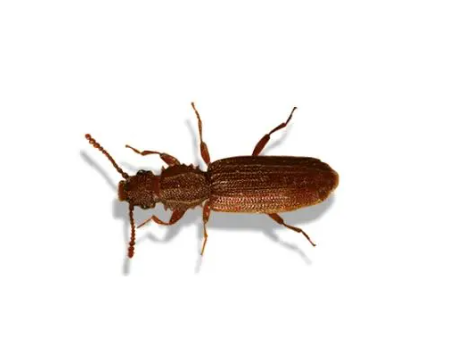
Adult saw-toothed grain beetles are small, slender insects measuring approximately 2.5 to 3 millimeters (0.1 inch) long.
- Appearance (Key ID): Long, narrow, flattened reddish-brown beetle.
- Thorax (Key ID): Six distinctive saw-like projections occur on each side of the thorax, giving the beetle its common name.
- Color: Light to dark reddish-brown.
- Body Shape: Extremely flattened, allowing entry into narrow cracks and food packaging.
- Larva (Key ID): Creamy-white to yellowish larva with a brown head and small body hairs.
- Conflict: Food contamination and stored-product losses.
Distribution and Habitat
Saw-toothed grain beetles occur worldwide and are found wherever stored food products are present. They thrive in both commercial and residential environments.
Common habitats include:
- Grain bins and silos
- Warehouses
- Food processing plants
- Retail food stores
- Household pantries
- Pet food storage areas
- Birdseed storage containers
These beetles are especially common in warm, humid environments where food products remain undisturbed for extended periods.
Life Cycle
Saw-toothed grain beetles undergo complete metamorphosis with four life stages:
- Egg
- Larva
- Pupa
- Adult
Egg Stage
Female beetles deposit eggs directly on or near food materials, often placing them in cracks, crevices, or among food particles. A single female may lay hundreds of eggs during her lifetime.
Larval Stage
Larvae hatch within a few days and begin feeding immediately on available food. They feed externally on grain fragments, processed foods, and damaged kernels.
Larvae pass through several molts before reaching maturity.
Pupal Stage
Pupation occurs within small cocoons constructed from food particles and debris. This stage typically lasts one to three weeks depending on temperature.
Adult Stage
Adults emerge from pupae and begin feeding and reproducing shortly afterward. Under favorable conditions, development from egg to adult may take as little as one month.
Multiple overlapping generations may occur annually in heated structures.
Behavior and Ecology
Saw-toothed grain beetles are highly adapted to stored-product environments.
- Excellent Crawlers: Their flattened bodies allow them to penetrate packaging seams and narrow crevices.
- Rapid Population Growth: Populations can increase quickly under warm conditions.
- External Feeders: Unlike rice weevils, they feed primarily outside kernels rather than developing internally.
- Food Generalists: They infest a broad range of dry foods.
- Hidden Habitats: Adults frequently hide in cracks, shelves, machinery, and packaging materials.
Damage and Economic Impact
Saw-toothed grain beetles cause significant economic losses in stored food products worldwide.
Food Contamination
Both adults and larvae contaminate stored foods with:
- Live insects
- Dead insects
- Cast skins
- Frass (fecal material)
- Food debris
Quality Reduction
Infested products lose market value and may become unacceptable for human consumption.
Packaging Infestation
These beetles often invade packaged foods and spread rapidly between products stored close together.
Economic Losses
Heavy infestations can force producers, processors, retailers, and homeowners to discard large quantities of food products.
Common Foods Attacked
- Rice
- Wheat
- Flour
- Cornmeal
- Pasta
- Breakfast cereals
- Dried fruits
- Nuts
- Seeds
- Pet food
- Birdseed
- Chocolate
- Spices
- Cookies and crackers
Signs of Infestation
- Small reddish-brown beetles crawling inside packages or cabinets
- Larvae or pupae in stored foods
- Cast skins and insect fragments
- Accumulations of fine food dust
- Infested products with unusual odors or clumping
Management and Control (IPM)
Successful management requires an Integrated Pest Management (IPM) approach emphasizing sanitation, monitoring, and proper storage.
Proper Storage Practices
- Store foods in airtight plastic, glass, or metal containers.
- Keep storage areas cool and dry.
- Rotate products regularly.
- Avoid long-term storage of susceptible foods.
Sanitation
- Clean pantry shelves frequently.
- Remove spilled grain and food debris immediately.
- Vacuum cracks, corners, and shelf joints.
- Discard heavily infested products.
Inspection and Monitoring
- Inspect stored foods regularly.
- Check newly purchased products before storage.
- Use sticky or pheromone traps to detect infestations.
- Monitor high-risk foods such as birdseed and pet food.
Temperature Management
Extreme temperatures can eliminate infestations.
- Freezing: Store infested products at 0°F (-18°C) for at least four days.
- Heat Treatment: Commercial heat treatments can eliminate all life stages.
Chemical Control
Chemical treatments are generally unnecessary in household settings if sanitation and removal of infested products are performed. In commercial facilities, approved residual insecticides or fumigation may be necessary under professional supervision.
Prevention
- Purchase only quantities that can be used promptly.
- Inspect food products before storage.
- Store foods in sealed containers.
- Freeze susceptible products after purchase as a preventative measure.
- Practice first-in, first-out product rotation.
- Maintain excellent sanitation in storage areas.
Research and Importance
Research on saw-toothed grain beetles focuses on improved monitoring systems, biological control methods, hermetic storage technologies, and reduced-risk pest management strategies. Because they are globally important stored-product pests, these beetles remain a major focus of food protection research.
Conclusion
Saw-Toothed Grain Beetles are serious pests of stored food products capable of rapidly infesting homes, warehouses, and food processing facilities. Their ability to exploit a wide variety of stored foods makes prevention, sanitation, monitoring, and proper storage essential for effective long-term control.