Overview
Rice Weevils (Sitophilus oryzae) are among the most destructive and widespread pests of stored grain products worldwide. These small beetles primarily infest stored rice, but they also attack wheat, corn, barley, oats, sorghum, rye, and numerous processed grain products. Because the larvae develop entirely inside individual kernels, infestations often remain hidden until significant damage has occurred.
Rice weevils are major pests in homes, grain elevators, warehouses, food processing facilities, and commercial storage systems. Their feeding reduces grain weight and quality while contaminating products with insects, cast skins, frass, and damaged kernels. Severe infestations can result in substantial economic losses for producers, processors, retailers, and homeowners.
Taxonomy and Classification
Rice weevils belong to the family Curculionidae, commonly known as the true weevils or snout beetles.
- Kingdom: Animalia
- Phylum: Arthropoda
- Class: Insecta
- Order: Coleoptera
- Family: Curculionidae
- Subfamily: Dryophthorinae
- Genus: Sitophilus
- Species: Sitophilus oryzae
Rice weevils are closely related to other important stored-product pests, including the Granary Weevil (Sitophilus granarius) and the Maize Weevil (Sitophilus zeamais).
Physical Description
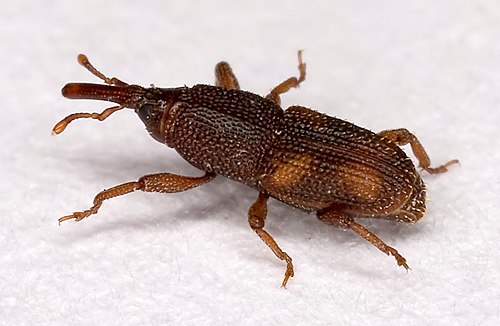
Adult rice weevils are small insects measuring approximately 2 to 3.5 millimeters (0.08 to 0.14 inches) long.
- Appearance (Key ID): Elongated, cylindrical beetle with a distinctive long, downward-curved snout (rostrum).
- Color: Reddish-brown to dark brown or nearly black.
- Elytral Markings: Four distinctive reddish or yellow-orange spots are typically visible on the wing covers.
- Antennae: Elbowed antennae arise from the snout.
- Wings: Unlike granary weevils, rice weevils possess functional wings and are capable of flight.
- Larva (Key ID): Creamy-white, legless grub with a brown head capsule, found entirely within grain kernels.
- Conflict: Stored grain destruction and food contamination.
Distribution and Habitat
Rice weevils are found worldwide and are especially common in warm, humid climates. They thrive in environments where grain is stored for extended periods.
Common habitats include:
- Grain storage bins
- Warehouses
- Food processing facilities
- Farm storage structures
- Commercial silos
- Retail food stores
- Household pantries
Rice weevils prefer whole grains but may also infest products such as pasta, birdseed, pet food, dried beans, and decorative corn.
Life Cycle and Development
Rice weevils undergo complete metamorphosis with four life stages:
- Egg
- Larva
- Pupa
- Adult
Egg Stage
Females use their snout to chew a small hole into a grain kernel. A single egg is deposited inside the kernel, and the opening is sealed with a gelatinous plug. A female may lay several hundred eggs during her lifetime.
Larval Stage
After hatching, the larva remains entirely inside the grain, feeding on the nutrient-rich interior. Because feeding occurs internally, infestations may go unnoticed for long periods.
Pupal Stage
The larva pupates within the hollowed grain kernel. The entire immature development occurs inside the grain.
Adult Stage
Adults chew circular exit holes as they emerge from kernels. Under favorable warm conditions, the complete life cycle may be completed in as little as four to six weeks, allowing multiple generations per year.
Behavior and Ecology
Rice weevils are highly adapted to stored-product environments.
- Internal Feeders: Larvae develop entirely inside grain kernels.
- Strong Dispersal Ability: Adults can fly and readily infest new grain sources.
- Preference for Whole Grain: Whole kernels are preferred over processed products.
- Rapid Reproduction: Warm temperatures accelerate development and population growth.
- Hidden Infestations: Because larvae feed internally, infestations may remain undetected until adults emerge.
Damage and Economic Impact
Rice weevils are among the most economically important stored-grain pests worldwide.
Grain Weight Loss
Larval feeding consumes the endosperm and embryo, reducing grain weight and market value.
Reduced Seed Viability
Infested grain intended for planting often loses its ability to germinate because the embryo has been consumed.
Food Contamination
Infested products may contain:
- Live insects
- Dead insects
- Cast skins
- Frass (insect excrement)
- Damaged kernels
Quality Deterioration
Heavy infestations can increase moisture and temperature within stored grain, promoting mold growth and secondary infestations by other pests.
Economic Losses
Infestations may force producers and retailers to discard contaminated products, resulting in substantial financial losses.
Signs of Infestation
- Small round exit holes in grain kernels
- Presence of adult beetles in stored products
- Damaged or hollow kernels
- Accumulation of fine grain dust
- Live larvae inside kernels
- Reduced grain weight and quality
Management and Control (IPM)
Successful management of rice weevils relies on an Integrated Pest Management (IPM) approach emphasizing prevention, sanitation, monitoring, and proper storage practices.
Proper Storage Practices
- Store grain in clean, dry, well-ventilated facilities.
- Use airtight containers whenever possible.
- Maintain low humidity and cool storage temperatures.
- Rotate stored products to avoid long-term storage.
Sanitation
- Clean storage areas thoroughly before adding new grain.
- Remove spilled grain and debris promptly.
- Vacuum cracks, corners, and shelving regularly.
- Dispose of heavily infested products immediately.
Inspection and Monitoring
- Inspect stored grain regularly.
- Look for exit holes and live adults.
- Use pheromone traps to monitor populations.
- Check incoming grain shipments before storage.
Temperature Management
Extreme temperatures effectively kill rice weevils.
- Freezing: Place infested products in a freezer at 0°F (-18°C) for at least four days.
- Heat Treatment: High temperatures can eliminate all life stages in commercial facilities.
Chemical Control
When infestations are severe, approved insecticides or fumigants may be used in commercial storage systems by trained professionals. Chemical treatments should always follow label directions and food safety regulations.
Prevention
- Purchase only quantities that can be used quickly.
- Inspect grains before purchase.
- Store products in sealed containers.
- Freeze newly purchased grain products as a preventative measure.
- Clean pantry shelves regularly.
- Practice first-in, first-out product rotation.
Research and Importance
Research on rice weevils focuses on improved monitoring systems, biological control, resistant grain varieties, hermetic storage technologies, and reduced-risk management strategies. Because of their global economic importance, rice weevils remain a major focus of stored-product entomology research.
Conclusion
Rice Weevils are among the most destructive pests of stored grains worldwide. Their ability to develop hidden inside kernels makes early detection challenging, while their rapid reproduction can quickly lead to severe infestations. Proper sanitation, careful monitoring, airtight storage, and integrated management practices are essential for protecting stored grain products and preventing economic losses.