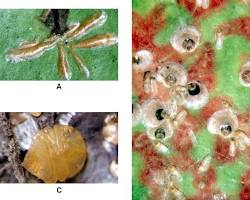
Zucchini scale insects are small sap-feeding pests that attach themselves firmly to stems, leaves, and other plant surfaces, where they feed quietly and often go unnoticed until the infestation becomes advanced. Unlike mobile chewing pests, scale insects live under protective coverings or waxy shells that make them look more like bumps, crusts, or small scabs than obvious insects. On zucchini, they are less commonly discussed than beetles, borers, or caterpillars, but when present they can still reduce plant vigor and add significant stress through steady sap loss.
Scale insects are difficult to notice because they do not jump, crawl rapidly, or leave chewing damage. Instead, they remain attached in place and feed continuously. This hidden, persistent feeding can cause leaves to yellow, stems to weaken, and plant growth to slow over time. In some cases, honeydew-producing scales also lead to sticky leaves and sooty mold, creating additional problems beyond sap removal alone.
Identification
Scale insects vary depending on the species, but most appear as tiny fixed bumps on plant tissue. Some are rounded and waxy, while others are flatter or more shell-like. Their colors may range from pale tan and brown to gray or white. The mobile crawler stage is the youngest stage and is often too small to notice easily, while older stages remain attached and protected by a covering.
On zucchini, scale insects may be found along stems, at leaf attachments, on leaf undersides, or in other relatively protected areas. Because they blend into plant surfaces, gardeners may mistake them for dirt, scars, or dried sap until closer inspection reveals that they are living pests.
Host Plants and Conditions
Scale insects attack many kinds of plants, including fruit trees, ornamentals, vines, shrubs, houseplants, and some vegetables. In zucchini, scale is more likely to become noticeable in sheltered plantings, greenhouse conditions, or situations where nearby infested plants serve as a source of spread. Because many scale insects prefer protected environments, crowded growth and limited airflow can make infestations harder to detect and easier to sustain.
Damage to Zucchini
The primary damage comes from sap feeding. Scale insects tap into plant tissues and steadily remove fluids, which weakens the plant over time. Infested zucchini may show yellowing leaves, reduced vigor, slower development, and general stress. Heavy infestations on stems can interfere with the plant’s overall health and make it less able to support normal leaf and fruit production.
Honeydew-producing scales create additional issues by coating nearby plant parts with sticky residue. This honeydew supports black sooty mold fungi, which darken the leaf surface and reduce photosynthesis. Ants may also be attracted to the honeydew and help protect the scales from predators. Even when scale populations are not dramatic, the long-term sap loss can still limit the performance of zucchini plants during periods of rapid growth.
Life Cycle
Scale insects begin life as eggs or very small mobile young, depending on the species. The crawler stage is the main dispersal stage. Once the crawlers settle on a suitable feeding site, they insert their mouthparts and begin to develop their protective coverings. After that, many become mostly stationary and continue feeding in place. Because generations can overlap, a single plant may host crawlers, immature stages, and adults simultaneously.
This life cycle makes timing important in management. Crawlers are typically the most vulnerable stage, while older scales are harder to control because of their protective coverings and fixed position on the plant.
Signs of Infestation
Signs include small crusty or waxy bumps on stems and leaves, yellowing foliage, sticky residue, sooty mold, and sometimes ant activity. Since scales do not create obvious chewing patterns, gardeners may overlook them until a section of the plant appears unusually weak or coated. A fingernail or tool can sometimes be used to gently lift one from the stem, revealing the insect body beneath the shell or covering.
Close inspection is especially important when zucchini plants are underperforming for no clear reason and no chewing or webbing pests are obvious. The problem may be fixed in place rather than moving around visibly.
Prevention and Management
Preventing scale problems starts with checking transplants and nearby host plants before they are placed near zucchini. Good spacing and airflow help reduce favorable hidden conditions. If infestations are localized, pruning or removing infested parts may reduce pressure. In small plantings, scales can sometimes be physically removed from stems or washed off to a limited extent, though fixed older stages may cling tightly.
Natural enemies such as lady beetles, parasitic wasps, and lacewings can help suppress scale insects, so preserving these beneficial insects is important. Ant control may also improve natural predator effectiveness when honeydew is present. If treatment is needed, it should target the vulnerable crawler stage whenever possible. Repeated monitoring is important because hidden individuals can easily survive and restart the infestation.
Integrated Pest Management for Scale
An integrated program for zucchini scale insects includes early detection, inspection of stems and protected plant parts, management of ants, support for biological control, and removal of heavily infested tissue when practical. Since scale insects are often found late, prevention and routine observation are more effective than waiting until the plant shows major stress symptoms.
Conclusion
Zucchini scale insects are quiet sap-feeding pests that weaken plants gradually by attaching to stems and leaves and feeding under protective coverings. Their slow, hidden nature makes them easy to miss, but the effects can become significant over time, especially when honeydew, sooty mold, or ant activity are involved. Careful inspection, sanitation, and support for natural enemies are the keys to preventing scale from becoming a lasting problem in zucchini plantings.