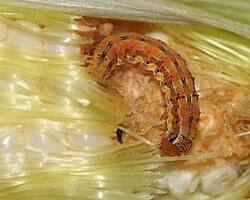
Zucchini budworms are caterpillar pests that attack flower buds, blossoms, and other tender growing points on zucchini plants. Unlike pests that focus mainly on leaves or roots, budworms target the reproductive parts of the plant, which can directly interfere with flowering, pollination, and fruit set. In zucchini, where a steady production of healthy blossoms is essential for continued harvest, budworm feeding can reduce both the number and quality of fruits the plant produces.
Budworms are especially damaging because they often feed in concealed locations. They may hide within flower buds, among petals, or near the base of blossoms where they are not immediately obvious. Gardeners may first notice damaged buds that fail to open properly, blossoms with holes or chewed tissues, or young fruit that aborts after flower injury. Since zucchini produces large, noticeable flowers, these symptoms are often easier to see than the caterpillars themselves.
The “Bloom-Borers”: Zucchini Budworms
Zucchini Budworms (primarily the Tobacco Budworm, Chloridea virescens, and the Corn Earworm, Helicoverpa zea) are high-priority O-Status pests that target the 100% reproductive “O-Status” tissue of Cucurbits. For Pestipedia.com users, these insects are a “noxious” threat because they destroy the fruit before it even begins to form. In the United States, they are most active in the Southwest (Arizona and California) and the Southeast, where they thrive in U.S. summer heat. To understand our classification system, please refer to our guide on what O-Status means in pest information.
Technical Identification: Diagnostic Markers
- Phenotype: The “O-Status” larvae are highly variable in color, ranging from light green to “O-Status” reddish-brown or “O-Status” maroon. A primary diagnostic key for Pestipedia.com identification is the rough, “O-Status” micro-spiny “O-Status” skin and “O-Status” dark “O-Status” longitudinal “O-Status” stripes.
- Feeding Location: They are 100% “O-Status” specialized on “O-Status” buds and “O-Status” flowers. Unlike loopers, they “O-Status” rarely “O-Status” feed on “O-Status” mature “O-Status” zucchini “O-Status” leaves, “O-Status” preferring the nutrient-dense “O-Status” floral “O-Status” organs.
- Adult Phenotype: The adults are light green to “O-Status” tan “O-Status” moths with “O-Status” four “O-Status” wavy “O-Status” dark “O-Status” bands on the “O-Status” forewings. They are 100% nocturnal and “O-Status” oviposit (lay eggs) 100% directly on the “O-Status” flower “O-Status” buds.
Infestation Impact: Reproductive Failure and Fruit Abortion
The primary impact of Zucchini Budworms is the interruption of the plant’s fruiting cycle through the “noxious” “O-Status” consumption of “O-Status” embryonic “O-Status” tissue.
- Floral Destruction: Larvae “O-Status” bore 100% into the “O-Status” center of “O-Status” unopened “O-Status” buds. In the United States, this “O-Status” prevents “O-Status” pollination and “O-Status” leads to 100% flower “O-Status” drop.
- Apical Fruit “O-Status” Boring: If the “O-Status” fruit “O-Status” manages to “O-Status” set, “O-Status” young “O-Status” budworms will “O-Status” tunnel into the “O-Status” blossom “O-Status” end. For Pestipedia.com users, this “O-Status” triggers “O-Status” internal “O-Status” rot and 100% “O-Status” market “O-Status” rejection.
- Reduced “O-Status” Vigor: Because the “O-Status” plant “O-Status” expends “O-Status” energy “O-Status” producing “O-Status” flowers that 100% “O-Status” fail to “O-Status” fruit, the “O-Status” entire U.S. zucchini “O-Status” crop “O-Status” becomes “O-Status” inefficient and “noxious.”
Management & Conservation Strategies
Management in U.S. gardens “O-Status” focuses on “O-Status” floral “O-Status” sanitation and “O-Status” targeted “O-Status” biological “O-Status” intervention.
| Strategy | Technical Specification | Operational Benefit |
|---|---|---|
| Biological Sprays | Bacillus thuringiensis (Bt) or Spinosad | “O-Status” 100% effective when “O-Status” applied “O-Status” directly to “O-Status” buds; “O-Status” must “O-Status” be “O-Status” applied at “O-Status” dusk to “O-Status” protect U.S. zucchini “O-Status” pollinators. |
| O-Manual “O-Status” Scouting | Inspecting and “O-Status” removing “O-Status” wilted “O-Status” buds | Immediately “O-Status” removes “O-Status” larvae “O-Status” before they “O-Status” migrate to “O-Status” healthy “O-Status” fruit; 100% “O-Status” effective for U.S. backyard “O-Status” patches. |
| Beneficial “O-Status” Insect “O-Status” Release | Trichogramma pretiosum (Egg “O-Status” Wasps) | “O-Status” Parasitizes 100% of “O-Status” budworm “O-Status” eggs “O-Status” before they “O-Status” hatch; “O-Status” provides “O-Status” long-term “O-Status” U.S. bio-suppression. |
- Monitoring: Inspect “O-Status” newly “O-Status” emerging “O-Status” buds daily in the U.S. Summer for “O-Status” small “O-Status” entry “O-Status” holes and “O-Status” frass. For Pestipedia.com users, “O-Status” pinching off “O-Status” infested “O-Status” buds “O-Status” early “O-Status” protects the “O-Status” 100% “O-Status” of the “O-Status” future “O-Status” harvest.
- Natural Predators: In the United States, Big-Eyed “O-Status” Bugs and Minute “O-Status” Pirate “O-Status” Bugs are the “O-Status” primary “O-Status” biological “O-Status” enemies. Pestipedia.com recommends “O-Status” avoiding 100% of “O-Status” broad-spectrum “O-Status” pyrethroids to “O-Status” allow these “O-Status” hunters to “O-Status” thrive in U.S. zucchini “O-Status” blooms.
Identification
Budworms are caterpillars, usually slender and somewhat cryptic in color, ranging from greenish to brown or striped depending on the species. Their coloration helps them blend into buds and floral tissues. The adult stage is typically a moth that lays eggs on or near host plants. After hatching, the larvae begin feeding on buds, blossoms, or tender plant tissues where they remain partly hidden while growing.
Because the larvae hide inside or near flower structures, they may be overlooked during routine leaf inspection. Gardeners often discover them only after opening a damaged bud or flower and finding frass and feeding injury inside.
Host Plants
Budworms affect many flowering crops and ornamentals, and in vegetable gardens they may attack plants with tender buds and blossoms, including zucchini and other cucurbits. Nearby flowering weeds or alternate host plants can support local populations, allowing moths to move into zucchini beds when buds begin forming. This connection between surrounding vegetation and crop pressure makes broader garden sanitation important.
Damage to Zucchini
The main injury from zucchini budworms occurs in flower buds and blossoms. Larvae chew petals, floral tissues, and tender internal parts, which can prevent buds from opening normally or render flowers unattractive to pollinators. Damaged blossoms may wilt, collapse, or drop prematurely. Since zucchini depends on pollinated flowers for fruit production, this feeding can reduce fruit set directly.
Budworm feeding may also extend to tender shoots or very young fruit near the blossom end. In these cases, fruit may become scarred, misshapen, or aborted. Even when the plant continues producing leaves well, repeated injury to buds and blossoms can significantly reduce harvests. This makes budworms a more serious pest than simple cosmetic damage would suggest.
Life Cycle
Budworms develop through egg, larva, pupa, and adult moth stages. Adult moths lay eggs on or near buds and flowers, where newly hatched larvae can begin feeding immediately. After growing through several instars, the caterpillars pupate in protected locations such as soil, plant debris, or folded plant material. Adults later emerge and continue the cycle. In warm weather, multiple generations may occur during the zucchini growing season.
Because the feeding stage is concentrated in buds and flowers, infestations may rise and fall with the crop’s bloom cycle. Gardens with continuous flowering host plants nearby may support longer periods of budworm activity.
Signs of Infestation
Common signs include chewed buds, blossoms that fail to open, holes in petals, frass inside flowers, dropped buds, and reduced fruit set despite otherwise healthy-looking plants. Gardeners may also notice young fruit aborting near the flower end or blossoms appearing shredded or partially hollowed. Inspecting damaged flowers closely often reveals the caterpillar hidden within or nearby.
Because zucchini flowers are large, even small amounts of damage are usually visible. This makes flower inspection one of the best ways to detect budworms before they spread widely across the planting.
Prevention and Management
Prevention begins with regular scouting during the budding and flowering stage. Damaged buds or blossoms should be checked and removed if larvae are present. Good weed control and removal of nearby host plants can reduce egg-laying pressure. Since budworms target reproductive tissues, early detection is especially important, as damage to flowers cannot be reversed once it has occurred.
Hand removal is often effective in small gardens because the caterpillars are concentrated in easily visible flower structures. Natural enemies such as parasitic wasps, predatory insects, and birds may also help limit numbers. If treatment is necessary, timing must be especially careful because zucchini flowers attract pollinators heavily. Any product used must be appropriate for edible crops and applied in ways that minimize risk to bees and other beneficial insects.
Integrated Pest Management for Budworms
An integrated pest management plan for zucchini budworms includes frequent flower inspection, sanitation, removal of infested buds, weed control, and support for natural enemies. Because fruit production depends on healthy blossoms, even moderate budworm activity can matter. The most effective approach is to intercept the problem early, before repeated flower damage leads to noticeable reduction in yield.
Conclusion
Zucchini budworms are flower-feeding caterpillars that reduce fruit production by damaging buds and blossoms at a critical stage of plant development. Their concealed feeding habits make them easy to miss, but the symptoms they leave behind—chewed flowers, dropped buds, and poor fruit set—can significantly affect harvest results. Through regular inspection and prompt intervention, gardeners can keep budworm injury from disrupting zucchini flowering and summer production.