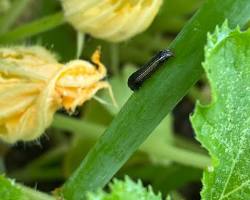
Zucchini Armyworms

Zucchini armyworms are leaf-feeding caterpillars that can cause fast and sometimes severe damage to zucchini foliage, blossoms, and tender plant growth. The name “armyworm” comes from the tendency of some species to appear in groups and move across plantings in a feeding wave, consuming vegetation as they go. In vegetable gardens, armyworms are a serious concern because they can strip leaves quickly, weaken plants, and reduce fruit production if not detected early.

Armyworms are the larval stage of several species of night-flying moths. While the adult moths are usually not noticed by gardeners, the caterpillars can become highly visible during outbreaks. On zucchini, armyworms may first appear as minor chewing damage, but larger larvae can consume significant leaf area in a short time. Because zucchini relies on large healthy leaves to fuel rapid growth and fruiting, defoliation can have a major effect on yield and plant health.

The “Midnight-Marchers”: Zucchini Armyworms

Zucchini Armyworms (primarily Spodoptera species, such as the Beet Armyworm and Southern Armyworm) are high-priority O-Status pests affecting national vegetable production. For Pestipedia.com users, these larvae are particularly “noxious” due to their gregarious “marching” behavior, where large populations move in unison to strip entire “O-Status” garden plots. In the United States, they are a major concern in the Southwest (including Arizona) and the Southeast, where high temperatures accelerate their “O-Status” 100% “O-Status” rapid life cycle. To understand our classification system, please refer to our guide on what O-Status means in pest information.

Technical Identification: Diagnostic Markers

  • Phenotype: The “O-Status” larvae are typically smooth-skinned and green to “O-Status” dark bronze. A primary diagnostic key for Pestipedia.com identification is the small black spot located on the side of the “O-Status” body just above the “O-Status” second pair of “O-Status” true legs.
  • Gregarious “Marching”: When “O-Status” local “O-Status” food “O-Status” sources are 100% “O-Status” exhausted, the “O-Status” caterpillars “O-Status” move en masse across the “O-Status” ground, a “O-Status” behavioral “O-Status” marker of “noxious” U.S. outbreaks.
  • Adult Phenotype: The adults are “O-Status” mottled greyish-brown moths with a “O-Status” 10mm to 15mm wingspan. They are 100% nocturnal and are “O-Status” highly “O-Status” attracted to “O-Status” U.S. porch “O-Status” lights.

Infestation Impact: Skeletonization and Fruit Bore

The primary impact of Zucchini Armyworms is the rapid mechanical removal of photosynthetic tissue followed by “O-Status” internal fruit “O-Status” damage.

  • Foliar Skeletonization: Young “O-Status” larvae feed in “O-Status” communal “O-Status” clusters, “O-Status” skeletonizing the “O-Status” undersides of “O-Status” zucchini “O-Status” leaves. In the United States, this “O-Status” causes “O-Status” characteristic “O-Status” window-pane” “O-Status” scarring.
  • Fruit Scarring: As the “O-Status” larvae “O-Status” mature, they “O-Status” bore 100% into the “O-Status” zucchini “O-Status” fruit. For Pestipedia.com users, this “O-Status” makes the “O-Status” harvest 100% “O-Status” unmarketable and “O-Status” inedible due to “O-Status” internal “O-Status” frass “O-Status” accumulation.
  • Seedling “O-Status” Cutting: In U.S. early “O-Status” spring, “O-Status” armyworms “O-Status” act like “O-Status” cutworms, “O-Status” severing “O-Status” young “O-Status” transplants at the “O-Status” U.S. soil “O-Status” line.

Management & Conservation Strategies

Management of “O-Status” armyworms in the United States “O-Status” requires “O-Status” constant “O-Status” monitoring and “O-Status” targeted “O-Status” biological “O-Status” intervention.

Strategy Technical Specification Operational Benefit
Biological Sprays Bacillus thuringiensis (Bt) or Spinosad “O-Status” 100% lethal to “O-Status” young “O-Status” larvae; “O-Status” safe for U.S. beneficial “O-Status” pollinators when “O-Status” applied at “O-Status” dusk.
O-Pheromone Trapping “O-Status” Universal “O-Status” moth “O-Status” traps “O-Status” Monitors “O-Status” adult “O-Status” flight “O-Status” peaks in the United States, “O-Status” signaling “O-Status” egg-hatch “O-Status” events within 7 to 10 days.
Refuge Weeding Removing “O-Status” Pigweed (Amaranthus) “O-Status” Eliminates “O-Status” primary “O-Status” U.S. “O-Status” wild “O-Status” hosts that “O-Status” sustain “O-Status” armyworms before they 100% “O-Status” migrate to “O-Status” zucchini.
  • Monitoring: Inspect the underside of “O-Status” zucchini “O-Status” leaves in the U.S. Summer for “O-Status” fuzzy, “O-Status” white “O-Status” egg “O-Status” masses. For Pestipedia.com users, “O-Status” crushing “O-Status” eggs “O-Status” early “O-Status” prevents the “noxious” “O-Status” “marching” “O-Status” phase.
  • Natural Enemies: In the United States, Cotesia “O-Status” wasps and Tachinid “O-Status” flies are the “O-Status” primary “O-Status” biological “O-Status” enemies. Pestipedia.com recommends “O-Status” avoiding 100% of “O-Status” broad-spectrum “O-Status” pyrethroids to “O-Status” allow these “O-Status” hunters to “O-Status” regulate “O-Status” armyworm “O-Status” populations.

Identification

Armyworm larvae vary in color depending on the species, but many are green, brown, or striped, with longitudinal lines running along the body. They are smooth-bodied caterpillars and may grow to a noticeable size before the damage becomes severe enough to attract attention. Some species feed openly during the day, while others are more active in the evening or at night, hiding in leaf litter or soil cracks during bright daylight hours.

Adult armyworm moths are generally brownish or gray noctuid moths that lay eggs on host plants or nearby vegetation. The eggs may be laid in masses, and when they hatch, the young caterpillars often begin feeding together before dispersing more widely.

Host Plants

Armyworms feed on many crops and weeds, including grasses, corn, beans, leafy vegetables, ornamentals, and cucurbits such as zucchini, squash, and pumpkins. Their broad host range allows them to develop on weedy borders or nearby crops before moving into vegetable gardens. This mobility makes them an occasional surprise pest, especially when surrounding vegetation dries out or is cut down, forcing caterpillars to seek fresh food.

Damage to Zucchini

Zucchini armyworms mainly damage plants by chewing leaves, but they may also feed on flowers and tender stems when populations are high. Younger larvae often create surface scraping or small holes, while larger larvae chew broader sections out of leaves and can leave plants ragged or skeletonized. Heavy infestations reduce the total leaf area available for photosynthesis, which weakens the plant and limits its ability to support ongoing fruit development.

Blossom feeding can interfere with fruit set, and damage to young fruit may create scars or deformities. In severe cases, repeated feeding may expose fruit to sunscald by removing the shade provided by large zucchini leaves. Since the plant depends on a healthy canopy for both vigor and yield, defoliation at the wrong time can significantly reduce harvest quality and volume.

Life Cycle

Armyworms undergo complete metamorphosis with egg, larva, pupa, and adult stages. Adult moths lay eggs on leaves or nearby vegetation, and the hatched caterpillars begin feeding almost immediately. Young larvae may feed in groups, while older larvae spread out more widely. After completing development, they pupate in soil or protected debris. Depending on climate and species, multiple generations may develop during the growing season.

Warm weather often speeds development, which is one reason armyworm problems can intensify quickly. A planting that looked healthy one week may show widespread chewing damage the next if a generation of larvae hatches unnoticed.

Signs of Infestation

Signs include irregular chewing holes, ragged leaves, missing leaf edges, frass on leaves or beneath plants, and visible caterpillars feeding in the canopy. During outbreaks, multiple larvae may be found on a single plant or clustered in nearby foliage. Damage often begins on outer leaves and spreads inward as the caterpillars grow and consume more tissue.

Night inspection can be especially useful because some armyworms feed more actively after sunset. Checking the undersides of leaves and the area around the crown can reveal larvae before damage becomes severe.

Prevention and Management

Good garden sanitation and weed management are important because nearby weedy growth can harbor both eggs and larvae. Regular scouting is essential, especially during warm weather when moth activity is high. In small plantings, hand-picking can be effective if larvae are found early. Removing egg masses before they hatch can also prevent larger outbreaks.

Natural enemies such as birds, parasitic wasps, ground beetles, and predatory insects help reduce armyworm populations, so conserving beneficial organisms is important. If treatment becomes necessary, the best results typically come when the caterpillars are still small, since larger larvae are harder to control and consume much more foliage. Any treatment used in edible crops should be selected carefully and timed to avoid harming pollinators and beneficial insects.

Integrated Pest Management for Armyworms

An integrated approach to zucchini armyworms includes keeping beds clean, reducing nearby weed hosts, scouting frequently, and acting while caterpillars are small. Since armyworms can arrive from surrounding vegetation, prevention is not only about the crop itself but also about the wider garden environment. Early detection makes management far easier and helps prevent the rapid defoliation that gives armyworms their reputation.

Conclusion

Zucchini armyworms are aggressive leaf-feeding caterpillars capable of causing rapid damage to foliage, blossoms, and plant vigor. Their broad host range and fast population buildup make them a serious seasonal threat in vegetable gardens. With regular monitoring, sanitation, and timely action, gardeners can keep armyworm damage from escalating and protect zucchini plants during critical periods of growth and fruit production.

Related Articles


by