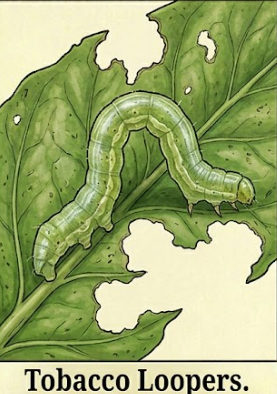
Tobacco Loopers are destructive foliage-feeding caterpillars that attack tobacco and a wide range of agricultural crops. These insects are named for their distinctive looping movement, which results from having fewer abdominal prolegs than most caterpillars. As they move, they arch their bodies into a characteristic loop before extending forward. While this unusual movement makes them relatively easy to identify, their feeding habits make them serious pests in tobacco production and vegetable-growing regions.
The larvae feed openly on leaves, consuming valuable foliage and reducing the plant’s ability to produce energy through photosynthesis. In tobacco crops, the leaves themselves are the harvested product, making even moderate feeding damage economically significant. Heavy infestations can skeletonize leaves, reduce plant vigor, lower crop quality, and substantially reduce market value. Because multiple generations can develop during a single growing season, Tobacco Loopers often remain a persistent threat throughout warm weather.
Taxonomy and Classification
Tobacco Loopers belong to the order Lepidoptera and are members of the family Noctuidae.
- Order: Lepidoptera
- Family: Noctuidae
- Subfamily: Plusiinae
- Representative Species: Chrysodeixis chalcites
- Common Name: Tobacco Looper
Loopers are closely related to armyworms and cutworms but can be distinguished by their unique method of locomotion and feeding behavior.
Identification
Tobacco Loopers are relatively easy to identify once their characteristic movement and body shape are observed.
Larvae
- Length: Up to 35–40 mm when fully grown.
- Color: Bright green to yellow-green.
- Body Shape: Narrow near the head and wider toward the rear.
- Markings: Thin white longitudinal stripes along the body.
- Movement: Distinctive looping or inching gait.
The looping movement occurs because the caterpillar possesses fewer abdominal prolegs than most other caterpillar species.
Adult Moths
- Wingspan: Approximately 30–35 mm.
- Color: Brown, bronze, or golden-brown.
- Wing Markings: Metallic silver or white spots on the forewings.
- Activity: Primarily nocturnal.
Adult moths are strong fliers and may disperse between fields and host plants.
Key Signs of Infestation
- Irregular holes in leaves.
- Windowpane feeding damage.
- Skeletonized foliage.
- Green caterpillars on leaves.
- Dark frass deposits.
- Chewed leaf margins.
Heavy infestations can quickly transform healthy foliage into ragged, damaged leaves.
Distribution and Habitat
Tobacco Loopers occur throughout tropical, subtropical, and warm temperate regions.
Common habitats include:
- Tobacco fields
- Vegetable farms
- Greenhouses
- Home gardens
- Ornamental landscapes
- Field margins
- Agricultural production systems
Warm temperatures and abundant host plants support rapid population growth.
Host Plants
Tobacco Loopers feed on a wide variety of plants.
Common hosts include:
- Tobacco
- Tomatoes
- Potatoes
- Peppers
- Soybeans
- Beans
- Cabbage
- Lettuce
- Various weeds
- Ornamental plants
Their broad host range allows populations to persist throughout the growing season.
Life Cycle
Tobacco Loopers undergo complete metamorphosis.
- Egg Stage: Females lay eggs individually on leaf surfaces.
- Larval Stage: Caterpillars feed actively through multiple growth stages.
- Pupal Stage: Pupation occurs within a thin silken cocoon attached to foliage or plant debris.
- Adult Stage: Moths emerge, mate, and begin a new generation.
Several generations may develop annually, especially in warm climates where host plants are continuously available.
Feeding Behavior
Tobacco Loopers are primarily foliage feeders.
Young larvae often begin feeding on the undersides of leaves, creating translucent feeding areas known as windowpanes.
As larvae mature, they consume:
- Leaf surfaces.
- Leaf margins.
- Tender foliage.
- Young plant growth.
Large caterpillars are capable of consuming substantial amounts of leaf tissue each day.
Damage and Economic Importance
The primary damage caused by Tobacco Loopers results from foliage consumption.
Windowpane Feeding
- Transparent feeding patches.
- Surface tissue removal.
- Early infestation indicator.
This symptom often appears before extensive chewing damage develops.
Leaf Skeletonization
- Leaf tissue removed between veins.
- Lace-like appearance.
- Significant loss of photosynthetic area.
Heavy infestations may leave only major veins intact.
Defoliation
- Reduced canopy density.
- Slower plant growth.
- Reduced vigor.
- Lower yields.
Severe infestations can dramatically reduce plant productivity.
Impact on Tobacco Production
Tobacco Loopers are particularly damaging because the harvested product consists of leaves.
- Reduced usable leaf area.
- Lower market quality.
- Downgraded harvests.
- Reduced curing performance.
- Economic losses.
Even moderate feeding damage can affect crop value when premium leaf quality is required.
Signs of Infestation
Growers should watch for:
- Looping caterpillars.
- Windowpane feeding.
- Skeletonized leaves.
- Dark frass pellets.
- Chewed foliage.
- Visible larvae on leaf undersides.
Regular scouting allows infestations to be detected before major defoliation occurs.
Behavior and Conflict
Several biological characteristics contribute to the pest status of Tobacco Loopers.
- High Consumption Rate: Large larvae eat substantial amounts of foliage.
- Multiple Generations: Populations can increase rapidly.
- Wide Host Range: Numerous plants support survival.
- Strong Adult Dispersal: Moths readily colonize new areas.
- Resistance Development: Some populations have developed resistance to certain insecticides.
These characteristics make integrated management especially important.
Monitoring and Detection
Regular field scouting is essential.
- Inspect leaf undersides.
- Monitor for feeding damage.
- Search for eggs and young larvae.
- Track moth activity.
- Examine plants weekly during active growth.
Young larvae are generally easier to control than mature caterpillars.
Management and Prevention
An Integrated Pest Management (IPM) strategy provides the best long-term control.
Cultural Controls
- Remove weeds that serve as alternate hosts.
- Destroy crop residues.
- Promote healthy plant growth.
- Monitor nearby host crops.
Biological Control
- Parasitic wasps.
- Predatory insects.
- Birds.
- Beneficial pathogens.
Natural enemies can significantly suppress looper populations.
Microbial Controls
- Bacillus thuringiensis (Bt) products are highly effective against young larvae.
Bt works best when applied before caterpillars become large.
Organic Controls
- Neem-based products.
- Spinosad formulations.
- Biological insecticides.
These options are frequently used in integrated pest management programs.
Chemical Control
- Target early larval stages.
- Rotate active ingredients.
- Monitor for resistance.
- Follow label directions carefully.
Careful resistance management is essential because looper populations can adapt to repeated chemical exposure.
Conservation and Research
Research on Tobacco Loopers focuses on biological control, pheromone monitoring systems, host plant resistance, and sustainable management strategies. Scientists continue investigating ways to reduce insecticide use while maintaining effective suppression of damaging populations.
Regular monitoring, conservation of natural enemies, sanitation, and timely intervention remain the most effective methods for preventing severe Tobacco Looper outbreaks and protecting crop quality. Early detection is particularly important because young larvae are easier to manage and cause less damage than fully developed caterpillars.