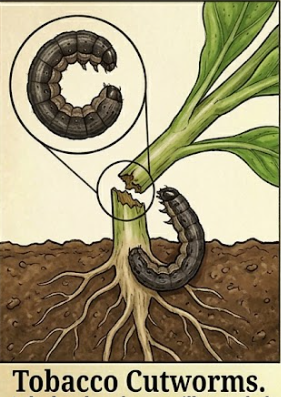
Tobacco Cutworms are destructive nocturnal caterpillar pests that attack tobacco and a wide variety of agricultural crops. These insects are best known for their ability to cut down young seedlings at or just below the soil line, often causing severe stand losses in newly established fields. Because they feed primarily at night and hide beneath soil, plant debris, or mulch during the day, infestations frequently go unnoticed until significant damage has already occurred.
In tobacco production, cutworm damage is especially serious during the transplant establishment stage. Young tobacco plants possess limited root systems and relatively fragile stems, making them highly vulnerable to attack. A single larva can destroy multiple plants in one evening, creating gaps in the field and reducing crop uniformity. In addition to tobacco, these pests commonly attack tomatoes, peppers, beans, leafy greens, and ornamental plants, allowing populations to persist across diverse agricultural landscapes.
Taxonomy and Classification
Tobacco Cutworms belong to the order Lepidoptera and are generally associated with several species of noctuid moths.
- Order: Lepidoptera
- Family: Noctuidae
- Common Species: Spodoptera litura and related cutworm species
- Common Name: Tobacco Cutworm
The caterpillar stage is responsible for all economically important damage. Adult moths primarily serve as reproductive stages and do not directly injure crops.
Identification
Tobacco Cutworms are most commonly identified by their feeding damage and distinctive larval appearance.
Larvae
- Length: Up to 40 mm when fully grown.
- Color: Gray, brown, black, or greenish-brown.
- Body: Smooth and relatively hairless.
- Markings: Often possess faint stripes and dark spots.
- Behavior: Curl into a tight “C” shape when disturbed.
The characteristic C-shaped defensive posture is one of the easiest ways to recognize a cutworm.
Adult Moths
- Wingspan: Approximately 30–40 mm.
- Color: Brown, gray, or dark mottled patterns.
- Activity: Nocturnal.
- Attraction: Frequently attracted to lights at night.
Adult moths are generally inconspicuous and often go unnoticed in agricultural settings.
Key Signs of Infestation
- Seedlings severed at the soil line.
- Wilted or fallen plants.
- Irregular holes in leaves.
- Stem feeding injury.
- Missing transplants.
- Larvae hidden beneath soil or debris.
Plants often appear healthy one day and completely cut down the next morning.
Distribution and Habitat
Tobacco Cutworms occur throughout many agricultural regions worldwide.
Common habitats include:
- Tobacco fields
- Vegetable gardens
- Commercial farms
- Greenhouses
- Field margins
- Cover-cropped areas
- Weedy landscapes
They thrive in areas where abundant vegetation and suitable host plants are available.
Host Plants
These pests feed on numerous crops and weeds.
Common hosts include:
- Tobacco
- Tomatoes
- Peppers
- Beans
- Lettuce
- Cabbage
- Spinach
- Corn
- Various weeds
- Ornamental plants
Their broad host range allows populations to survive even when tobacco is not present.
Life Cycle
Tobacco Cutworms undergo complete metamorphosis.
- Egg Stage: Females deposit eggs on vegetation, crop residues, or host plants.
- Larval Stage: Caterpillars feed on foliage before transitioning to stem-cutting behavior.
- Pupal Stage: Pupation occurs in the soil.
- Adult Stage: Moths emerge, mate, and lay eggs.
Several generations may occur annually in warm climates where host plants remain continuously available.
Feeding Behavior
Tobacco Cutworms are primarily nocturnal feeders.
During the day they hide:
- Under soil clods.
- Beneath mulch.
- Under plant debris.
- Within shallow soil tunnels.
At night they emerge to feed on nearby plants.
Young larvae often feed on leaves before progressing to more destructive stem-cutting behavior as they mature.
Damage and Economic Importance
The greatest economic impact occurs during early crop establishment.
Seedling Destruction
- Plants cut at ground level.
- Rapid stand loss.
- Missing rows.
- Uneven crop development.
A single larva may destroy multiple seedlings during a single night of feeding.
Leaf Feeding
- Ragged holes.
- Missing leaf margins.
- Reduced photosynthetic area.
Older plants often experience leaf feeding rather than complete severing.
Stem Damage
- Stem gouging.
- Weakening of young plants.
- Delayed growth.
- Increased susceptibility to disease.
Even plants that survive cutworm feeding may suffer reduced vigor throughout the growing season.
Secondary Problems
Cutworm injury can create additional management challenges.
- Entry points for pathogens.
- Uneven field stands.
- Increased weed pressure.
- Reduced harvest efficiency.
Fields with significant seedling loss often require replanting or additional management interventions.
Signs of Infestation
Growers should monitor for:
- Freshly cut seedlings.
- Wilted transplants.
- Missing plants.
- Nighttime feeding activity.
- C-shaped larvae beneath soil.
- Leaf chewing damage.
Inspecting the soil immediately around damaged plants often reveals the responsible caterpillar.
Behavior and Conflict
Several biological characteristics make Tobacco Cutworms particularly troublesome.
- Nocturnal Feeding: Damage occurs while growers are absent.
- Concealed Hiding: Larvae remain hidden during daylight.
- Broad Host Range: Numerous crops support survival.
- High Feeding Capacity: Individual larvae destroy multiple plants.
- Multiple Generations: Continuous pressure during the growing season.
These traits make early scouting and prevention especially important.
Monitoring and Detection
Successful management depends on regular monitoring.
- Inspect fields frequently after transplanting.
- Search around damaged plants.
- Monitor during evening hours.
- Check beneath debris and mulch.
- Track adult moth activity when possible.
Night scouting often provides the most reliable method for locating active larvae.
Management and Prevention
An Integrated Pest Management (IPM) program provides the most effective long-term control.
Field Sanitation
- Remove weeds.
- Destroy crop residues.
- Manage volunteer host plants.
- Reduce hiding locations.
Sanitation limits egg-laying sites and alternative food sources.
Physical Barriers
- Use collars around transplants.
- Protect vulnerable seedlings.
- Prevent stem access.
Collars are particularly effective in gardens and small-scale plantings.
Biological Control
- Ground beetles.
- Parasitic wasps.
- Birds.
- Beneficial nematodes.
Natural enemies can help suppress populations when conserved.
Organic Controls
- Bacillus thuringiensis (Bt).
- Spinosad-based baits.
- Diatomaceous earth barriers.
Applications are most effective when targeted toward young, actively feeding larvae.
Chemical Control
- Target early larval stages.
- Monitor fields closely.
- Use registered products appropriately.
- Follow label directions carefully.
Control measures are generally more effective before larvae become large and highly destructive.
Conservation and Research
Research on Tobacco Cutworms focuses on biological control agents, pheromone-based monitoring systems, resistant crop varieties, and sustainable management programs. Scientists continue developing strategies that minimize pesticide use while maintaining effective suppression of damaging populations.
Early scouting, field sanitation, weed management, and timely intervention remain the most effective defenses against Tobacco Cutworm infestations. Preventing damage during the vulnerable transplant stage is particularly important for protecting crop establishment and maximizing yield potential.