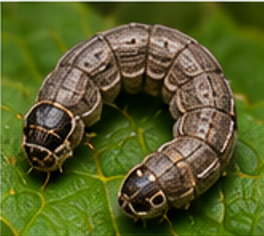
Night-flying cutworms are the larval stage of several moth species and are among the most destructive pests in agriculture and home gardens. These caterpillars feed at night and hide in soil during the day, making them difficult to detect. Their name comes from their habit of “cutting” seedlings at ground level, often killing young plants overnight.
These pests are particularly damaging in early growing seasons when seedlings are most vulnerable. A single cutworm can destroy multiple plants in a short period.
The Stealth Harvester: Night-Flying Cutworms
The Night-Flying Cutworm (primarily Agrotis ipsilon, the Black Cutworm, and related Noctuidae species) is a specialized agricultural pest found throughout the United States. These larvae earn their name from their binary lifestyle: they spend the daylight hours curled in a “C” shape beneath the soil surface, only emerging under the cover of darkness to “cut” down young seedlings at the soil line.
The “Guillotine” Feeding Method
The damage caused by Night-Flying Cutworms is distinctive and heart-breaking for gardeners and farmers alike. Because they feed on the succulent stems of transplants and sprouts, the damage is often absolute:
- Stem Severing: Unlike climbing caterpillars that eat leaves, cutworms chew through the main stem just above or below the soil surface. This causes the plant to topple over like a felled tree, often leaving the foliage completely uneaten.
- Dragging Behavior: In some cases, the cutworm will pull the severed plant into its underground burrow to feed in safety during the day, leaving only a small hole in the dirt where a plant once stood.
- High Economic Impact: Because a single larva can “cut” several plants in a single night without consuming them, they can thin out entire rows of corn, beans, or peppers in a matter of days.
Identification and Nocturnal Habits
The adult moths are heavy-bodied, drab brown or gray insects with a wingspan of about 1.5 to 2 inches. They are strong fliers and are highly attracted to lights at night. The larvae are greasy-looking, hairless caterpillars that range from gray to nearly black. When disturbed, they immediately curl into a tight ball, a defensive posture that makes them easy to identify when digging in the garden.
U.S. Management: The “Collar” Defense
In the United States, managing Night-Flying Cutworms is a classic example of mechanical and biological integration. Because the larvae are soil-dwellers, surface sprays are often ineffective. Management includes:
- Cutworm Collars: For home gardeners, placing a “collar” made of a cardboard toilet paper roll or a plastic cup (with the bottom removed) around individual transplants prevents the larvae from reaching the stem. The collar should be pushed 1–2 inches into the soil.
- Pre-Plant Tillage: Tilling the soil in the early spring can expose the larvae and pupae to birds and other predators.
- Bacillus thuringiensis (Bt): While effective, Bt must be applied as a “bait” (mixed with bran or molasses) on the soil surface, as the larvae do not typically feed on the sprayed leaves of the plant.
Identification
Larvae are smooth, gray or brown caterpillars that curl into a C-shape when disturbed. Adults are moths that are active at night.
Life Cycle
Eggs are laid on soil or plant debris. Larvae hatch and feed at night before pupating in soil. Multiple generations can occur annually.
Damage
Damage includes severed seedlings, wilted plants, and reduced crop establishment.
Control
Control includes using collars around seedlings, removing debris, and applying biological controls such as beneficial nematodes.