Overview
Southern Armyworms (Spodoptera eridania) are destructive caterpillar pests that attack a wide variety of agricultural crops, ornamental plants, and weeds throughout warm regions of the Americas. Their common name comes from their tendency to feed in large groups during early development and then move collectively across fields in search of fresh food sources.
These insects are highly adaptable and can feed on more than 200 plant species. Southern Armyworms are particularly damaging to vegetables, soybeans, peanuts, tomatoes, sweet potatoes, peppers, cotton, and numerous ornamental plants. Severe infestations can rapidly strip foliage, damage fruits, and significantly reduce crop yields.
Taxonomy and Classification
- Kingdom: Animalia
- Phylum: Arthropoda
- Class: Insecta
- Order: Lepidoptera
- Family: Noctuidae
- Genus: Spodoptera
- Species: Spodoptera eridania
Southern Armyworms belong to the same genus as several other important agricultural pests, including the Fall Armyworm and Beet Armyworm. Members of this group are known for their rapid reproduction, wide host range, and ability to cause sudden outbreaks.
Physical Description
The larval stage is responsible for virtually all plant damage.
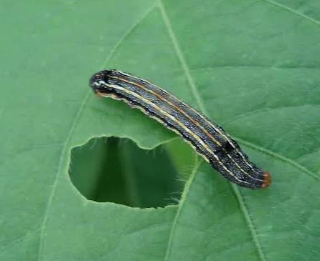
- Larva (Key ID): Robust caterpillar reaching up to 1.4 inches (35 mm) in length.
- Coloration: Variable, ranging from green and brown to dark gray or nearly black.
- Distinctive Markings: Prominent yellow or cream-colored stripes along the body and a large dark spot on the side of the first abdominal segment.
- Head Capsule: Typically reddish-brown or orange-brown.
- Adult Moth: Medium-sized moth with gray-brown forewings and pale hindwings.
- Egg Masses: Clusters of eggs covered with grayish scales from the female’s body.
- Conflict: Defoliation, fruit damage, crop loss, and ornamental plant destruction.
Distribution and Habitat
Southern Armyworms are found throughout tropical and subtropical regions of the Western Hemisphere.
In the United States they are most common in:
- Florida
- Texas
- Louisiana
- Mississippi
- Alabama
- Georgia
- Arizona
- California
- Other southern states
Populations thrive in warm climates and may survive year-round in frost-free regions. In cooler areas, adults migrate northward during favorable weather conditions.
Common habitats include:
- Vegetable gardens
- Agricultural fields
- Ornamental landscapes
- Greenhouses
- Weedy areas
- Roadside vegetation
Life Cycle
Southern Armyworms undergo complete metamorphosis with four distinct life stages:
- Egg
- Larva
- Pupa
- Adult
Egg Stage
Females lay egg masses on the undersides of leaves. Each mass may contain hundreds of eggs and is typically covered with protective scales.
Larval Stage
Larvae pass through several developmental stages called instars. Young caterpillars often feed together, skeletonizing leaves. Older larvae disperse and consume large quantities of foliage.
Pupal Stage
Pupation occurs in the soil, where larvae construct earthen chambers before transforming into adults.
Adult Stage
Adult moths emerge, mate, and begin laying eggs within a few days. Multiple generations can occur annually, especially in warm climates.
Damage and Symptoms
Southern Armyworms can damage plants at multiple growth stages.
Leaf Skeletonization
Young larvae feed on leaf tissue while leaving veins intact, producing a lacy or transparent appearance.
Defoliation
Older caterpillars consume entire leaves, often stripping plants of foliage in a short period.
Fruit Damage
Larvae frequently bore into fruits such as tomatoes and peppers, causing direct losses and secondary rot.
Stem Feeding
Heavy infestations may damage stems, flowers, and developing plant tissues.
Mass Movement
When food becomes scarce, caterpillars move together to nearby host plants, creating the characteristic “armyworm” migration.
Host Plants
Southern Armyworms feed on an exceptionally wide range of plants.
Common hosts include:
- Tomatoes
- Peppers
- Sweet potatoes
- Soybeans
- Peanuts
- Cotton
- Beans
- Lettuce
- Cabbage
- Beets
- Ornamental flowers
- Various weeds
This broad host range allows populations to survive and expand rapidly across agricultural landscapes.
Behavior and Conflict
The primary challenge of Southern Armyworm management is their ability to reproduce quickly and consume large quantities of plant material.
- Rapid Feeding: Large larvae can destroy entire plants within days.
- Wide Host Range: More than 200 plant species serve as food sources.
- Group Feeding: Early instars feed together and can overwhelm young plants.
- Migration: Caterpillars move en masse when food resources become depleted.
- Seasonal Outbreaks: Populations often peak during late summer and early fall.
Economic Importance
Southern Armyworms are important agricultural pests because of their ability to reduce both crop quality and yield.
- Reduced vegetable production
- Fruit contamination and damage
- Defoliation of field crops
- Increased pest management costs
- Losses in ornamental plant industries
- Crop quality reductions
Outbreaks can result in significant economic losses if not detected and managed early.
Management and Control (IPM)
Successful management requires an integrated pest management approach focused on early detection and targeted control.
Monitoring
- Inspect plants regularly for egg masses.
- Look for young caterpillars and leaf skeletonization.
- Use pheromone traps to monitor adult moth activity.
Biological Control
- Encourage predatory insects.
- Protect parasitic wasps.
- Conserve beneficial insects through selective pesticide use.
Microbial Control
- Apply Bacillus thuringiensis (Bt) against young larvae.
- Treat early for maximum effectiveness.
Cultural Practices
- Remove weeds that serve as alternate hosts.
- Rotate crops when possible.
- Destroy crop residues after harvest.
- Maintain healthy plants capable of tolerating minor feeding.
Chemical Control
Targeted insecticide applications may be necessary when populations exceed economic thresholds. Treatments are most effective against small larvae before extensive feeding damage occurs.
Research and Conservation
Research focuses on improving biological control programs, monitoring resistance development, refining pheromone-based detection systems, and developing more sustainable management strategies.
Scientists continue to investigate environmentally friendly methods that reduce reliance on broad-spectrum insecticides while maintaining effective control.
Conclusion
Southern Armyworms are highly destructive caterpillar pests capable of causing severe damage to vegetables, field crops, and ornamental plants. Their broad host range, rapid reproduction, and army-like feeding behavior make them one of the more challenging defoliators in warm climates. Early scouting, biological control, sanitation, and properly timed treatments remain the most effective methods for protecting crops and landscapes from significant losses.