Overview
Soybean Loopers (Chrysodeixis includens) are among the most important defoliating caterpillar pests of soybeans and other legume crops throughout North and South America. These voracious foliage feeders are capable of rapidly removing large amounts of leaf tissue, particularly during the late reproductive stages of crop development when plants are most vulnerable to yield loss.
The name “looper” comes from the caterpillar’s distinctive looping movement. Unlike many caterpillars, soybean loopers possess fewer abdominal prolegs, forcing them to arch their bodies into a loop as they move. This characteristic makes them relatively easy to identify in the field.
Although soybeans are their primary economic host, soybean loopers also attack numerous other crops and weeds, allowing populations to persist throughout agricultural landscapes. Heavy infestations can result in severe defoliation, reduced photosynthesis, poor pod fill, and significant yield losses.
Taxonomy and Classification
Soybean Loopers belong to the order Lepidoptera and the family Noctuidae.
- Kingdom: Animalia
- Phylum: Arthropoda
- Class: Insecta
- Order: Lepidoptera
- Family: Noctuidae
- Genus: Chrysodeixis
- Species: Chrysodeixis includens
They are closely related to other economically important caterpillar pests such as armyworms, cutworms, and cabbage loopers.
Physical Description
The destructive larval stage measures approximately 1 to 1.5 inches long when fully mature.
- Larva (Key ID): Bright green caterpillar with several thin white stripes running lengthwise along the body.
- Looping Movement (Key ID): Moves by arching its body into a loop because it has only two pairs of abdominal prolegs.
- Body Shape: Narrow near the head and noticeably wider toward the rear.
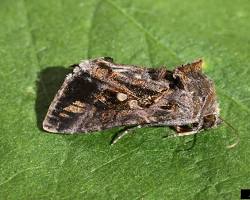
- Adult Moth (Key ID): Medium-sized brown moth with distinctive silvery markings on the forewings.
- Damage Sign (Key ID): Windowpane feeding, skeletonized leaves, and extensive defoliation.
- Conflict: Significant foliage loss and yield reduction.
Distribution and Habitat
Soybean Loopers are widely distributed throughout tropical, subtropical, and warm temperate regions of the Americas.
They are particularly abundant in:
- Southern United States
- Gulf Coast states
- Southeastern agricultural regions
- Central America
- South America
Their habitat includes soybean fields, peanut fields, cotton production areas, vegetable gardens, and weedy field margins where host plants are available.
Life Cycle
Soybean Loopers undergo complete metamorphosis consisting of four stages: egg, larva, pupa, and adult.
Egg Stage
Females lay individual eggs on the undersides of leaves. Eggs hatch within several days depending on temperature.
Larval Stage
The caterpillar passes through multiple growth stages while feeding continuously on foliage.
This stage causes all economic damage.
Pupal Stage
Fully developed larvae spin loose silken cocoons on foliage or nearby plant debris before pupating.
Adult Stage
Adult moths emerge, mate, and begin a new generation.
Several generations may occur annually in warm climates.
Feeding Behavior
Soybean Loopers feed primarily on leaves and prefer the underside of foliage where they are protected from predators and environmental conditions.
Young larvae begin by scraping leaf tissue while older larvae consume increasingly larger portions of the leaf.
- Windowpanning: Early feeding leaves transparent leaf surfaces.
- Skeletonization: Larger larvae consume tissue between veins.
- Canopy Feeding: Populations often build in lower plant canopies.
- Rapid Consumption: Mature larvae consume far more foliage than younger caterpillars.
Damage and Symptoms
The primary damage caused by Soybean Loopers is foliage removal.
Early Damage
- Windowpane feeding
- Small feeding scars
- Minor leaf thinning
Advanced Damage
- Skeletonized leaves
- Large irregular holes
- Severe canopy thinning
- Heavy defoliation
Yield Effects
Defoliation becomes especially damaging during flowering and pod-fill stages.
Heavy infestations may result in:
- Reduced photosynthesis
- Poor pod development
- Reduced seed fill
- Lower grain quality
- Yield loss
Economic Importance
Soybean Loopers are among the most costly defoliating pests in soybean production systems.
Economic losses result from:
- Reduced yields
- Additional management expenses
- Repeated insecticide applications
- Resistance management costs
- Loss of photosynthetic capacity
Large outbreaks can rapidly defoliate entire fields and significantly reduce profitability.
Resistance Challenges
One of the major concerns associated with Soybean Loopers is their ability to develop resistance to commonly used insecticides.
Resistance has been documented against several insecticide classes in some production regions.
This makes integrated management and insecticide rotation essential components of control programs.
Management and Control (IPM)
Effective management requires regular scouting and a combination of biological, cultural, and chemical strategies.
Monitoring
- Conduct regular field scouting.
- Use sweep nets and visual inspections.
- Estimate larval density and defoliation levels.
- Identify larval size distribution.
Biological Control
Numerous natural enemies help suppress looper populations.
- Parasitic wasps
- Tachinid flies
- Predatory bugs
- Spiders
- Birds
- Naturally occurring viruses and fungal pathogens
Microbial Control
- Bacillus thuringiensis (Bt): Effective against young larvae.
- NPV Viruses: Naturally infect and kill looper populations.
Cultural Control
- Maintain healthy crop growth.
- Manage weed hosts.
- Encourage beneficial insect populations.
- Avoid unnecessary broad-spectrum insecticide applications.
Chemical Control
Select insecticides carefully and rotate modes of action to reduce resistance development.
Treatments are most effective when directed at small larvae before significant defoliation occurs.
Research and Future Management
Current research focuses on improving resistance management programs, enhancing biological control agents, developing more effective monitoring systems, and breeding crop varieties that better tolerate looper feeding.
Scientists also continue to investigate new microbial and selective insecticides that minimize impacts on beneficial insects.
Conclusion
Soybean Loopers are highly destructive defoliating caterpillars capable of causing significant economic losses in soybean and other crops. Their characteristic looping movement, rapid feeding behavior, and potential insecticide resistance make them an important pest for growers to monitor closely. Through early detection, biological conservation, resistance-aware management, and integrated pest management practices, growers can successfully protect crops and reduce yield losses.