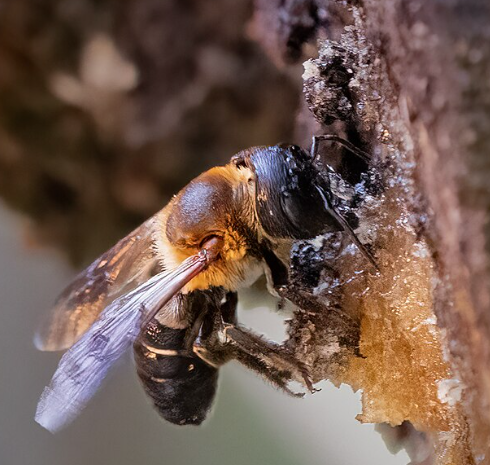
Resin Bees (Megachile spp. and related genera within the family Megachilidae) are solitary bees known for their remarkable nest-building behavior, which often involves the use of plant resins, mud, leaf fragments, or other natural materials. Unlike honey bees or bumble bees, resin bees do not live in colonies. Each female independently constructs and provisions her own nest. These bees are highly beneficial pollinators and play an important role in both natural ecosystems and agricultural production.
Resin bees are generally considered harmless to humans. They are non-aggressive, rarely sting, and typically ignore people while foraging. Although some species may occasionally enlarge existing cavities in soft wood or occupy abandoned carpenter bee tunnels, any damage they cause is minimal compared to the tremendous ecological benefits they provide through pollination.
Taxonomy and Classification
Resin bees belong to the order Hymenoptera and the family Megachilidae, a diverse group commonly referred to as leafcutter, mason, and resin bees.
- Kingdom: Animalia
- Phylum: Arthropoda
- Class: Insecta
- Order: Hymenoptera
- Family: Megachilidae
- Genera: Megachile, Heriades, Dianthidium, and others
Unlike social bees, resin bees are solitary. Each female acts as both queen and worker, constructing nests, collecting food, and laying eggs without assistance.
Physical Description
Adult resin bees typically range from 6 to 15 millimeters in length, depending on the species.
- Adult (Key ID): Robust, moderately hairy body that is often black, dark brown, or metallic in coloration.
- Pollen-Carrying Structure: Females possess a dense brush of hairs called a scopa on the underside of the abdomen, which is used to transport pollen.
- Wing Appearance: Transparent to smoky wings with strong flight muscles.
- Nesting ID: Nests are constructed in existing cavities and sealed with resin, mud, leaves, pebbles, or plant fibers.
- Sting ID: Females are capable of stinging but rarely do so unless directly handled or trapped.
- Conflict: None to Negligible Nuisance; Highly Beneficial.
Many resin bees resemble leafcutter bees but can often be distinguished by their use of sticky plant resins during nest construction.
Distribution and Habitat
Resin bees are found throughout much of the world, including North America, Europe, Asia, Africa, and Australia. They inhabit a wide range of environments wherever flowering plants and suitable nesting sites occur.
Common habitats include:
- Gardens and landscapes
- Meadows and grasslands
- Woodlands and forest edges
- Agricultural fields
- Urban parks
- Orchards
- Native plant habitats
Suitable nesting sites are essential for reproduction. Females frequently utilize:
- Abandoned beetle galleries
- Hollow plant stems
- Dead wood cavities
- Natural cracks and crevices
- Drilled nesting blocks
- Abandoned carpenter bee tunnels
Life Cycle
Resin bees undergo complete metamorphosis consisting of egg, larva, pupa, and adult stages.
Nest Construction
During spring and summer, females search for suitable nesting cavities. Once a cavity is found, they partition it into individual brood cells using resin, mud, or other materials.
Egg Stage
Each brood cell receives a mixture of pollen and nectar known as a pollen loaf. The female then deposits a single egg onto the food supply before sealing the chamber.
Larval Stage
Larvae hatch and feed on the stored provisions. Because each cell contains sufficient food, the developing larva requires no parental care.
Pupal Stage
After completing development, the larva pupates within the sealed chamber.
Adult Emergence
Adults emerge the following season, although some species may remain dormant for extended periods depending on environmental conditions.
Behavior and Ecological Importance
Resin bees are exceptionally important pollinators.
- Pollination: They transfer pollen while visiting flowers for nectar and pollen collection.
- Buzz Pollination: Some species effectively pollinate plants requiring vibration to release pollen.
- Specialized Foraging: Certain species show preferences for specific native plants.
- Solitary Lifestyle: Each female independently raises her offspring.
- Low Aggression: Resin bees rarely exhibit defensive behavior toward humans.
Many agricultural crops, ornamental flowers, and native plants benefit from their pollination services.
Potential Conflicts
Conflicts involving resin bees are generally minor and uncommon.
- Tunnel Enlargement: Some species may enlarge existing holes in soft or weathered wood.
- Occupying Existing Tunnels: Resin bees frequently nest in abandoned carpenter bee galleries.
- Minor Cosmetic Damage: Small amounts of chewing may occur on soft wood, pithy stems, or weathered building materials.
These activities rarely result in structural damage and typically do not justify control measures.
Management and Prevention
Because resin bees are highly beneficial, management generally focuses on conservation rather than elimination.
Conservation (Recommended Strategy)
- Allow nesting activity whenever possible.
- Preserve flowering plants that provide nectar and pollen.
- Maintain natural habitat areas.
- Provide artificial bee hotels or nesting blocks.
Nuisance Prevention
If nesting in specific locations becomes undesirable, simple exclusion measures are usually sufficient.
- Seal unused holes and gaps after bees have emerged.
- Repair damaged wood surfaces.
- Fill abandoned carpenter bee galleries if nesting is not desired.
- Inspect nesting blocks annually and replace worn materials.
When sealing tunnels, wait until late summer or autumn after adult emergence to avoid trapping developing bees.
Invasive Species Considerations
Certain introduced resin bee species, such as the giant resin bee (Megachile sculpturalis), have become established outside their native range. These invasive species may compete with native solitary bees for nesting sites.
Monitoring and reporting unusual bee species to local extension offices or pollinator conservation organizations can assist researchers in tracking their spread.
Conservation and Research
Researchers continue to study resin bees because of their value as pollinators and their potential use in commercial agriculture.
Current research areas include:
- Commercial crop pollination efficiency
- Nesting biology and habitat requirements
- Competition between native and invasive species
- Effects of pesticides on solitary bees
- Conservation strategies for native pollinator populations
Many resin bee species are considered important components of sustainable agricultural systems.
Conclusion
Resin Bees are gentle, solitary pollinators that provide tremendous ecological and agricultural benefits. Although they occasionally occupy holes in wood or enlarge existing cavities, they cause little or no significant damage. Their exceptional pollination abilities, non-aggressive behavior, and important role in ecosystem health make them valuable allies in gardens, farms, and natural landscapes.