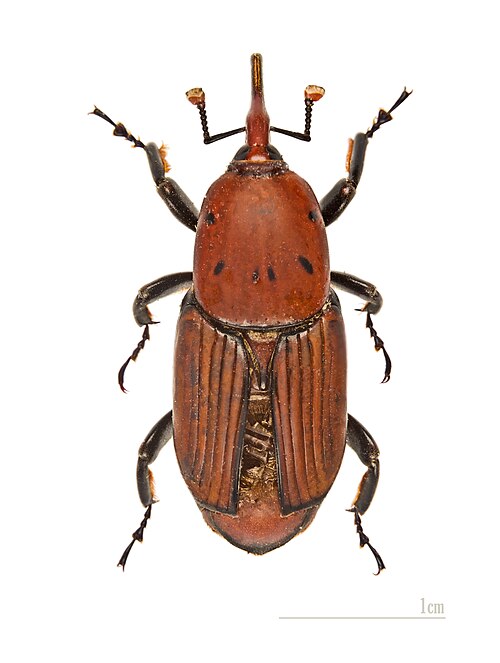
Red Palm Weevils (Rhynchophorus ferrugineus) are among the most destructive insect pests of palm trees worldwide. These large snout beetles are considered serious quarantine pests because of their ability to rapidly spread and kill economically and ornamentally valuable palms. Originally native to Southeast Asia, red palm weevils have expanded their range across the Middle East, Africa, Europe, and other regions through the movement of infested palm material.
The greatest threat posed by red palm weevils comes from their larvae, which tunnel extensively through the soft tissues inside palm trunks and crowns. Because feeding occurs entirely within the tree, infestations often remain undetected until severe damage has occurred. In many cases, heavily infested palms collapse and die, requiring complete removal and destruction.
Taxonomy and Classification
Red palm weevils belong to the family Curculionidae, commonly known as snout beetles or true weevils.
- Kingdom: Animalia
- Phylum: Arthropoda
- Class: Insecta
- Order: Coleoptera
- Family: Curculionidae
- Genus: Rhynchophorus
- Species: Rhynchophorus ferrugineus
Like other beetles, red palm weevils undergo complete metamorphosis consisting of egg, larval, pupal, and adult stages.
Physical Description
Adult red palm weevils are large insects, typically measuring between 20 and 50 millimeters in length.
- Adult (Key ID): Large reddish-brown to orange-brown beetle with a long, curved snout (rostrum).
- Thorax: Usually marked with dark spots or stripes, although coloration varies considerably.
- Larva (Key ID): Cream-colored, legless grub with a hardened brown head capsule; the most destructive stage.
- Pupa: Develops inside a distinctive oval cocoon constructed from palm fibers.
- Damage ID: Oozing sap, chewed fibers, crown drooping, holes in trunks, and eventual crown collapse.
- Conflict: Agricultural, Ornamental, Quarantine.
Adult males can often be distinguished from females by the presence of dense hairs on the upper surface of the snout.
Distribution and Habitat
Native to Southeast Asia, the red palm weevil has become one of the world’s most invasive palm pests.
Established populations now occur throughout:
- The Middle East
- North Africa
- Southern Europe
- Mediterranean countries
- Parts of Central and South Asia
- Numerous tropical and subtropical regions
The insect primarily inhabits areas where palms are grown, including:
- Date palm plantations
- Coconut plantations
- Urban landscapes
- Parks and gardens
- Nurseries
- Resorts and ornamental landscapes
Host Plants
Red palm weevils attack numerous palm species, but some hosts are especially susceptible.
Common hosts include:
- Date palms (Phoenix dactylifera)
- Canary Island date palms (Phoenix canariensis)
- Coconut palms (Cocos nucifera)
- Oil palms (Elaeis guineensis)
- Sago palms
- Washington palms
- Fan palms
- Various ornamental palm species
Young palms and recently pruned trees are often particularly vulnerable.
Life Cycle
The life cycle of the red palm weevil varies according to temperature and host quality but may be completed within several months.
Egg Stage
Female weevils lay eggs individually within wounds, cracks, or soft tissues of palms. A single female may deposit several hundred eggs during her lifetime.
Larval Stage
After hatching, larvae immediately begin tunneling into the palm tissue.
Larvae are highly destructive and create extensive galleries throughout the crown, trunk, and growing point. Feeding continues for several weeks or months, depending on environmental conditions.
Pupal Stage
Mature larvae construct oval cocoons from palm fibers within the trunk or crown. Pupation occurs inside these protective structures.
Adult Stage
Adults emerge from the cocoon and leave the palm through exit holes. Newly emerged adults disperse in search of suitable host trees for reproduction.
Multiple overlapping generations may occur annually in warm climates.
Damage and Symptoms
Because larvae feed internally, early symptoms are often subtle and difficult to detect.
Common signs of infestation include:
- Fermented Sap: Brown or reddish sap oozing from feeding sites.
- Frass Accumulation: Presence of coarse fibers and chewed plant material around openings.
- Feeding Sounds: Audible chewing noises may sometimes be heard within heavily infested palms.
- Crown Decline: Wilting, drooping, or yellowing fronds.
- Crown Collapse: Severe infestations can cause complete collapse of the growing point.
- Trunk Holes: Circular emergence holes left by adults.
- Plant Death: Untreated infestations frequently kill the entire palm.
Unfortunately, visible symptoms often indicate advanced infestation.
Behavior and Conflict
The destructive nature of red palm weevils is largely due to their concealed feeding behavior.
- Endophagous Feeding: Larvae remain hidden within palm tissues throughout development.
- Difficult Detection: Infestations often remain unnoticed until severe damage occurs.
- Attraction to Wounds: Adults are strongly attracted to pruning wounds and damaged tissue.
- Rapid Spread: Adults are capable of flying considerable distances to locate new hosts.
- High Reproductive Potential: Large numbers of eggs allow populations to expand rapidly.
These characteristics make red palm weevils one of the most challenging palm pests to manage.
Economic Importance
Red palm weevils cause substantial economic losses worldwide.
- Destruction of date palm plantations
- Loss of ornamental landscape palms
- Reduced fruit production
- Expensive tree removal and replacement costs
- Trade restrictions and quarantine measures
- Increased management expenses
In heavily infested regions, millions of dollars may be spent annually on monitoring and control programs.
Management and Prevention
Successful management relies on early detection, preventive treatments, and rapid removal of infested palms.
Monitoring (Key Strategy)
- Use aggregation pheromone traps to detect adult populations.
- Inspect palms regularly for symptoms.
- Monitor recently pruned or injured palms closely.
- Use acoustic devices to detect larval feeding sounds.
Preventive Practices
- Avoid unnecessary pruning.
- Prune during cooler periods when adults are less active.
- Treat pruning wounds when recommended.
- Maintain overall palm health through proper irrigation and nutrition.
Chemical Control
Preventive treatments are commonly used to protect valuable palms.
- Systemic insecticide trunk injections.
- Crown drenches and sprays.
- Preventive treatments during high-risk periods.
Treatment programs should always follow local regulations and label instructions.
Biological Control
Researchers continue evaluating biological control agents, including:
- Entomopathogenic fungi
- Beneficial nematodes
- Parasitoids
- Predatory insects
Eradication
Severely infested palms typically require complete removal and destruction.
- Remove infested trees promptly.
- Destroy infested material according to local quarantine regulations.
- Avoid transporting potentially infested palm material.
Quarantine Importance
The red palm weevil is considered one of the world’s most important quarantine pests.
Many countries regulate the movement of palms and palm products to prevent accidental introduction and spread.
Strict inspection and certification programs are essential for protecting uninfested regions.
Research and Future Management
Research priorities include:
- Remote sensing technologies
- Thermal imaging detection systems
- Improved pheromone trapping
- Genetic resistance in palms
- Biological control development
- Early detection technologies
Scientists continue developing innovative methods to identify infestations before visible symptoms appear.
Conclusion
Red Palm Weevils are among the most destructive pests affecting palms worldwide. Their concealed larval feeding, rapid reproduction, and ability to kill valuable trees make them a major threat to agriculture and ornamental landscapes. Early detection, preventive management, and strict quarantine measures remain essential for limiting the spread and impact of this devastating pest.