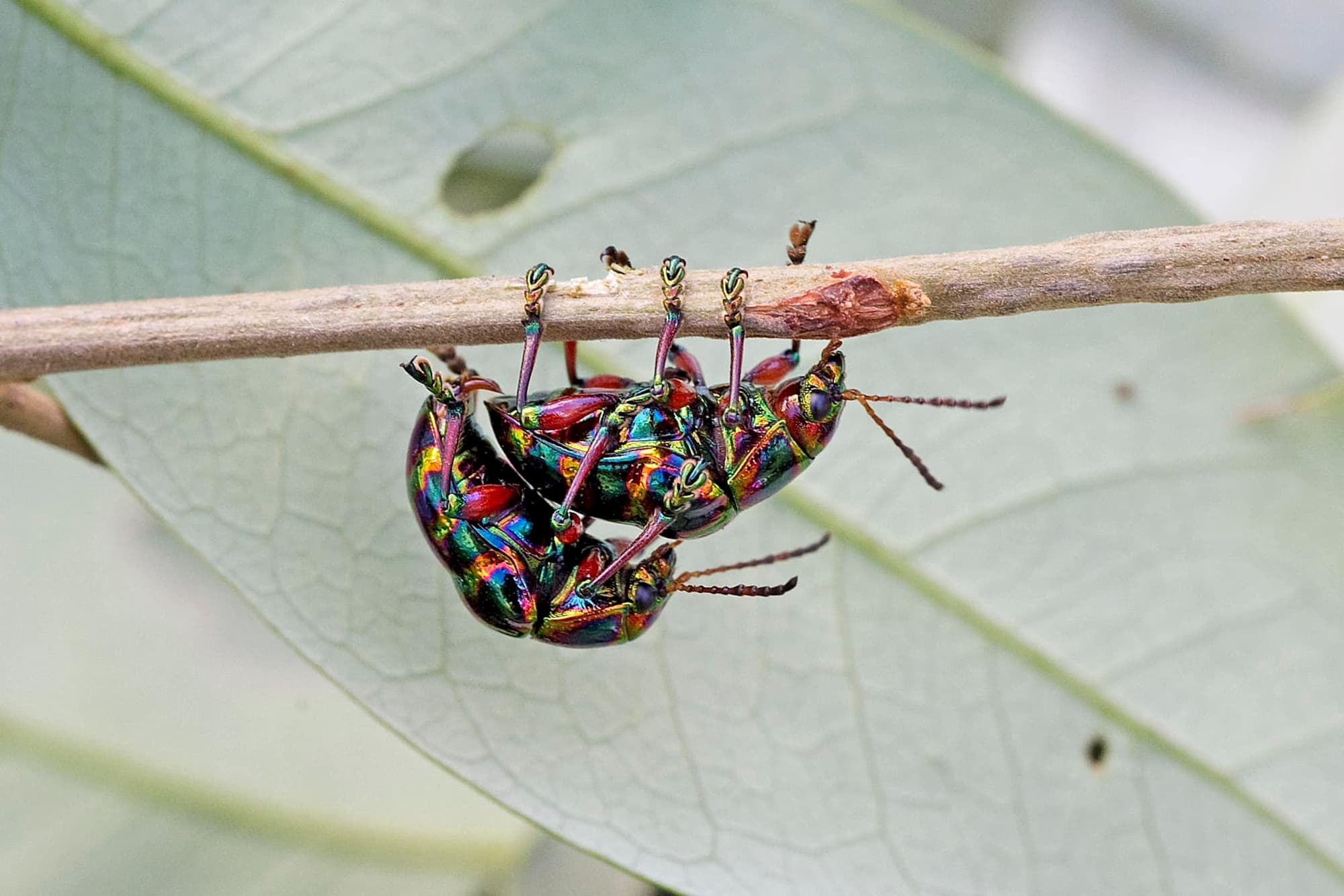
Queensland leaf beetles are plant-feeding beetles found in Queensland and other parts of northern and eastern Australia. The name does not refer to one formally recognized species. Instead, it can describe several members of the leaf beetle family Chrysomelidae that damage crops, pasture plants, ornamental trees, and eucalyptus plantations in Queensland.
Important examples include the redshouldered leaf beetle (Monolepta australis), swarming leaf beetles (Rhyparida species), the black leaf beetle (Rhyparida nitida), and several eucalyptus-feeding paropsine beetles. These species differ in appearance and life cycle, but adults generally damage plants by chewing leaves, flowers, buds, or tender new growth.
Taxonomy and Classification
- Common name: Queensland leaf beetles
- Order: Coleoptera
- Family: Chrysomelidae
- Important genera: Monolepta, Rhyparida, Paropsis, and Paropsisterna
- Type: Plant-feeding beetles
- Primary region: Queensland and neighboring areas of Australia
Chrysomelidae is one of the largest beetle families in the world. Most members feed on living plant tissue as adults, larvae, or both. Some species have narrow host ranges, while others consume plants belonging to several unrelated families.
Important Queensland Species
Redshouldered Leaf Beetle
The redshouldered leaf beetle (Monolepta australis) is one of the most noticeable crop-feeding species in Queensland. Adults are generally about 6 to 7 millimeters long. They have yellow-orange bodies, reddish shoulder markings, and a red or dark spot on each wing cover.
Adults may gather in large numbers and attack soybeans, mungbeans, navy beans, peanuts, cotton, corn, sorghum, avocados, mangoes, lychees, macadamias, strawberries, eucalyptus, and ornamental plants. Swarms can strip tender foliage and damage flowers within a short period.
Swarming Leaf Beetles
Swarming leaf beetles in the genus Rhyparida are usually small, shiny, brown or black beetles measuring approximately 3 to 5 millimeters long. Adults often emerge from the soil in large numbers after substantial rain, particularly following a dry period.
The larvae feed underground on grass roots. Adults may move into nearby crops, orchards, or eucalyptus trees. Some species are active primarily at night and hide beneath leaves or in protected locations during the day.
Eucalyptus Leaf Beetles
Queensland is also home to numerous paropsine leaf beetles associated with eucalyptus and closely related trees. Species in genera such as Paropsis and Paropsisterna may be rounded, oval beetles with brown, tan, yellow, green, red, or mottled markings. Their colors frequently blend with eucalyptus bark, buds, and leaves.
Both adults and larvae may consume eucalyptus foliage. Repeated defoliation can slow tree growth, deform young trees, and reduce the productivity of commercial hardwood plantations. Damage is most consequential when large beetle populations repeatedly attack young trees or fresh leaf growth.
Identification
Queensland leaf beetles vary considerably in size, color, and body shape. Most adults have hardened wing covers, chewing mouthparts, and relatively short antennae. Their bodies may be elongated, oval, or strongly rounded.
Redshouldered leaf beetles are distinctive because of their yellow-orange coloring and reddish markings. Rhyparida beetles are smaller, darker, and often uniformly brown or black. Paropsine eucalyptus beetles are generally broader and more rounded, sometimes resembling small tortoises or lady beetles.
Larval appearance depends on the group. Monolepta and Rhyparida larvae live in soil and resemble small, pale grubs. Eucalyptus leaf beetle larvae live aboveground and may have soft, segmented bodies with dark heads, visible legs, defensive glands, or distinctive markings.
Distribution and Habitat
Crop-feeding leaf beetles occur across northern Australia and into northern New South Wales. They are particularly common in coastal agricultural districts and regions where grasses, sugarcane, eucalyptus, pulse crops, or orchard trees provide suitable food.
Habitats include farms, pastures, sugarcane fields, orchards, native forests, eucalyptus plantations, gardens, and roadside vegetation. Some beetles move between native eucalyptus trees and nearby cultivated crops. Field-edge damage may therefore be greater where susceptible crops border wooded windbreaks.
Life Cycle
Queensland leaf beetles undergo complete metamorphosis consisting of egg, larval, pupal, and adult stages. The details differ among species.
Redshouldered and swarming leaf beetles generally deposit their eggs close to the soil surface. After hatching, the larvae move underground and feed on grass roots or other plant material. Mature larvae pupate in soil before emerging as adults. Development may take approximately two months under favorable conditions, and multiple generations can occur in warm areas.
Heavy rainfall can trigger the emergence of large numbers of adult swarming beetles. The adults then fly into neighboring crops and begin feeding. This sudden movement explains why apparently healthy fields or orchards can suffer rapid damage.
Many eucalyptus leaf beetles follow a different pattern. Females place eggs directly on eucalyptus leaves or tender shoots. The larvae hatch and feed openly on the foliage before pupating. Adults continue feeding after emergence, so both major mobile stages can contribute to defoliation.
Plant Damage
Adult Queensland leaf beetles chew plant tissue rather than sucking sap. Small populations may produce scattered holes or notches with little effect on plant health. Large aggregations can skeletonize leaves, leaving veins and fragments of tougher tissue behind.
Redshouldered leaf beetles may damage new leaves, flowers, buds, and reproductive structures. Swarms can arrive quickly and cause serious injury within hours. Flower feeding can reduce fruit or seed development even when the plants retain much of their foliage.
Underground larvae may damage grass roots, sugarcane stools, corn roots, and the bases of young plants. In sugarcane, certain Rhyparida larvae bore into the plant base, weakening or killing the stool. Severe root injury may cause young plants to become stunted, wilt, lodge, or die.
On eucalyptus, larvae and adults remove sections of leaves or consume most of the leaf blade. A single period of light defoliation may be tolerated, but repeated attacks can reduce photosynthesis and slow tree growth. Young plantation trees are particularly vulnerable because they have limited reserves and smaller canopies.
Signs of Queensland Leaf Beetles
- Small yellow-orange, brown, black, or patterned beetles on plants
- Large groups of beetles appearing after heavy rainfall
- Irregular holes and notches in leaves
- Leaves eaten down to larger veins
- Damaged flowers, buds, or tender shoots
- Patchy defoliation concentrated along field edges
- Pale beetle larvae feeding on roots in the soil
- Weak, stunted, or dying young plants
- Larvae and rounded beetles feeding on eucalyptus foliage
Monitoring
Inspect susceptible plants regularly during late spring and summer. Monitoring is especially important after the first substantial rain following an extended dry period. Examine new foliage, flowers, and field edges closest to eucalyptus windbreaks or grassy areas.
Redshouldered leaf beetles are highly visible but can fly away quickly when disturbed. Dark Rhyparida beetles may be more difficult to detect because some species feed at night. Night inspections or examination of sheltered areas beneath leaves may reveal activity missed during the day.
Yellow sticky traps placed near boundary vegetation can provide an early indication of adult beetle movement. Traps should supplement direct plant inspection rather than replace it, since crop damage and beetle distribution may be highly localized.
Management and Control
Cultural Management
Avoid planting highly susceptible cereal crops immediately after grass pasture where damaging soil larvae are present. Where practical, separate vulnerable crops from known larval host areas. Crop rotation and management of grassy weeds may reduce the resources available to underground stages.
Inspect windbreaks and eucalyptus trees near crops because beetles may gather there before entering a field or orchard. Healthy, well-watered plants are generally better able to tolerate limited leaf loss than plants already stressed by drought, nutrient deficiency, or root injury.
Targeted Treatment
Leaf beetle infestations are often patchy. When intervention is justified, treating affected field edges, individual trees, or concentrated swarms may be more appropriate than spraying an entire property. Targeted treatment reduces pesticide use and helps preserve beneficial organisms elsewhere in the crop.
Any pesticide used in Australia must be registered for the target crop and pest or covered by a valid permit. Consult the Australian Pesticides and Veterinary Medicines Authority database and follow all label directions, withholding periods, and safety requirements.
Special care is necessary when beetles attack flowers. Many crops depend on bees and other insects for pollination, and poorly timed pesticide applications can harm them. Avoid treating flowers while bees are actively visiting and follow every pollinator precaution on the product label.
Importance Outside Australia
“Queensland leaf beetle” is not a standard name for a common North American species. Similar-looking leaf beetles occur in the United States, but appearance alone is not enough to identify them as Australian species. A suspect beetle associated with imported plants, produce, timber, or packing material should be preserved and reported to the appropriate state agriculture department or plant diagnostic service.
Conclusion
Queensland leaf beetles are a varied group of chrysomelid beetles rather than one individual species. Redshouldered, swarming, black, and eucalyptus leaf beetles can damage crops or trees through leaf, flower, root, and stem feeding. Regular monitoring after heavy rain, inspection of field edges, crop planning, and targeted treatment help reduce losses. Accurate species identification remains essential because the beetles differ substantially in their host plants, immature stages, and management requirements.