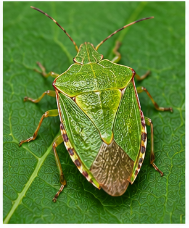
Predatory Stink Bugs in the genus Podisus are among the most important beneficial insects used in biological pest control throughout North America. Unlike the plant-feeding stink bugs that damage crops, Podisus species are aggressive predators that hunt caterpillars, beetle larvae, sawflies, and numerous other destructive insects. Their ability to naturally suppress agricultural pests has made several species valuable components of Integrated Pest Management (IPM) programs and commercial biological control operations.
Perhaps the best-known member of the genus is the Spined Soldier Bug (Podisus maculiventris), a native predator that has become one of the most widely studied beneficial insects in North American agriculture. These stink bugs provide environmentally friendly pest control by reducing populations of many economically important crop pests without damaging healthy plants.
Taxonomy and Classification
Podisus species belong to the family Pentatomidae, which contains both beneficial predatory species and plant-feeding stink bugs. Members of this genus are distinguished by their predatory lifestyle and specialized mouthparts adapted for feeding on other insects.
- Order: Hemiptera
- Family: Pentatomidae
- Genus: Podisus
- Common Species: Podisus maculiventris (Spined Soldier Bug), Podisus serieventris, Podisus placidus
Although they resemble pest stink bugs, Podisus species perform an entirely different ecological role by consuming insect pests rather than feeding on crops.
Physical Description
Predatory stink bugs possess several adaptations that distinguish them from plant-feeding relatives.
- Length: 10–15 mm
- Color: Gray, brown, tan, or mottled brown depending on species
- Body: Broad, shield-shaped body typical of stink bugs
- Mouthparts: Thick piercing-sucking beak designed for capturing prey
- Legs: Strong walking legs used while stalking insects
- Pronotal Spines: Many species possess pointed shoulder spines that aid identification.
Nymphs resemble miniature wingless adults and become progressively darker and more robust through five developmental stages.
Distribution and Habitat
Podisus species occur throughout much of North America and occupy a wide variety of habitats where insect prey is abundant.
- Agricultural fields
- Vegetable gardens
- Fruit orchards
- Woodlands
- Forest edges
- Prairies
- Urban landscapes
- Commercial crop production areas
They are especially common in fields containing caterpillars and beetle larvae, where they actively search vegetation for prey.
Behavior and Ecology
Unlike herbivorous stink bugs, Podisus species are active predators throughout both the nymph and adult stages.
After locating prey, they grasp it with their front legs and insert their sharp beak into the victim. Digestive enzymes liquefy the internal tissues, allowing the stink bug to consume the contents.
Common prey includes:
- Armyworms
- Cutworms
- Fall Armyworms
- Cabbage Loopers
- Colorado Potato Beetle larvae
- Tent Caterpillars
- Sawfly larvae
- Beetle larvae
- Various moth caterpillars
Their wide prey range makes them valuable predators in both agricultural and natural ecosystems.
Life Cycle
Podisus stink bugs undergo incomplete metamorphosis consisting of egg, nymph, and adult stages.
- Egg: Females deposit clusters of barrel-shaped eggs on leaves.
- Nymph: Newly hatched nymphs begin feeding on insect prey after their first molt.
- Adult: Mature adults continue hunting and reproducing throughout the growing season.
Several generations may occur annually in warmer climates, while northern populations typically complete one generation each year.
Agricultural Importance
Podisus species are among the most valuable naturally occurring predators used in Integrated Pest Management.
They help suppress populations of numerous crop pests affecting:
- Corn
- Soybeans
- Potatoes
- Tomatoes
- Cabbage and broccoli
- Fruit orchards
- Forest trees
- Ornamental landscapes
Their ability to reduce damaging insect populations often decreases the need for chemical insecticide applications.
Management and Conservation
Predatory stink bugs should be protected whenever possible.
- Reduce Broad-Spectrum Insecticides: Preserve beneficial predator populations.
- Plant Diverse Vegetation: Encourage habitats that support beneficial insects.
- Use Integrated Pest Management: Monitor pest populations before treating.
- Correct Identification: Distinguish beneficial Podisus species from plant-feeding stink bugs.
- Maintain Flowering Plants: Adults occasionally feed on nectar and plant moisture when prey is scarce.
Several commercial insectaries even rear and sell Podisus maculiventris for release in greenhouses, nurseries, and agricultural operations.
Conservation and Research
Podisus species continue to receive significant scientific attention because of their outstanding potential as biological control agents. Researchers study their feeding behavior, reproduction, prey preferences, and effectiveness against economically important crop pests. Their role in sustainable agriculture has made them one of the best-known predatory stink bug genera in North America.
Conclusion
Predatory Stink Bugs in the genus Podisus are highly beneficial insects that naturally suppress caterpillars, beetle larvae, and numerous other agricultural pests. Rather than damaging crops, these predators help protect gardens, forests, and commercial farms through natural biological control. Encouraging their presence is an important component of environmentally responsible pest management and healthy agricultural ecosystems.