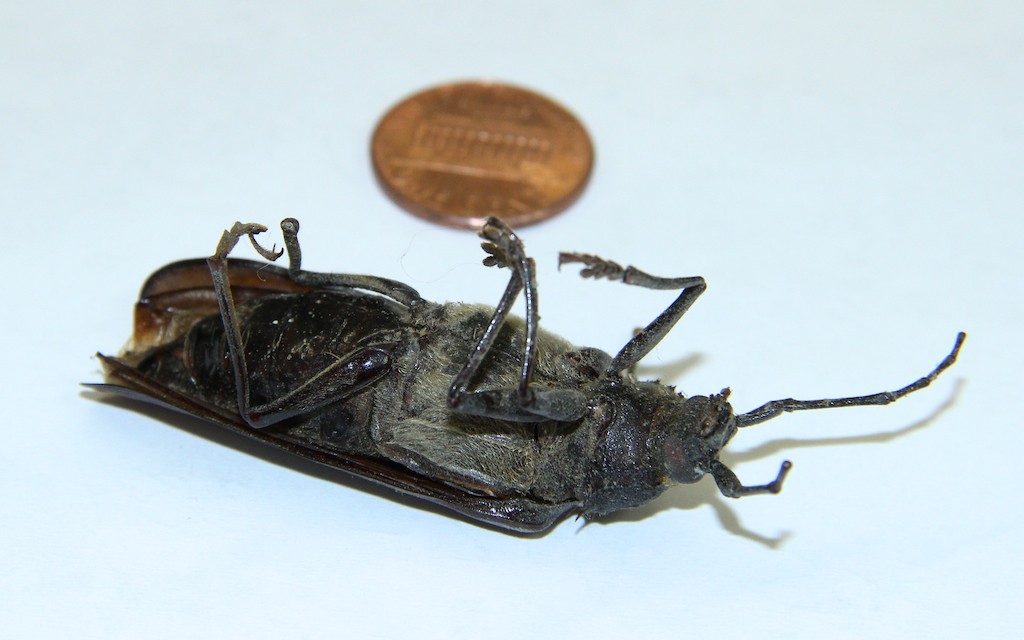
The Ponderous Borer Beetle (Ergates spiculatus) is one of the largest and most impressive longhorn beetles found in western North America. This massive wood-boring insect is closely associated with mature conifer forests, where its larvae develop deep within dead or decaying trees. Despite its intimidating appearance and large size, the Ponderous Borer Beetle is not considered a serious pest of healthy trees or structures. Instead, it serves an essential ecological role by helping decompose dead wood and recycle nutrients within forest ecosystems. Because of its remarkable size and striking appearance, the species is frequently encountered by hikers, campers, foresters, and homeowners living near coniferous forests.
Taxonomy and Classification
The Ponderous Borer Beetle belongs to the family Cerambycidae, commonly known as the longhorn beetles. Members of this family are characterized by their elongated bodies and exceptionally long antennae. The genus Ergates contains only a few species worldwide, with Ergates spiculatus representing North America’s largest member.
- Order: Coleoptera
- Family: Cerambycidae
- Subfamily: Prioninae
- Genus: Ergates
- Species: Ergates spiculatus
This species belongs to the subfamily Prioninae, a group that includes many of the world’s largest beetles. Its closest relatives are similarly large wood-boring insects found in forests across Europe and Asia.
Physical Description
The Ponderous Borer Beetle is renowned for its enormous size. Adults typically measure between 30 and 60 millimeters (1.2 to 2.4 inches) in length, although exceptionally large individuals may exceed these dimensions.
- Length: 30–60 mm
- Color: Dark brown, reddish-brown, or black
- Body Shape: Robust and elongated
- Antennae: Long, segmented, and often longer than the body in males
- Mandibles: Strong jaws capable of chewing wood and bark
Males and females differ in appearance. Males generally possess much longer antennae and slightly more slender bodies, while females tend to be larger and heavier. Both sexes have hardened forewings, known as elytra, that protect the delicate hindwings used for flight.
The larvae are large, creamy-white grubs with powerful jaws adapted for feeding within decaying wood. Mature larvae may reach lengths of over 75 millimeters before pupation.
Distribution and Habitat
Ponderous Borer Beetles are native to western North America and are widely distributed throughout mountainous and forested regions.
- British Columbia
- Washington
- Oregon
- California
- Idaho
- Montana
- Wyoming
- Colorado
- Northern Arizona
- New Mexico
The species is strongly associated with conifer forests, especially areas containing abundant dead or dying timber. Preferred habitats include:
- Pine forests
- Fir forests
- Spruce forests
- Mixed conifer woodlands
- Recently burned forests
- Areas with fallen logs and stumps
Larvae develop primarily within dead, decaying, or severely weakened conifer wood. Healthy trees are rarely attacked.
Life Cycle
The life cycle of the Ponderous Borer Beetle is unusually long. Females deposit eggs in cracks and crevices within dead or dying conifer wood. After hatching, larvae bore deeply into the wood where they feed and grow for several years.
Depending on environmental conditions and food quality, larval development may require three to six years to complete. During this period, the grubs excavate extensive tunnels through decaying wood while consuming cellulose-rich material.
When fully mature, larvae create a pupal chamber near the wood surface. After pupation, adults emerge during late spring and summer by chewing characteristic round exit holes through bark and wood.
Adult beetles typically live only a few weeks. Their primary purpose is reproduction, and they often do not feed extensively during this stage.
Behavior and Ecology
Adult Ponderous Borer Beetles are primarily nocturnal. They become active during warm summer evenings and are frequently attracted to lights around cabins, campsites, and homes located near forests.
Although these beetles appear intimidating, they are generally harmless to humans. Adults may produce a loud buzzing sound during flight and can deliver a painful pinch if handled carelessly, but they are not aggressive.
The larvae play an essential ecological role by accelerating wood decomposition. Their tunneling activity breaks down dead timber, allowing fungi, microorganisms, and other decomposers to further recycle nutrients back into forest soils.
The species also serves as prey for numerous forest animals, including:
- Woodpeckers
- Black bears
- Small mammals
- Predatory beetles
- Parasitic wasps
- Forest birds
Economic Importance and Damage
Unlike many wood-boring beetles, the Ponderous Borer Beetle rarely causes significant economic damage because it primarily infests already dead or severely decayed wood.
Occasionally, larvae may continue developing in untreated lumber, logs, or firewood brought indoors. Adults emerging from stored firewood can alarm homeowners, but they do not reinfest structural lumber or attack healthy wood within buildings.
Potential concerns include:
- Nuisance emergence from stored firewood
- Minor damage to untreated logs or lumber
- Cosmetic exit holes in wood products
Structural infestations are extremely uncommon because larvae require moist, decaying wood conditions that are rarely present in properly maintained buildings.
Management and Prevention
Management is seldom necessary because Ponderous Borer Beetles are beneficial decomposers rather than destructive pests. However, certain preventive measures can minimize nuisance encounters.
| Management Strategy | Description | Benefit |
|---|---|---|
| Inspect Firewood | Examine logs before bringing them indoors. | Prevents unexpected adult emergence inside homes. |
| Store Firewood Outdoors | Keep wood away from living spaces. | Reduces indoor nuisance problems. |
| Remove Severely Decayed Wood | Dispose of heavily infested logs near structures. | Minimizes beetle activity around buildings. |
| Maintain Dry Structural Wood | Prevent moisture accumulation in buildings. | Discourages wood-boring insect activity. |
Chemical treatment is rarely recommended or necessary because infestations typically occur only in dead wood already undergoing decomposition.
Conservation and Research
Ponderous Borer Beetles are important contributors to forest health and biodiversity. By breaking down dead timber, they facilitate nutrient recycling and create habitats for other organisms.
Modern forestry practices that remove all dead wood from forests may reduce habitat availability for this species and other saproxylic insects. Researchers continue studying these beetles to better understand decomposition processes and forest ecosystem dynamics.
Conclusion
The Ponderous Borer Beetle (Ergates spiculatus) is one of North America’s largest and most impressive longhorn beetles. Although its enormous size may startle observers, this species is primarily a beneficial decomposer associated with dead conifer wood. Its long life cycle, ecological importance, and striking appearance make it a fascinating component of western forest ecosystems.